Greek Paintings: Frescoes, Panels and Fragments Explained
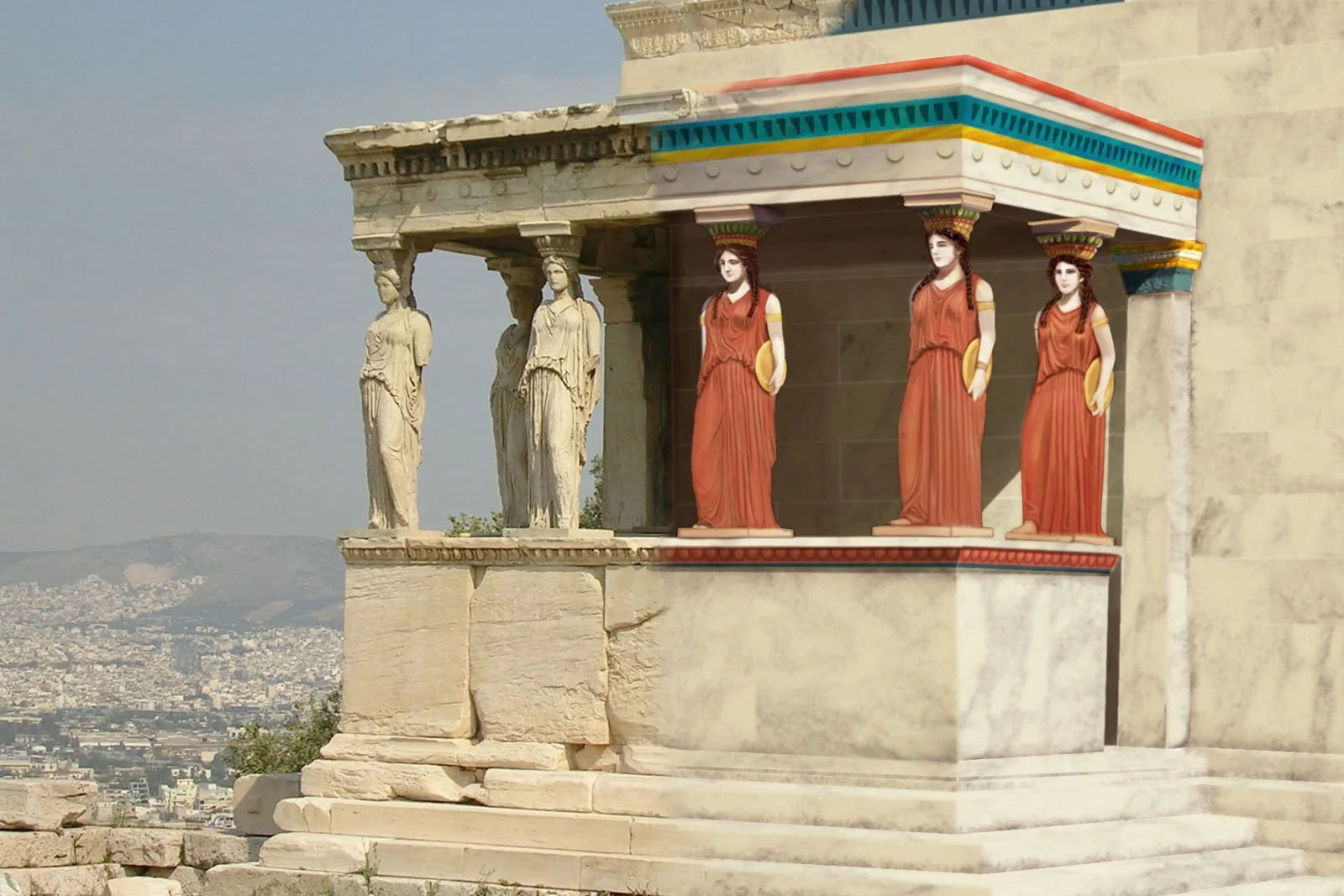
Color reconstruction of the Erechtheion porch hints how vivid Greek temples once looked, maidens blazing with paint instead of cool bare marble.
When you walk through a Greek gallery, it can feel as if the ancient world was carved, not painted. Marble everywhere, terracotta everywhere, almost no colour in sight. Yet ancient writers could not stop talking about Greek paintings. They praised illusionistic pictures, shimmering draperies, and artists who could trick the eye. The punchline: nearly all of those works are gone.
In this guide, we zoom out and treat painting as part of a bigger environment. We move between wall frescoes, panel paintings and the painted surfaces of Greek pottery and Greek vases, so you can start to imagine Greek buildings and sanctuaries as colourful spaces, not white shells. If you want a focused list of surviving pieces, you can pair this with our hunt for ancient Greek paintings.
Myth vs Fact
Myth: Greeks only cared about sculpture.
Fact: Ancient authors ranked painting among the highest arts, but most works were lost because they were on fragile materials.

Greek paintings once filled buildings, but only traces remain
A good starting point is to accept a slightly uncomfortable fact: we know Greek painting was everywhere, but we see almost none of it today.
Ancient texts describe large panel paintings on wood, wall cycles in stoas (public colonnades) and richly coloured decorations on temples and houses. Authors mention famous artists by name, rivalries between painters, even technical innovations like shading, multiple ground lines and early perspective. Smarthistory and the Oxford Classical Dictionary both stress that, if we had even a fraction of this output, our mental image of ancient Greek art would be far more colourful and pictorial.
The problem is the supports they chose. The most prestigious paintings were usually on wood or thin plaster, both vulnerable to fire, moisture and rebuilding. Temple renovations, earthquakes and later reuse of materials erased wall programs; wooden panels simply decayed. Harvard and museum guides often remind readers that what we see in galleries is biased toward stone and fired clay, because those materials survive better in the ground.
What remains are exceptions: pictures sealed in tombs, protected on stone stelae, or preserved as tiny panel fragments. This is why we dedicated a full article to the handful of ancient Greek paintings we can still actually point at. It is also why painted ceramics like Greek black-figure pottery carry so much weight; they give us a more continuous record of how Greek artists handled bodies, drapery and narrative when other surfaces disappeared.
So, when we talk about “Greek paintings” here, we are always juggling three things: a huge lost tradition, a small group of surviving works and a lot of indirect evidence from pottery and texts.
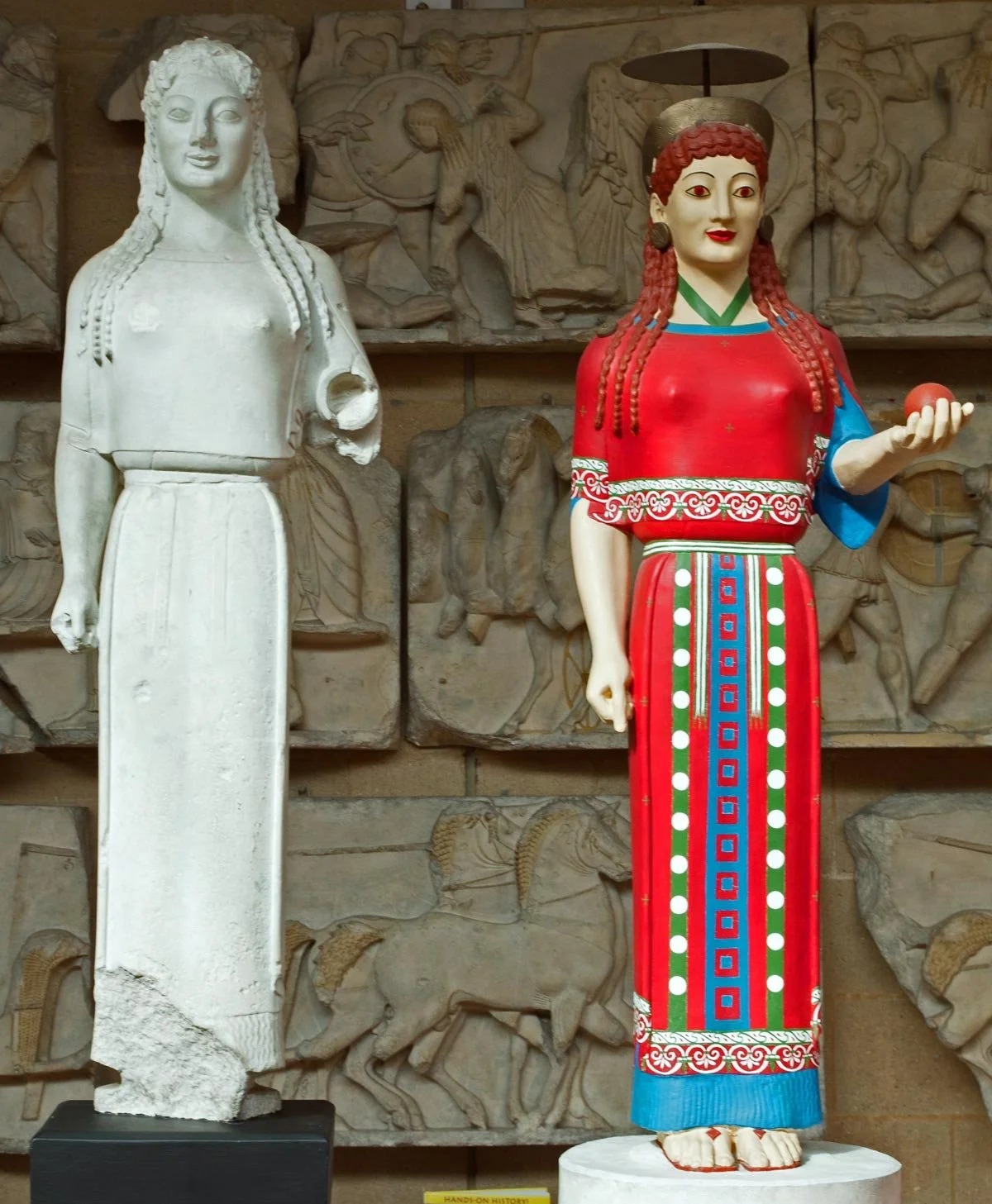
Peplos Kore shown twice: pale plaster cast and bold colour reconstruction, reminding us Greek marble sculpture was once vividly painted.
Frescoes: how Greeks painted on walls, tombs and sanctuaries
If we follow the material, Greek wall paintings are best preserved not in grand temples but in tombs and smaller enclosed spaces. That sounds niche, yet these tomb frescoes are some of our clearest windows into Greek colour and composition.
The star example is the Tomb of the Diver at Paestum, a small stone burial chamber from around 500–470 BCE. Its interior shows reclining men at a symposium on the walls and, on the ceiling slab, the famous diver leaping into a band of water. Technical studies confirm that the images were painted in fresco on white plaster, using a range of pigments such as Egyptian blue, red and yellow ochres, green earth and carbon black. The tomb is often described as the only fully preserved Greek tomb with figurative wall painting from the Archaic or early Classical period, which makes it precious evidence for large scale painting at that time.
Later, in the Hellenistic period, we gain more examples. Macedonian chamber tombs preserve hunts, chariots and large figures painted in more nuanced shading. In Alexandria, painted limestone funerary stelae show the deceased in framed panels, interacting with family members or servants. A Met essay and recent conservation articles on these monuments underline how they project social identity into the afterlife and reveal a sophisticated handling of colour, pattern and architectural framing.
These works also connect directly to ancient Greek religion. Tombs and sanctuaries were not just stone structures; they were stages for processions, feasts and offerings. Painted banquets, processions or heroes in these spaces visualised ideas about death, memory and divine presence. When we set these images next to Aegean palace frescoes like Minoan bull-leaping, we can trace a very long habit of using walls as narrative and symbolic surfaces.
If you keep that in mind, it becomes easier to imagine Greek sanctuaries as mixed environments: carved reliefs, painted walls, inscribed stone and clusters of votive objects all coexisting, rather than sculpture standing alone.
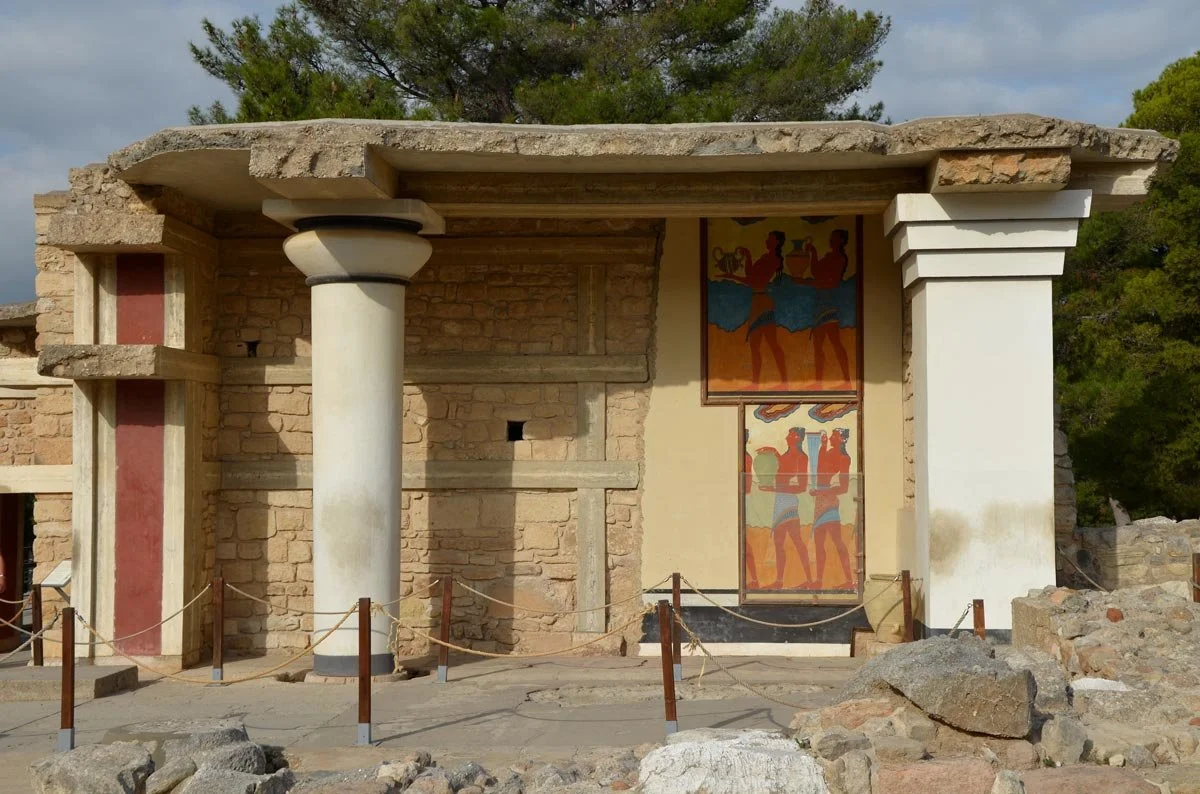
Partly reconstructed wing of the Palace of Knossos, showing Evans’ concrete columns and colourful Procession Fresco fragments in situ.
Panel painting: the prestigious art we mostly know from stories
The other major branch of Greek paintings is panel painting, which sadly is even more fragmentary. Yet the few pieces we do have, plus detailed technical studies, still tell us a lot.
The most famous survivors are the Pitsa panels, small wooden tablets from near ancient Sicyon. They date to the later sixth century BCE and are coated with a thin white gesso layer, then painted with bright mineral pigments in blue, red, yellow, green, black and white. Scientific analysis has identified rare pigments like pararealgar and confirmed that the scenes were built with drawn outlines and flat colour fields rather than heavy shading. Scholars describe them as the oldest known examples of Greek panel painting.
Literary sources, especially later authors like Pliny, give us the names of famous painters (Polygnotos, Zeuxis, Apelles and others), praise their technical feats and recount anecdotes about illusionistic tricks. They talk about large battle scenes, myth cycles and portraits on wooden boards, many of them displayed in public buildings like the Painted Stoa in Athens. None of those original panels survive, but the stories confirm that panel painting was a prestige medium, at least as admired as sculpture.
If we place the Pitsa tablets and tomb frescoes alongside painted pottery and these texts, a pattern emerges. Greek panel and wall painters seem to share some core habits with the craftsmen who decorated Greek vases and Greek pottery: clear outlines, carefully chosen flat colours, patterned borders and narrative scenes organised in bands or framed fields. At the same time, panel painting probably developed more ambitious experiments with scale and illusion, some of which we may glimpse through later Roman copies.
So even though the “great” Greek panel paintings are gone, the combination of Pitsa-like fragments and ancient praise helps us see them as a living part of the same visual world, not a separate, mysterious genre.
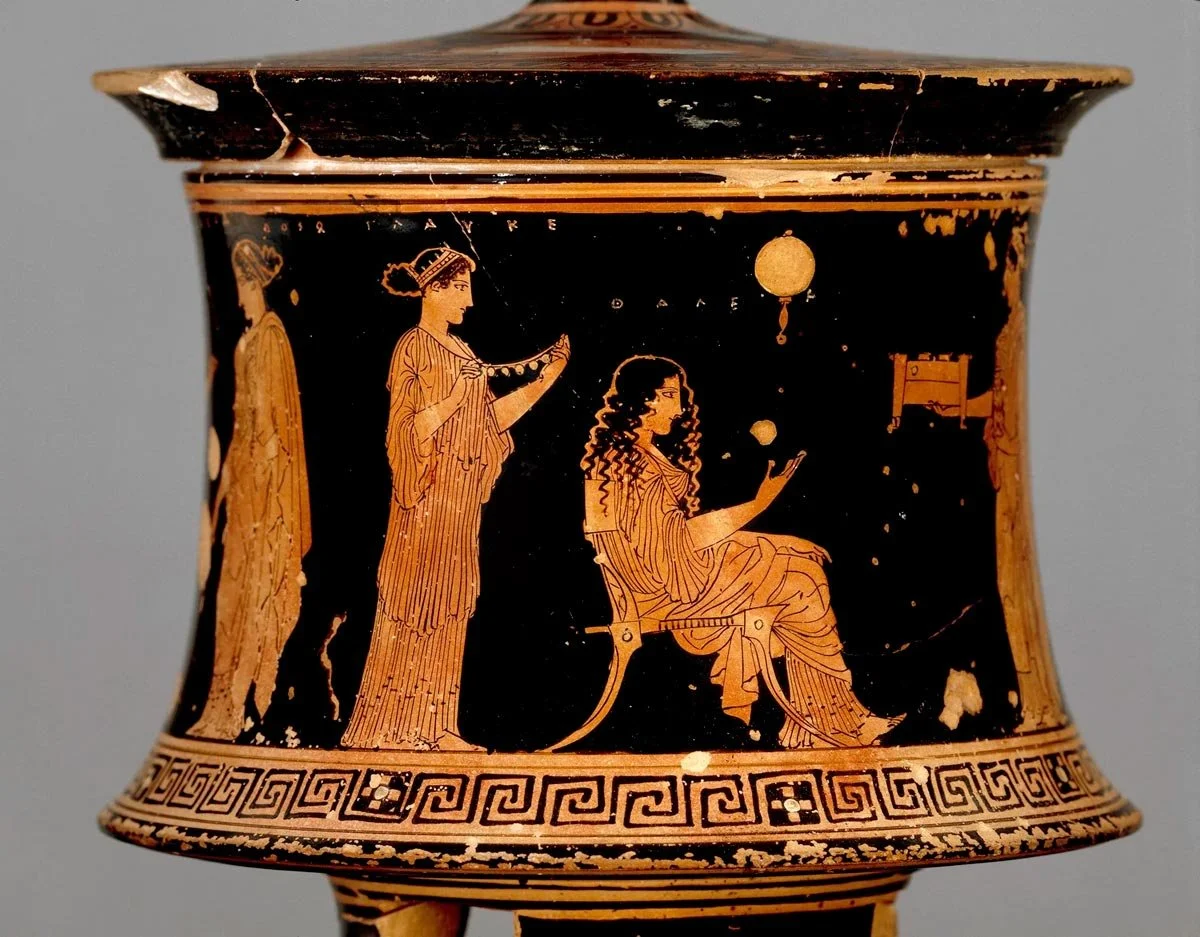
A refined red-figure vessel showing women at home, reminding us that Greek pottery also pictured quiet domestic rituals and care.
Rebuilding the painted environment with fragments, vases and sculpture
Given all these gaps, the practical question is: how do we actually imagine Greek paintings in their full context? One useful move is to stop treating painting, pottery and sculpture as separate boxes and instead think in terms of whole spaces.
Start with a typical sanctuary or civic building. Architectural guides remind us that many temples and stoas once had polychrome details, from painted metopes and pediments to coloured mouldings and backgrounds behind reliefs. Smarthistory even points out that famous structures like the Stoa Poikile were defined by their painted cycles. If we mentally “re-colour” the architecture, then place painted panels and votive statues inside, the space becomes much more layered.
Next, fold in ceramics. The same hands that painted Greek black-figure pottery and later red-figure vases were solving visual problems very similar to those of wall and panel painters: how to show overlapping figures, suggest depth, or tell a myth across a curved surface. Many technical developments mentioned in texts about painters, like experimenting with perspective or multiple ground lines, can be tracked very clearly in vase imagery. In that sense, painted pottery acts as a kind of open sketchbook for a wider pictorial culture.
Finally, connect all of this to religion and daily life. A painted tomb, a decorated drinking cup and a small panel offering might all show similar subjects: a symposium, a procession, a god receiving worship. When we approach them together, they become pieces of one visual language that spread across houses, sanctuaries and graves, echoing the beliefs described in ancient Greek religion. The Aegean murals we meet in Minoan bull-leaping show that this habit of saturating built space with colour and figures goes back even before the classical polis.
The more we train ourselves to read Greek paintings as part of that full environment, the less “empty” ancient Greece feels, even if most of the original walls and panels have vanished.
Conclusion
Greek paintings are tricky to love at first, because they mostly exist as absence. We met a tradition that stretched across frescoed tombs, sanctuary walls and wooden panels, yet survives today in a handful of examples and a lot of second hand descriptions. By walking through those fragments carefully – from tombs at Paestum and Macedonia to the bright little Pitsa panels – and by constantly cross checking them with ancient Greek paintings, Greek pottery and Greek vases, we managed to sketch a more colourful, lived-in picture of Greek visual culture.
For me, the big shift is this: instead of thinking “we have almost no Greek paintings”, it is more helpful to think “we have just enough to reconstruct the habits behind them”. Strong outlines, organised spaces, repeating themes, interactions with ancient Greek religion, and a deep connection to the painted surfaces of ceramics all point in the same direction. If you keep this article open next time you read about ancient Greek art or scroll through Aegean murals like Minoan bull-leaping, try to imagine a full room rather than a single object: walls, panels, vases and statues all talking to each other in colour. That mental reconstruction is where the “lost” art of Greek painting slowly starts to feel present again.
Sources and Further Reading
Smarthistory — “Ancient Greece, an introduction” (overview of Greek art and painting)
Smarthistory — “Tomb of the Diver” (Paestum wall painting case study)
PLOS ONE — Alberghina et al., “The Tomb of the Diver and the frescoed tombs in Paestum” (2020)
Oxford Research Encyclopedia of Classics — “Pottery, Greek” (reference entry on painted ceramics)
You may also like