Late Classical Greek Art: Why Greek Sculpture Starts to Feel More Human
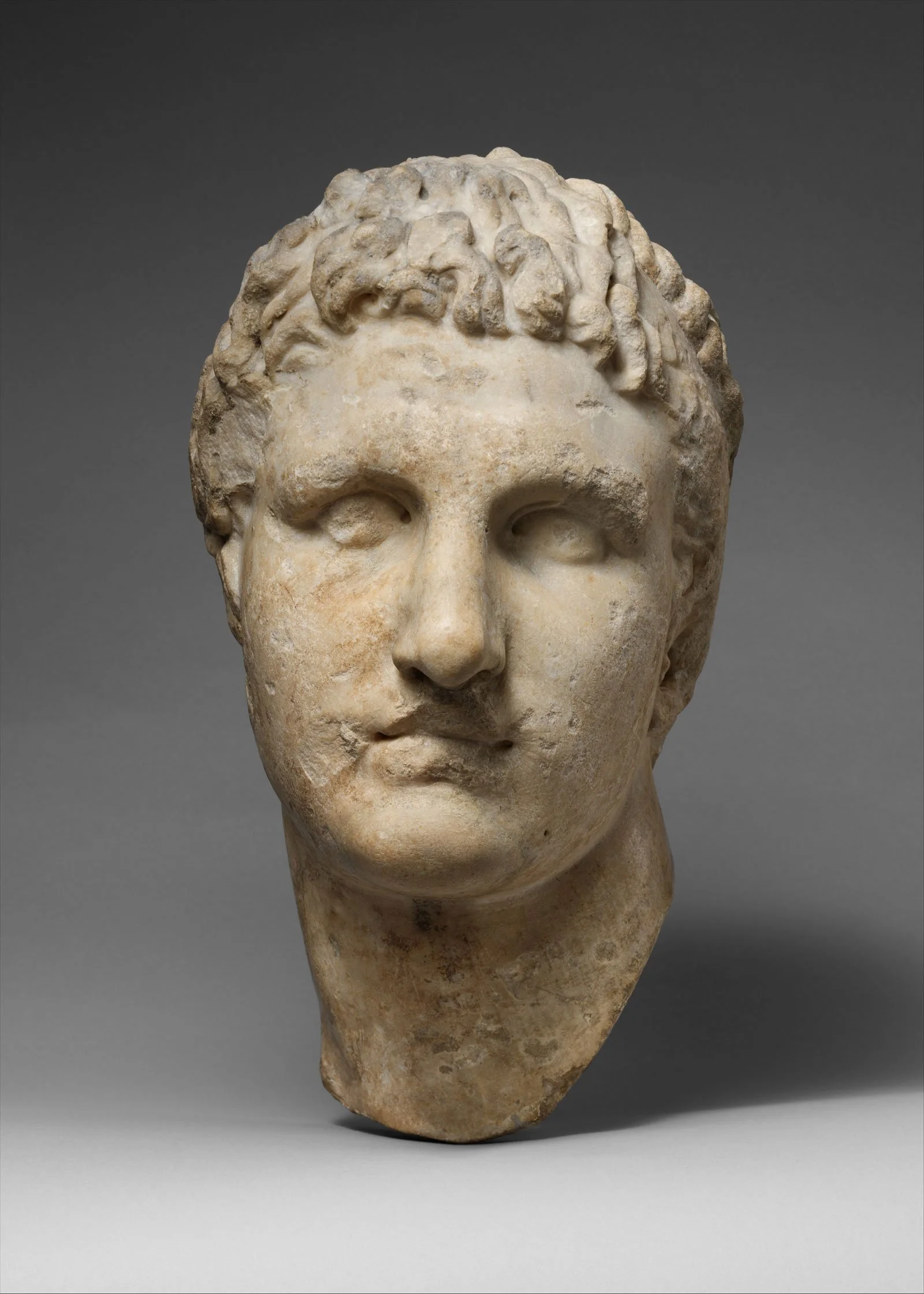
A head like this shows the Late Classical shift toward softer features and a more inward human presence.
There is a moment in Greek art when the body stops feeling purely exemplary and starts feeling more personal. The stance softens. The surface becomes gentler. The face, even when calm, seems to hold an inner life. That is the world of late classical Greek art.
In simple terms, this is the later phase of Classical Greek art, mostly the 4th century BCE, when sculpture becomes less severe, less publicly monumental in tone, and much more attentive to grace, mood, sensuality, and psychological presence. It still believes in ideal beauty. But now that beauty feels quieter, more intimate, and more human.
If early and high Classical art often feels stable, civic, and controlled, the Late Classical phase feels more flexible. Figures lean instead of simply standing. Gods seem closer to human experience. Bodies are still carefully designed, but they are no longer only about public perfection. They begin to suggest softness, thought, desire, fatigue, and emotion.
Definition: Late Classical Greek art is the 4th-century BCE phase in which Greek sculpture becomes softer, more graceful, and more psychologically human while still remaining idealized.
Late Classical Greek art is a later Classical phase, not a totally new world
The first thing to get straight is that Late Classical art is still Classical. It does not reject the older Greek love of balance, proportion, and ideal form. It builds on it.
That matters because the shift is easy to misread. The Late Classical phase is not Greek art suddenly becoming “realistic” in the modern sense. It is Greek art becoming more flexible in how it presents the ideal. The body still follows rules. Beauty is still structured. But the result feels less like a public statement of perfect order and more like a living presence.
The usual date range is roughly 400 to 323 BCE, the century between the end of the high classical art moment and the death of Alexander the Great. In bigger terms, it belongs inside the long story of ancient Greek art, but it has a distinct mood of its own.
This is also why the Late Classical phase feels so important. It stands between two worlds. On one side is the strong, measured confidence we often associate with the Golden Age of Greece and high Classical sculpture. On the other side is the dramatic, emotional, and often more theatrical world of the Hellenistic period. Late Classical art is the bridge.
So when we ask what changes here, the answer is not “everything.” The answer is: the ideal becomes more intimate.
The body stops feeling severe and starts feeling lived-in
This is the shift most beginners notice first, even before they know the dates.
Earlier Classical sculpture often gives us bodies that feel structurally convincing and beautifully controlled. They are calm, balanced, and designed to look right from every angle. But they can also feel slightly impersonal, as if the body is carrying a cultural idea before it carries an inner life.
Late Classical sculpture keeps the structure but changes the emotional temperature. Bodies become slimmer, softer, and more elastic. The torso may bend more gently. The hips may shift more freely. The muscles are still clear, but they are often less sharply announced. The surface feels smoother, almost touch-aware.
This is one reason late classical sculpture often feels surprisingly modern to us. It does not only show what a body is. It shows how a body rests, turns, leans, or hesitates. The figure no longer seems built only for public display. It seems capable of private life.
You can think of the difference like this:
High Classical bodies often feel stable and exemplary
Late Classical bodies often feel graceful and inward
Hellenistic bodies will later feel dramatic and outwardly expressive
That middle category is the key. The Late Classical body is still idealized, but it is not emotionally blank. Even when a figure is simply standing, it may suggest a mood: softness, introspection, charm, or restrained desire.
That is why late ancient Greek sculpture feels so important. It teaches us that Greek art was never one frozen formula. It kept rethinking what a “beautiful” body could communicate.
Contrapposto becomes looser, and the old canon starts to bend
One of the clearest ways to see the Late Classical shift is through pose.
Greek artists had already discovered contrapposto, the weight shift in which a figure rests on one leg and the body counterbalances through hips, spine, and shoulders. In earlier Classical sculpture, contrapposto creates believable life while still preserving a strong architectural order. The body feels calm, balanced, and fully under control.
Late Classical sculptors take that same basic idea and make it more fluid.
The weight shift can become softer. The spine can curve more delicately. The figure may seem to drift rather than simply stand. Instead of a body that feels engineered into equilibrium, we get a body that seems to settle into itself. This is where the Late Classical love of grace really shows.
The same thing happens with proportion. The influence of Polykleitos’ canon does not disappear, but it stops being the only available model. Earlier Classical art often treats proportion as a system for achieving stable perfection. Late Classical artists begin to stretch that inheritance. Bodies can become slimmer, heads slightly smaller in relation to the body, limbs more elegant, and silhouettes more flowing.
That change matters because it makes the figure feel less like a rule made visible and more like a presence unfolding in space.
So if you are ever looking at a Greek statue and thinking, “This still feels ideal, but also somehow softer and more personal,” you are probably very close to the Late Classical world. The body is still disciplined. It is just no longer disciplined in exactly the same way.
Gods and mortals start feeling more approachable
One of the most beautiful things about Late Classical Greek art is that divine figures begin to feel less distant.
Earlier Greek sculpture often gives gods an air of formal authority. They are recognizable, composed, and elevated above ordinary human life. Late Classical art does not remove that dignity, but it brings divinity closer to lived experience. Gods can look relaxed, youthful, seductive, or quietly absorbed in a moment.
This is a major shift.
A figure like Apollo Sauroktonos, traditionally associated with Praxiteles, does not present Apollo as a remote divine ruler. He appears youthful, almost playful, caught in an intimate and surprisingly casual moment. The body is elegant, the mood is light, and the god feels nearer to the human world.
The same is true of Hermes with the infant Dionysus, where the relationship between the adult god and the child adds tenderness to the sculptural experience. Even if we focus less on attribution debates and more on style, the important point is clear: the sculpture invites us to feel softness, ease, and interaction.
Then there is the famous Aphrodite of Knidos, one of the most important works in the whole history of Western art. Its importance is not just that it introduced a new kind of female nude at monumental scale. It is that the goddess is shown in a way that feels both idealized and psychologically present. She is divine, but she is also embodied in a way that encourages a new kind of looking.
This is where Late Classical art becomes especially human. It allows even divine beauty to feel less purely symbolic and more relational. The figures are still ideal. But they seem aware of space, of mood, and sometimes of the viewer.
Three sculptors help define the Late Classical mood
If high Classical sculpture is often discussed through names like Pheidias and Polykleitos, the Late Classical world is usually shaped around Praxiteles, Skopas, and Lysippos. They do not all do the same thing. That is exactly why they matter.
Praxiteles is the sculptor most associated with softness, delicacy, and sensuous grace. His figures often feel relaxed rather than tense, elegant rather than monumental. Marble in his world does not just describe anatomy. It seems to hold light and skin-like softness. He is one of the main reasons Late Classical art feels more intimate.
Skopas pushes in a different direction. If Praxiteles gives us gentle grace, Skopas is associated with emotional intensity. Ancient writers connect him with figures that show stronger feeling, deeper-set eyes, and a more powerful inner energy. He helps move Greek sculpture toward emotion, though not yet toward full Hellenistic drama.
Lysippos changes proportion and spatial presence. His figures are often slimmer and more extended. They seem built for movement through real space, not just for frontal viewing. With him, sculpture starts opening itself outward. The famous Apoxyomenos is especially important here. The athlete’s arm projects into the viewer’s space, and the whole body invites us to move around it rather than read it from one fixed viewpoint.
Together, these three artists show us that Late Classical art is not one look. It is a broader change in attitude. Greek sculpture becomes more varied in mood, more daring in body language, and more interested in what happens when the ideal body is made softer, more expressive, or more spatially alive.
Marble starts to matter in a new way
Material always matters in sculpture, but in the Late Classical period it matters in a particularly visible way.
Greek artists had long worked in both bronze and marble. But the softer human feeling of many Late Classical works is deeply connected to what marble can do well: smooth transitions, gentle surface effects, delicate light, and a sense of tactile presence. Marble allows the sculptor to create not only form, but atmosphere.
This is one reason Praxitelean sculpture feels so distinctive. The body is not carved to show hard muscular definition at every point. Instead, surfaces move gradually. Light slides across the skin. The figure feels less like an anatomical diagram and more like a living body translated into stone.
That change is not purely technical. It is aesthetic. It reflects a new interest in charm, softness, and the subtler side of physical presence.
Late Classical sculpture also shows more interest in moments that feel less grand and more immediate. A god leaning. A youth pausing. A female figure caught in a vulnerable or intimate instant. These scenes benefit from a material that can suggest delicacy without losing monumentality.
So when we say Late Classical Greek art feels more human, part of what we mean is this: the material handling itself becomes gentler. The surface is no longer only there to clarify structure. It is there to shape mood.
This art feels more human, but it is still not “realism” in the modern sense
This is the part worth slowing down for, because it keeps the whole period clear.
Late Classical Greek art does not abandon idealization. It does not suddenly decide to show ordinary bodies exactly as they are, with all the unpredictability and variation of daily life. The figures are still highly selected, highly edited, and deeply shaped by cultural ideas of beauty.
So why do they feel more human?
Because “human” here does not mean merely realistic. It means emotionally legible. It means the figure seems capable of inner life. It means the body no longer acts only as a perfect public sign. It begins to carry mood, tenderness, self-awareness, and desire.
That distinction matters a lot. A Late Classical statue may still show a body more beautiful than any ordinary body. But that body now feels less remote. It seems to inhabit time more gently. It may look as though it has just shifted weight, just turned its head, or just noticed something.
In other words, the humanity is not only in anatomy. It is in presence.
This is why the Late Classical phase is so compelling for beginners. It gives you a way to feel Greek sculpture changing without needing specialist vocabulary first. You do not need to begin with theory. You can begin with a simple visual question: does this figure feel more distant and exemplary, or more intimate and inward?
If the answer is the second one, you are probably already sensing the Late Classical turn.
Late Classical art is the bridge to the Hellenistic world
The Late Classical period matters not only for what it is, but for what it makes possible next.
Without the softer bodies of Praxiteles, the emotional intensity associated with Skopas, and the more spatial, elastic figures of Lysippos, the Hellenistic world would be much harder to imagine. The later age will push movement further, emotion further, and theatrical impact further. But many of those possibilities begin here.
That is why this phase should not be treated as a quiet afterthought to the “great” Classical age. It is one of the most inventive moments in Greek art. It rethinks the human figure from inside the Classical tradition rather than from outside it.
And it also broadens what Greek sculpture can be.
It can still be noble, but now nobility can be tender.It can still be ideal, but now ideality can be sensuous.It can still be balanced, but now balance can sway, lean, and breathe.
Seen that way, Late Classical Greek art is not a decline from earlier perfection. It is a reinterpretation of it. The sculptors of the 4th century BCE inherit the Classical language and teach it to say new things.

Conclusion
Late Classical Greek art is the moment when Greek sculpture becomes softer, quieter, and more psychologically alive. The body is still idealized, but it now feels more intimate. Contrapposto loosens. Proportions shift. Gods become more approachable. Surfaces become gentler. And sculptors such as Praxiteles, Skopas, and Lysippos open the door to a new understanding of what the human figure can express.
Once you can see that shift, Greek sculpture stops looking like one unchanging marble tradition. It becomes a living sequence of choices. And the Late Classical phase is one of the most revealing choices of all: the decision to make perfection feel human.
FAQ
What is Late Classical Greek art in simple terms?
It is the later phase of Classical Greek art, mostly in the 4th century BCE, when sculpture becomes softer, more graceful, and more emotionally human.
What are the dates of the Late Classical period?
It is usually dated to about 400–323 BCE, between the high Classical age and the beginning of the Hellenistic period.
Why does Late Classical sculpture feel more human?
Because figures become more relaxed, more psychologically present, and more attentive to softness, mood, and lived bodily presence.
Is Late Classical art still idealized?
Yes. The figures are still carefully designed according to ideals of beauty and proportion. They simply feel less severe and more intimate.
Who are the main sculptors of the Late Classical period?
The three names most often associated with it are Praxiteles, Skopas, and Lysippos.
How is Late Classical art different from Hellenistic art?
Late Classical art usually keeps its emotion restrained and elegant, while Hellenistic art often becomes more dramatic, dynamic, and openly expressive.
Sources and Further Reading
The Metropolitan Museum of Art — “The Art of Classical Greece (ca. 480–323 B.C.)” (2008)
Encyclopaedia Britannica — “Western sculpture: Late Classical period (c. 400–323 bce)” (n.d.)
JSTOR / University of Texas Press — “Greek Art and Aesthetics in the Fourth Century B.C.” (2017)
Cambridge University Press — “The Female Body: Aphrodite of Cnidos” (2018)
You may also like