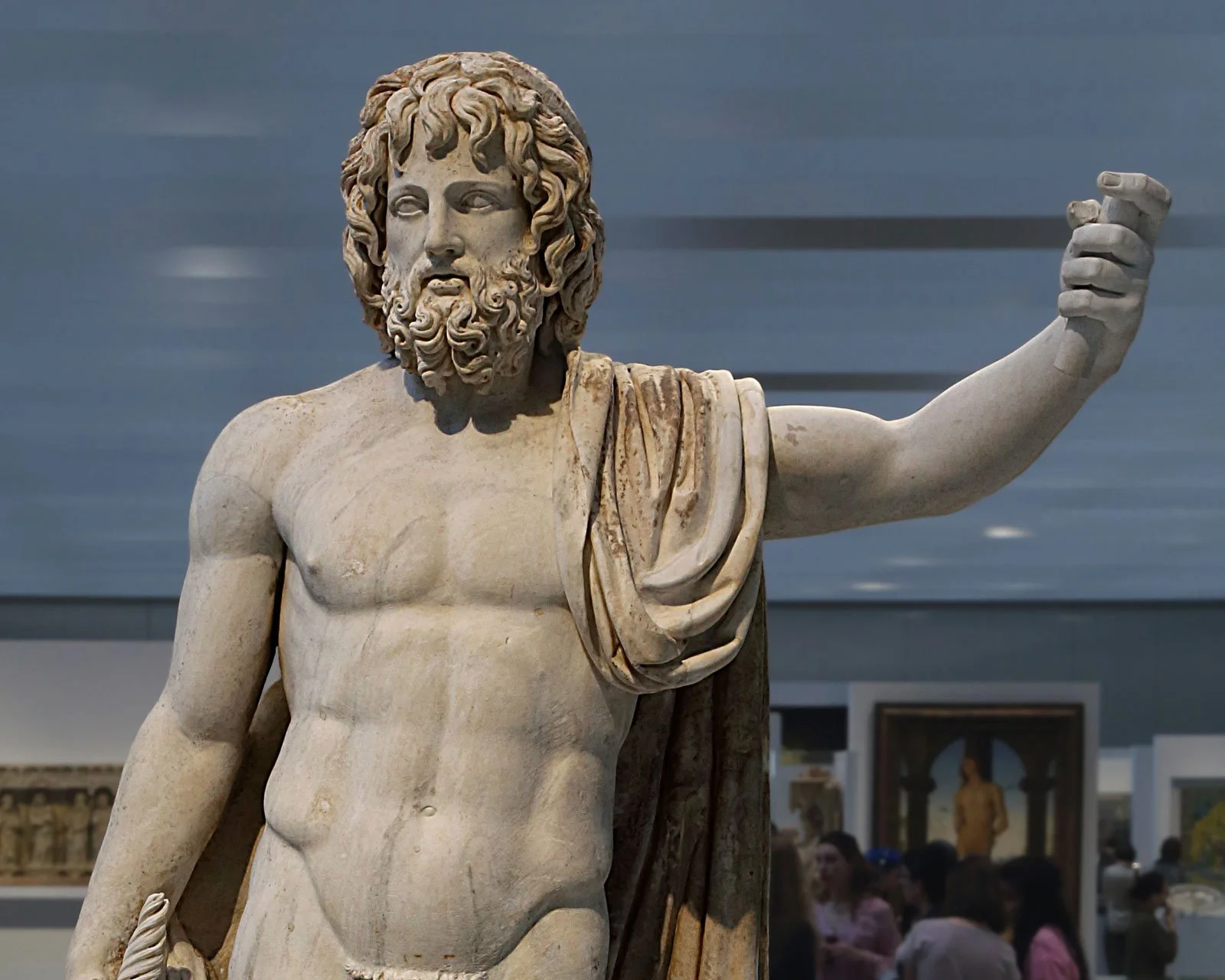
A mature beard and commanding gesture are standard Zeus markers.
A Zeus statue can feel strangely familiar even when we can’t name it. Mature beard. Massive body. Calm face. A posture that says “I don’t need to move to be powerful.” Then we look closer and realize we’re not just identifying a god. We’re identifying authority, carved into stone or cast into bronze.
That’s the thing about Zeus. His myth is basically a story about becoming king of the gods. So Greek artists made him readable as a ruler first, and a character second. This guide uses myth as our map: we’ll retell the power moments that shaped Zeus’s image, then turn them into a quick visual checklist you can actually use in a museum.
Zeus looks like authority because his myth is about winning authority
Zeus isn’t “born” as a gentle sky dad. He becomes Zeus by surviving, overthrowing, and taking control.
In the big myth arc, Zeus defeats the Titans and establishes a new order. That matters because it gives him a very specific visual role: he is the god who rules, not the god who simply appears. When Greek art wants to communicate “king of the gods,” it leans into kingship signals: throne, scepter, eagle, and the weapon that only Zeus carries with full confidence.
If you want the wider cultural logic behind that, it helps to remember how Greeks treated cult images in general. A cult image is, in plain words, the main sacred statue in a sanctuary. It’s a designed presence, meant to shape how a community experiences divine power. That’s why Zeus’s imagery fits so neatly into how Greeks imagined divine authority.
So when we identify Zeus in sculpture, we’re not only looking for “a bearded man.” We’re looking for the visual language of rule.
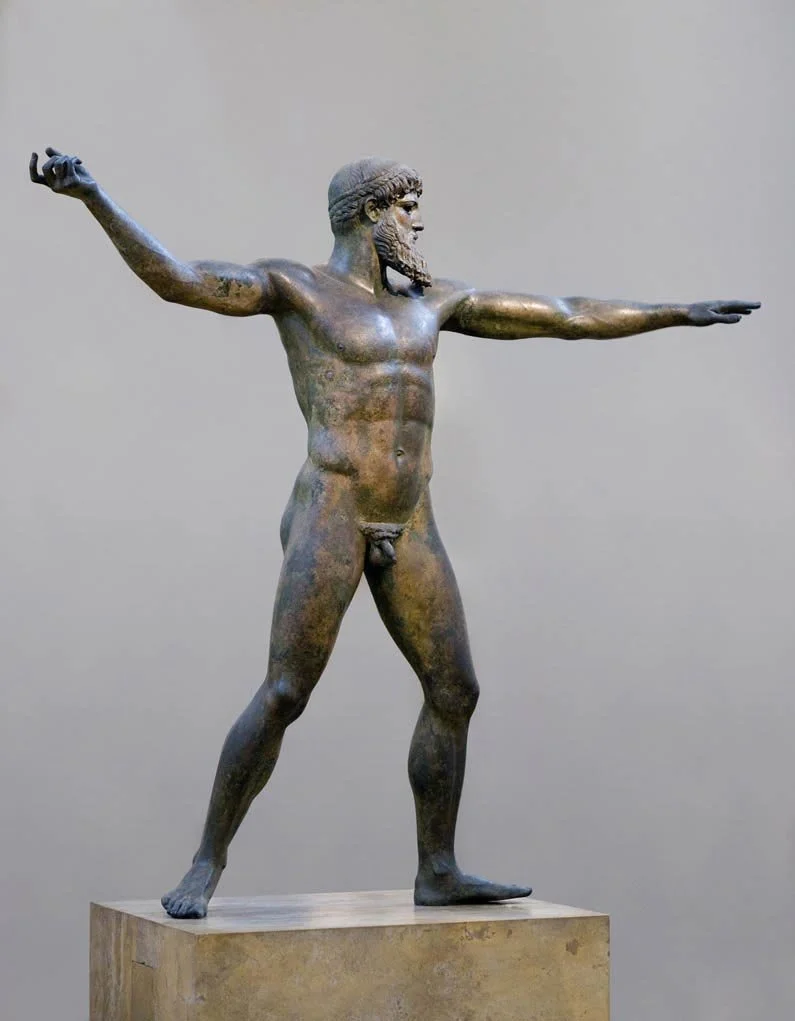
This statue is famous because the missing attribute makes Zeus and Poseidon hard to separate.
The thunderbolt is Zeus’s clearest ID badge
If you can find the thunderbolt, the game is almost over.
A thunderbolt is a stylized lightning weapon. In art it can look like a bundle of zigzags, a forked flame, or a compact “lightning cluster” held like a short spear. It’s not just a prop. It’s the symbol of Zeus’s control over sky force.
This is why Zeus gets confused with Poseidon so often. Both are mature, bearded, “big god” types. Both can extend an arm as if throwing something. Without the object, the figure becomes ambiguous.
But with the object, it’s easy:
Thunderbolt = Zeus
Trident = Poseidon
This difference is so basic it’s almost the whole identification lesson. And it’s exactly why a lot of ancient bronzes are labeled “Zeus or Poseidon” when the hand is broken.
Myth vs Fact
Myth: Any bearded god statue is Zeus.
Fact: Zeus needs his attribute (thunderbolt, throne, eagle) to be certain.
If you want a quick broader system for this, the Zeus attributes lens is the simplest way to see how Greek artists made gods readable across the whole pantheon.
The throne matters because Zeus is often shown as “already in control”
The thunderbolt shows power in action. The throne shows power as permanence.
A throne is a seat that signals rulership, not rest. Zeus is frequently shown seated, especially in cult contexts, because seated kingship communicates something standing doesn’t: the idea that rule is stable. Zeus doesn’t need to run. He doesn’t need to chase. He holds authority like gravity holds the world.
The most famous example is the colossal seated type we meet in Zeus at Olympia. Even though the original statue is lost, the tradition around it is crystal clear: Zeus seated, holding Victory, holding a scepter, framed by a throne that functioned like an artwork within the artwork.
That seated formula becomes a mental template. When you see a mature enthroned god with a calm face and an “I own the room” posture, Zeus becomes likely even before you find the thunderbolt.
And it’s not only cult statues. Even in smaller works, a seated Zeus signals “king of gods” more directly than a standing figure ever can.
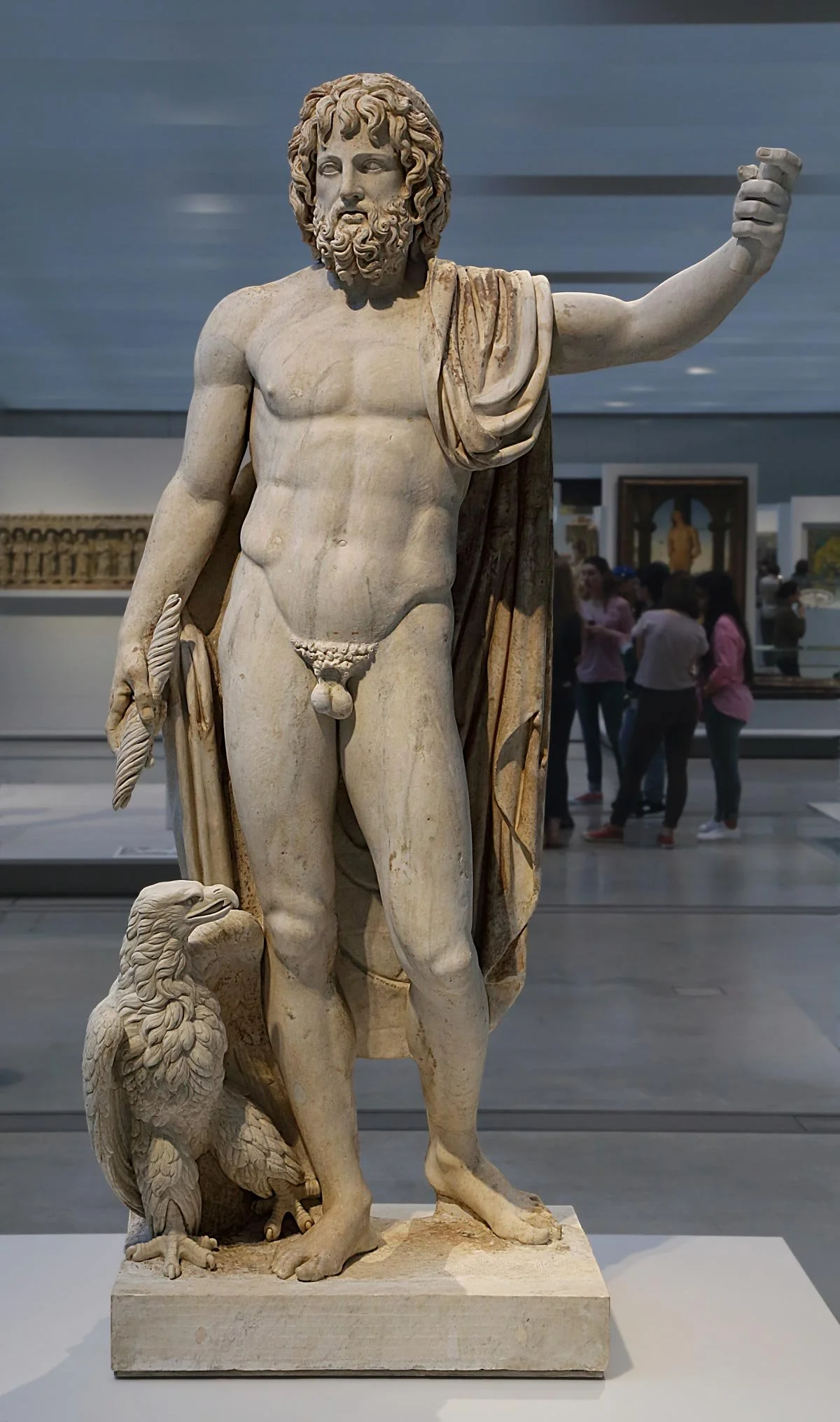
The eagle is one of Zeus’s clearest identifying symbols.
Zeus’s beard and body type are age-coding, not just “Greek men had beards”
Here’s a practical clue that’s easy to overlook.
Greek art often uses age coding (visual signs of maturity) to separate divine roles. Zeus is usually not a youthful god type like Apollo. He’s typically shown as mature: beard, strong chest, heavy presence.
This is not only about realism. It’s about hierarchy. A youthful face can communicate beauty. A mature face can communicate legitimacy and judgment. Zeus is the god of order and arbitration as much as lightning. So artists make him look like someone who can decide outcomes.
But be careful. Beard alone is not a proof. Poseidon, Hades, and other mature male divinities can also be bearded. The beard is supportive evidence. The attribute is the deciding evidence.
So the best museum logic is:
beard + thunderbolt = strong Zeus
beard + trident = strong Poseidon
beard + throne + eagle motifs = Zeus likely even if hand is missing
Zeus appears in Parthenon myth scenes as a “cosmic anchor,” not the main hero
Sometimes we identify Zeus not from a standalone statue, but from a myth program where multiple gods appear together.
This is where temple sculpture becomes a cheat code. On buildings like the Parthenon, gods are often identified by their role in the myth, their placement, and their relationship to other figures.
For Zeus specifically, the Parthenon context is useful because it shows him as the authority figure behind Athena’s story, not as the star of the show. That’s why reading Zeus in Parthenon myths can sharpen your Zeus recognition. He appears as the power source and legitimizer: the god from whose head Athena is born, the ruler whose presence stabilizes the scene.
And once you start thinking this way, Zeus becomes easier to identify in multi-figure programs, because he tends to occupy a conceptual role: the cosmic baseline of order. That logic fits into the broader gods inside the Parthenon program approach, where each sculptural zone contributes to a larger civic message.
So even when the thunderbolt isn’t visible, the story can identify the god.
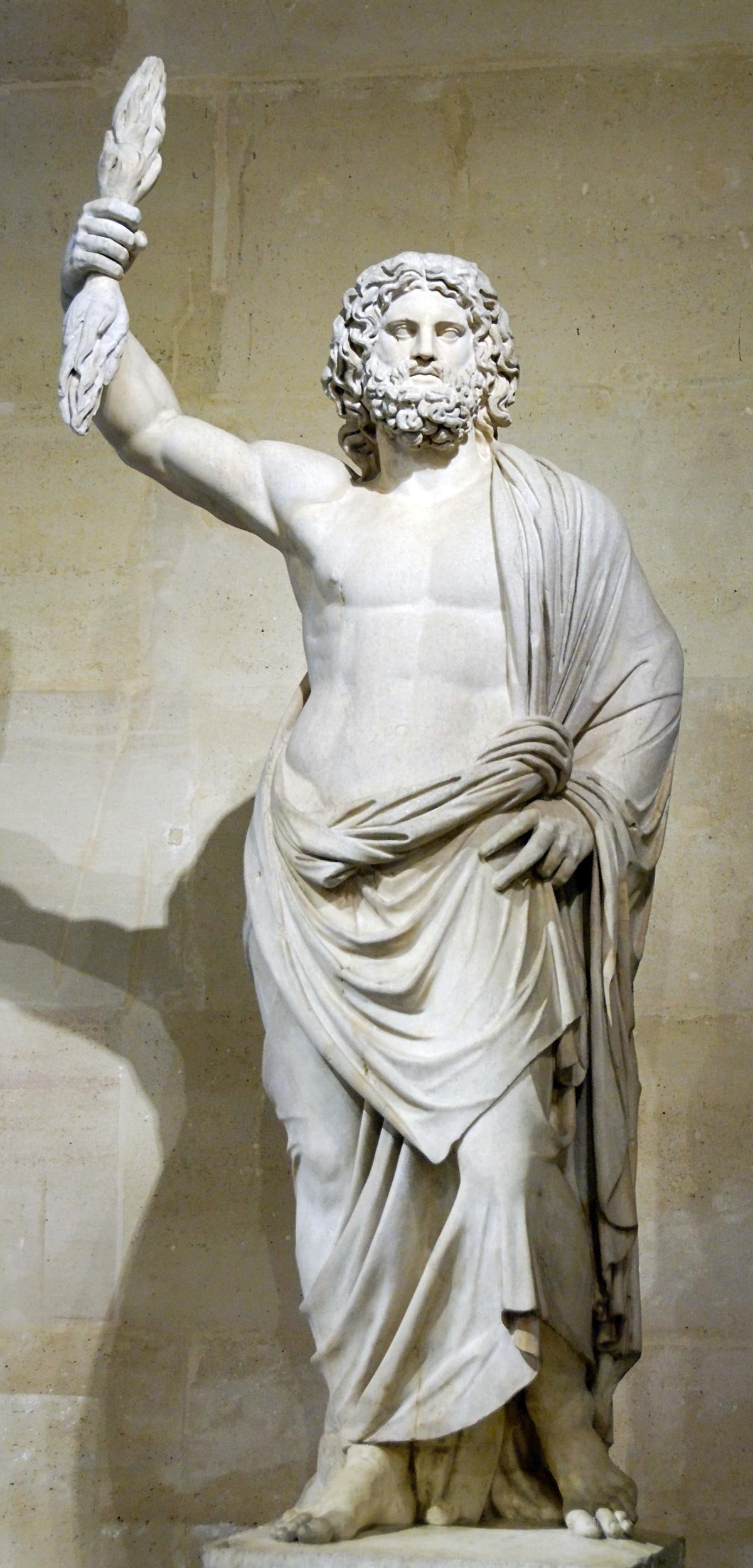
When Zeus holds the thunderbolt, the identification is usually straightforward.
A quick Zeus identification checklist you can actually use
If you want the ten-second version, scan for combinations, not one single clue.
Thunderbolt: the strongest single proof.
Throne: kingship, stable authority, cult-image logic.
Scepter: staff of rule, often paired with throne.
Eagle: Zeus’s animal sign, often on the scepter or nearby.
Mature beard and heavy presence: supports the identification.
“Ruler posture”: calm face, no frantic motion, dominance through stillness.
If you get thunderbolt plus one more cue, you can be confident. If the hand is missing, throne plus scepter plus eagle can still build a very strong Zeus case.
And if you want the wider system for gods in general, loop back to Zeus attributes. It turns “guessing” into pattern reading.

Conclusion
Zeus is identifiable because Greek artists wanted him to be identifiable. His myth is the story of authority establishing order, so his image becomes the visual language of rule: thunderbolt, throne, scepter, eagle, mature presence, calm dominance.
Once we learn that language, a Zeus statue stops being “generic bearded god.” It becomes a readable claim: this is the force that governs the sky, legitimizes the cosmos, and makes civic order feel divinely backed.
Sources and Further Reading
Metropolitan Museum of Art — “Bronze statuette of Zeus or Poseidon” (n.d.)
UNESCO World Heritage Centre — “Archaeological Site of Olympia” (1989)
ASCSA (Hesperia) — “The Pheidian Zeus at Olympia” (1966)
Smarthistory — “Temple of Zeus, Olympia” (n.d.)
Perseus Digital Library — “Pausanias, Description of Greece 5.11 (Zeus at Olympia)” (1918 trans.)
Encyclopaedia Britannica — “Statue of Zeus” (2026)
You may also like