Hellenistic Period: What It Is, Dates, Map, and Why It Matters
A head like this shows the Late Classical shift toward softer features and a more inward human presence.
The Hellenistic period is what comes after the old world of Classical Greece stops being enough to describe the Greek-speaking Mediterranean. It begins after the death of Alexander the Great, when the Greek world becomes much larger, more connected, and much more mixed. Instead of thinking only about Athens, Sparta, or the old ancient Greek city-states, we now have to think about kingdoms, huge cities, long trade routes, royal courts, and a map that stretches far beyond mainland Greece.
In the simplest terms, the Hellenistic age is the period from 323 BCE to 31 BCE in most art-history timelines, though some histories round the ending to 30 BCE because that is when Roman Egypt is absorbed after Cleopatra. What matters most is the broader shift: Greek culture no longer belongs mainly to the Aegean world. It spreads across Egypt, Anatolia, the Levant, Mesopotamia, and even into Central Asia, while constantly mixing with local cultures already there.
That is why the Hellenistic period matters so much. It is not just a final chapter after the Golden Age of Greece. It is the moment when the Greek world becomes international, urban, royal, and deeply interconnected. And once you see that, Greek art, politics, and identity start looking very different.
Definition: The Hellenistic period is the age between Alexander’s death and Rome’s takeover of the eastern Mediterranean, when the Greek world becomes bigger, more urban, and more culturally mixed.
The Hellenistic period begins after Alexander, but it is not just “after Alexander”
The first thing to understand is that the Hellenistic period does not begin because artists suddenly changed style overnight. It begins because the political world changes dramatically.
Alexander the Great dies in 323 BCE, and his vast empire does not stay united. Instead, it breaks into competing kingdoms ruled by his successors. This is the start of the Hellenistic world. The word Hellenistic means, in simple terms, connected to Greek culture. But that does not mean “purely Greek” in a narrow sense. It means a world shaped by Greek language, Greek institutions, Greek elites, and Greek artistic forms, all interacting with older and local traditions across a huge geographic area.
This is why the Hellenistic period feels different from earlier ancient Greek art. Classical Greece is still a useful reference point, but it is no longer enough. We are no longer dealing mainly with independent poleis, or city-states, competing in a relatively compact Aegean world. We are dealing with large kingdoms, royal patronage, cross-cultural exchange, and new kinds of cities.
The ending is usually placed at 31 BCE, the date of the Battle of Actium, or 30 BCE, when Roman control over Egypt becomes final. In practice, both dates are pointing to the same transition: Rome becomes the dominant power in the eastern Mediterranean, and the Hellenistic political world comes to an end.
So the Hellenistic period is not just “late Greece.” It is a new historical frame. The Greek world expands, changes scale, and begins operating in a much wider system.
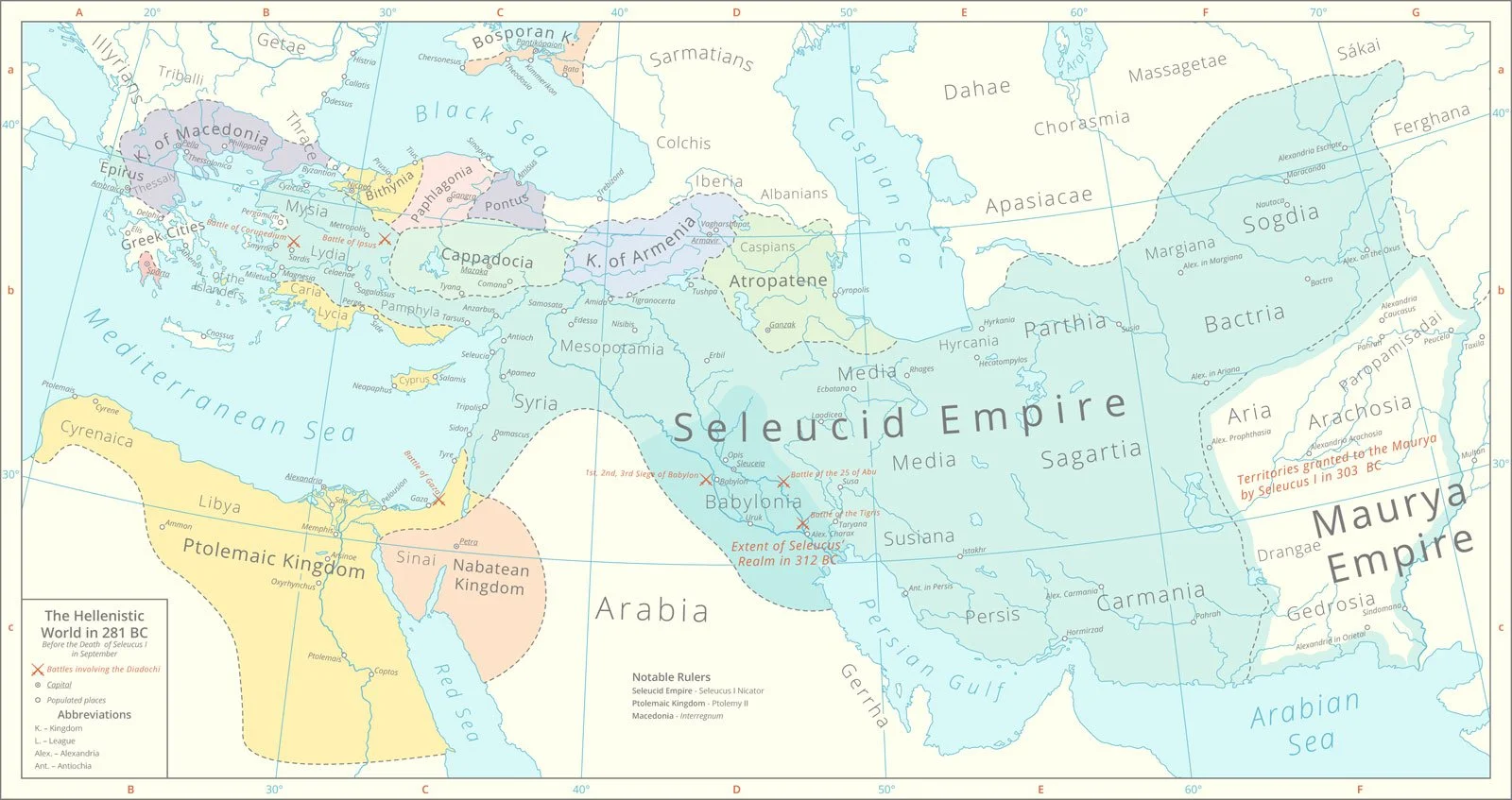
If you picture only Greece, the Hellenistic map makes no sense
This is the most important mental reset.
If someone says “Greek history,” many people still imagine a relatively small world around mainland Greece and the Aegean islands. That older map matters, of course, and it is worth knowing through a good ancient Greek map. But the Hellenistic map is much bigger.
At its broadest, the Hellenistic world stretches across:
mainland Greece and the Aegean
Egypt
western Asia Minor, or Anatolia
the Levant
Mesopotamia
parts of Iran
regions extending toward Central Asia
That scale changes everything. Greek culture is no longer concentrated mainly around a network of neighboring city-states. It now circulates through kingdoms and cities spread across enormous distances.
A useful way to picture this is through the major post-Alexander powers:
Antigonid Macedonia in the Greek and Macedonian world
Ptolemaic Egypt, centered on Alexandria
Seleucid territories, stretching across much of the Near East
Pergamon, which becomes a major cultural and political center in western Anatolia
The result is a much wider and more uneven world than Classical Greece. Some places are old Greek centers. Others are newly founded or newly reorganized cities. Others are regions with deep local traditions that now become part of a Greek-speaking political system without losing their own histories.
That is why the Hellenistic map matters. It is not just a bigger version of Greece. It is a new geopolitical landscape in which Greek language and culture travel through a much larger and more mixed world.
The old world of city-states does not disappear, but kingdoms now dominate
One of the easiest mistakes is to imagine a total break: city-states vanish, kingdoms take over, end of story. The real picture is more interesting.
The polis, meaning self-governing city-state, remains important in the Hellenistic period. Cities still matter enormously. Civic identity still matters. Local institutions still matter. But they now exist inside a broader political world dominated by kings and dynasties.
That is one of the biggest structural differences from earlier Greece. In the Classical age, power is often imagined through the rivalry of city-states like Athens, Sparta, Corinth, or Thebes. In the Hellenistic world, power is much more often organized through monarchies. Royal courts become major engines of culture, money, architecture, diplomacy, and image-making.
This shift helps explain why the Hellenistic world feels less local and more networked. A royal court can sponsor major building programs, attract scholars and artists, and connect distant regions through administration, trade, and prestige. At the same time, cities remain active participants in this world. They negotiate with kings, benefit from royal patronage, preserve civic traditions, and continue to define local belonging.
So the Hellenistic period is not the death of the Greek city. It is the age in which the city has to coexist with something larger: kingdom-scale politics.
That is also why the Hellenistic world often feels more layered than the earlier Greek world. People could belong to a city, live under a king, speak Greek in one context, and participate in older local traditions in another. Identity becomes more flexible, and sometimes more complex.
Greek culture spreads widely, but the Hellenistic world is mixed rather than purely Greek
This is where the period becomes especially interesting.
The Hellenistic world is often described as the spread of Greek culture. That is true, but only if we say it carefully. Greek language, Greek artistic forms, Greek educational models, and Greek political habits do spread widely. A common Greek, often called koine, meaning shared Greek language, becomes a major tool of communication across different regions.
But this is not a story in which Greek culture simply replaces everything else.
The Hellenistic world is mixed. It includes people of different languages, religions, customs, and local histories. Greek influence is powerful, but it works inside societies that were already culturally rich and historically deep. That means Hellenistic culture is not just exported Greece. It is a world of adaptation, overlap, negotiation, and sometimes tension.
You can see that in religion, in urban life, in art, and in social identity. Greek gods continue, but they can be understood differently in different places. Greek-speaking elites operate across the eastern Mediterranean, but local languages do not simply disappear. Greek forms of education and public life spread, yet they do so unevenly and in conversation with other traditions.
This is one reason the Hellenistic period feels bigger than a simple label like “Greek civilization” can hold on its own. It is still Greek in important ways, but it is also broader than Greece. That is exactly what makes it so historically important.
It also helps explain why the period can feel more cosmopolitan. Cosmopolitan means, in plain words, made up of many peoples and cultures. Big cities like Alexandria become famous precisely because they gather different communities, languages, and forms of knowledge into one place.
So if the Classical Greek world often feels centered on a recognizable civic model, the Hellenistic world feels much more open, mobile, and mixed.
The Hellenistic city becomes bigger, richer, and more ambitious
If you want to feel the Hellenistic period physically, look at its cities.
The Hellenistic age is full of urban expansion, city foundations, re-planning, and architectural ambition. This is one of the reasons it matters so much for the history of Greek architecture. The city is no longer just a civic center for a small polis world. It becomes a stage for power, administration, education, trade, and royal display.
Alexandria is the obvious example. It becomes one of the great cities of the ancient world, famous not only for political importance but for institutions of learning, libraries, and its cosmopolitan scale. Antioch, Pergamon, and Seleucia also matter for the same reason. These are not just local towns with Greek buildings. They are major urban centers in a world of wide political networks.
Hellenistic urbanism often favors:
large-scale planning
gridded streets
monumental public spaces
theaters, stoas, sanctuaries, and gymnasia
architecture designed for visibility and civic prestige
That does not mean every Hellenistic city looks the same. It means the period encourages city-making on a larger and more integrated scale.
This also changes how art and architecture function. Buildings are not only expressions of local identity. They can now also express royal generosity, dynastic power, or the prestige of a major regional center. Public space becomes more theatrical, more carefully staged, and often more expansive.
In other words, the Hellenistic city is not just where the period happens. It is one of the clearest forms the period takes.
Art changes because the Hellenistic world changes
Even though this article is about the period as a whole, it is impossible to understand the Hellenistic age without noticing what happens to art.
The old Classical preference for balance, clarity, and ideal calm does not vanish. But it is no longer the only model. Hellenistic art becomes more varied in subject matter, more experimental in mood, and often more interested in movement, emotion, age, difference, and lived experience.
That makes sense once we remember the world behind it.
A wider world produces wider artistic interests. Royal courts want splendor. Big cities want monuments. Collectors want objects for private display. Artists work in a landscape of greater mobility and greater variety. The result is an art world that can include divine drama, sensuality, portraits, children, elderly figures, foreigners, grotesques, battle scenes, and striking emotional intensity.
This does not mean every Hellenistic work is theatrical. But the range expands dramatically.
The same broad shift affects architecture. The Hellenistic age often favors more complex settings, stronger visual impact, and more ambitious urban placement. Buildings and sculptural programs are increasingly designed for large civic environments and for viewers moving through them.
So when people say Hellenistic art feels more emotional, more dynamic, or more diverse, that is not just a style label. It reflects the larger world that produced it: bigger kingdoms, more mixed populations, new patrons, and a different relationship between art and public life.
The Hellenistic period matters because it changes what “Greek” can mean
This is the deepest reason the period matters.
Before the Hellenistic age, “Greek” is often easiest to imagine through the city-state world, the Aegean, and the Classical cultural model. After Alexander, that frame becomes too small. Greekness now travels. It becomes mobile, adaptable, and international. It exists in places far from the old core, and it interacts constantly with people who are not simply Greek in the older civic sense.
That shift matters politically, culturally, and artistically.
It matters politically because the eastern Mediterranean is reorganized around large kingdoms and then gradually drawn into Roman power.
It matters culturally because Greek language and education become major connective forces across a vast region.
It matters artistically because the Hellenistic period opens up new possibilities in subject matter, scale, patronage, and visual effect.
And it matters historically because Rome inherits a world already reshaped by Hellenistic networks. In that sense, the Hellenistic age is not just a final Greek period. It is a bridge between the Classical Greek world and the Roman Mediterranean.
Once you see that, the Hellenistic period stops feeling like an appendix after “real” Greece. It becomes one of the most decisive ages in ancient history: the moment when Greek culture becomes part of a much larger and more entangled world.

Conclusion
The Hellenistic period is the age in which the Greek world becomes bigger than old Greece. It begins after Alexander, expands across a huge map, reorganizes power around kingdoms, builds major cities, spreads Greek language widely, and creates a much more mixed cultural landscape than the earlier world of city-states.
That is why it matters so much. It helps explain why later Greek art looks different, why ancient cities become more ambitious, and why the eastern Mediterranean becomes so interconnected before Rome fully takes over. Once you understand the Hellenistic age, you stop seeing Greek history as one small, self-contained story. You start seeing it as a world system.
FAQ
What is the Hellenistic period in simple terms?
It is the period after Alexander the Great when Greek culture spreads across a much larger world and mixes with many local cultures.
When does the Hellenistic period begin and end?
It begins in 323 BCE, after Alexander’s death, and usually ends in 31 BCE in art-history timelines, though some histories use 30 BCE.
Why is it called “Hellenistic”?
Because it refers to a world strongly shaped by Greek, or Hellenic, language and culture, even though that world is broader and more mixed than old Greece itself.
Is the Hellenistic world the same as Classical Greece?
No. Classical Greece is centered more on the city-state world, while the Hellenistic age is larger, more royal, more urban, and more international.
Which kingdoms matter most in the Hellenistic period?
The major powers usually discussed are Macedonia, Ptolemaic Egypt, the Seleucid Empire, and Pergamon.
Why does the Hellenistic period matter for art?
Because it creates a wider and more varied artistic world, with new patrons, bigger cities, more emotional range, and more diverse subject matter.
Sources and Further Reading
The Metropolitan Museum of Art — “Art of the Hellenistic Age and the Hellenistic Tradition” (2007)Smarthistory — “Empire and Art in the Hellenistic world (c. 350–31 B.C.E.)” (n.d.)
Encyclopaedia Britannica — “Hellenistic civilization” (2026)
Cambridge University Press — “The Cambridge Companion to the Hellenistic World” (2007)
You may also like