Myron Discobolus: Why This Athlete Defined Classical Motion
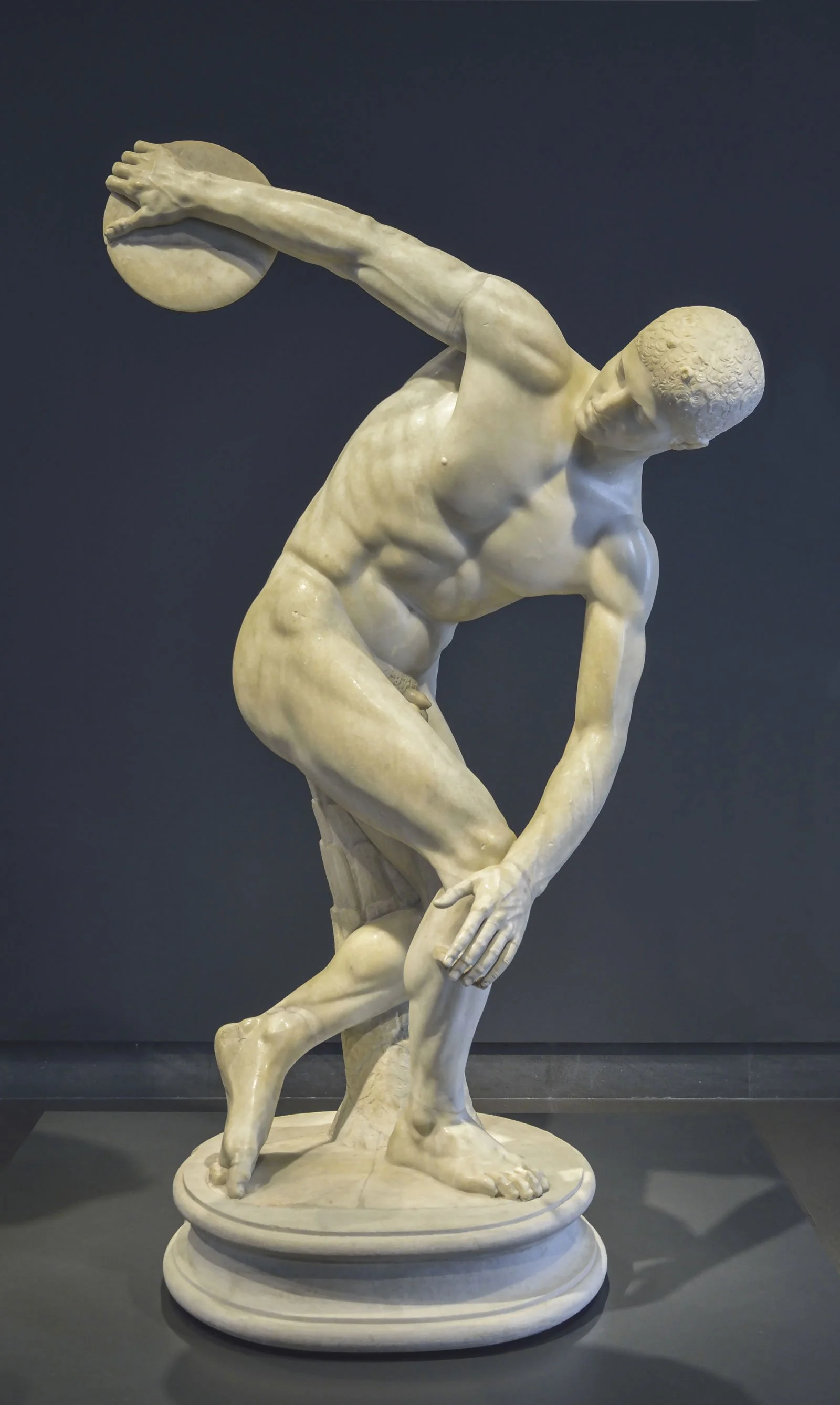
The Discobolus is famous because it turns a brief athletic action into a carefully balanced sculptural pose.
The Discobolus is the kind of statue that makes you physically react. You lean in. Your shoulders tense up a little. Your brain completes the throw before the marble ever moves.
That’s the miracle and the point. Myron’s Discobolus is not just “a guy with a discus.” It’s an experiment in how to freeze motion without killing it. And it arrives right when Greek sculpture is learning a new skill: how to make a body feel alive while keeping it Classical calm.
We’re going to read the Discobolus the way Myron likely wanted it read: as a choreographed moment, a designed balance, and a public ideal of what the male body could mean in Greek culture.
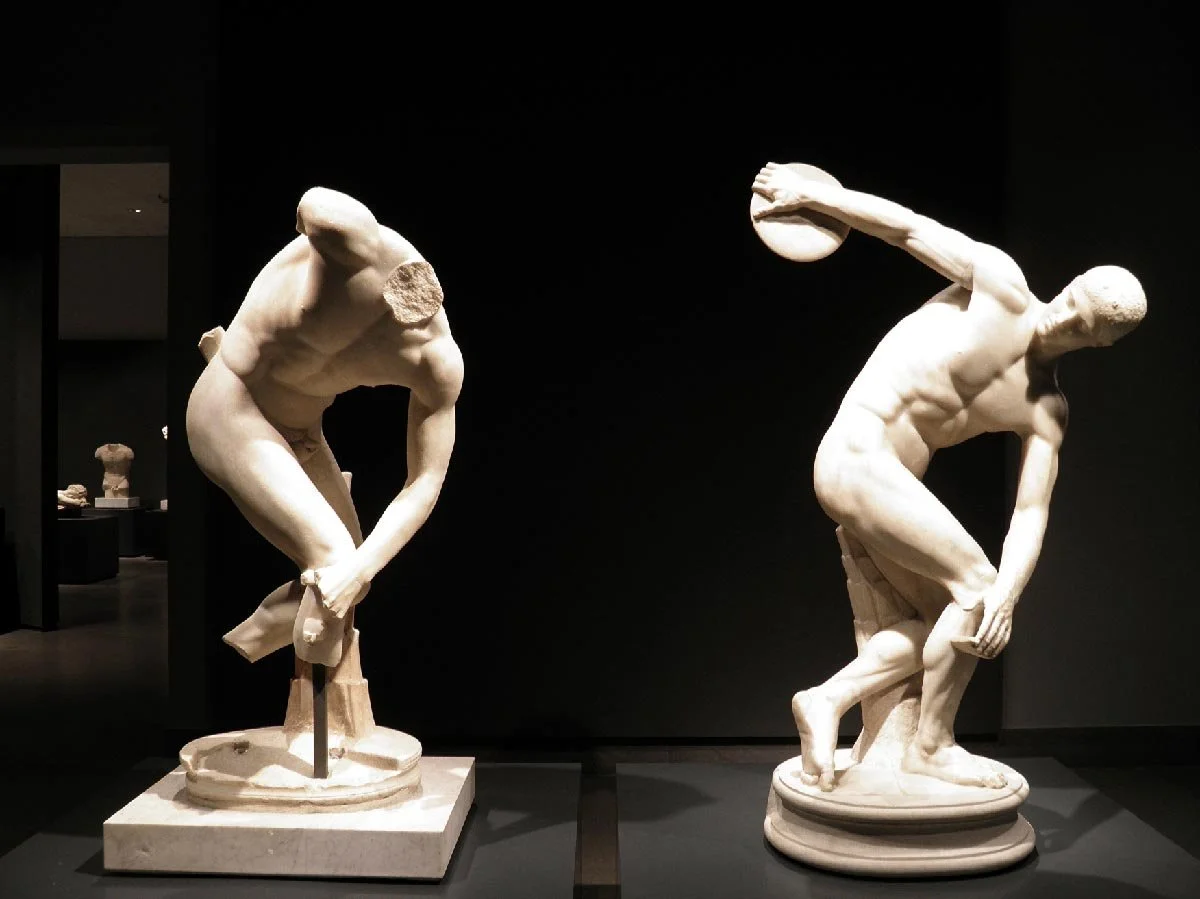
Roman copies are the main reason we can still study Myron’s Discobolus today.
The Discobolus isn’t a snapshot of sport, it’s a sculpture of potential energy
It captures the moment before release, not the moment that is easiest to copy from life.
If you’ve ever watched a real discus throw, you might notice something funny: Myron’s pose can feel slightly “too perfect” to be pure athletic documentation. That’s because the Discobolus isn’t trying to teach technique. It’s trying to make us feel a body wound tight like a spring.
Define it simply: potential energy is stored force before movement happens.
Myron picks the instant when everything is coiled. The torso twists. The arms extend like a bowstring. The weight settles into a stance that looks stable, even though the pose is extreme. The statue is quiet in the face and loud in the body, which is the essence of Classical motion: intensity controlled by structure.
If you want a baseline for spotting what counts as “Classical” before we get nerdy about this one statue, start with visual clues for Classical style. The Discobolus is basically a high-performance version of those clues: clarity, balance, and a body that behaves as one connected system.
Myth vs Fact
Myth: The Discobolus is mainly about realistic sports technique.
Fact: It’s mainly about designed balance and rhythm.
So when people say “it redefined motion,” they don’t mean it looks like a blurred photo. They mean it made motion readable as a composed form.
Classical motion and calm is the Discobolus’ real superpower
It shows maximum strain without turning the statue into a drama face.
Here’s the paradox that makes Myron feel so modern. The body is doing something intense, but the expression stays controlled. No open mouth. No grimace. No theatrical suffering. The face stays almost neutral, as if the athlete’s mind is steady even when the body is at full extension.
That tension is exactly what we mean by Classical motion and calm. Classical sculpture often pushes life into posture and rhythm, not into facial emotion. The Discobolus becomes iconic because it proves you can show action without losing harmony.
A quick definition in-line: rhythm in sculpture is the repeated flow of lines and volumes.
If you trace the Discobolus with your eyes, you can feel that rhythm. The curve of the back echoes the arc of the arms. The twist of the torso leads to the implied circle of the discus path. It’s almost musical. That’s why the statue reads so powerfully from different angles. It’s designed to be walked around, not consumed from one front view.
And that is a huge shift from earlier Greek bodies that can feel more frontal and emblem-like. If you want the big picture, what changed since Archaic bodies is essentially the story of Greek art learning how to choreograph the body in space.
Myron isn’t inventing movement out of nothing. He’s refining the grammar of the body until motion becomes legible as structure.
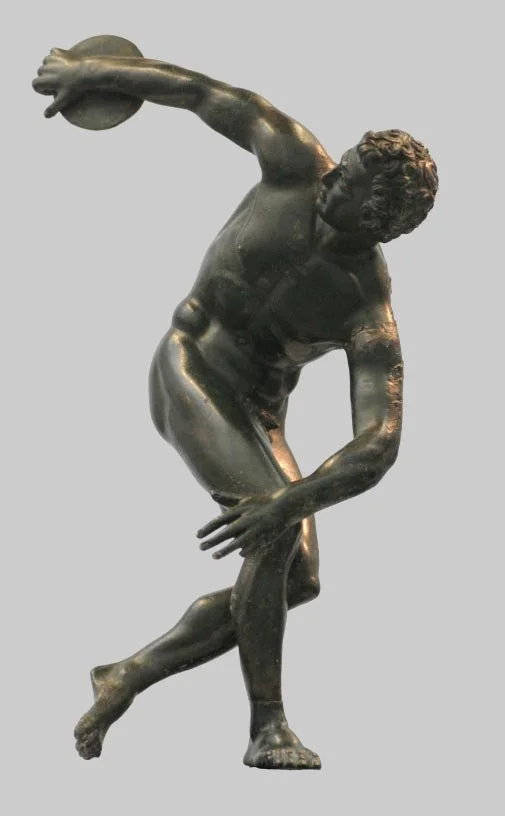
Even in reduced copies, the Discobolus keeps its key idea: motion held in a single controlled instant.
Bronze originals vs copies explains why the Discobolus looks the way it does today
Most of what we see is marble, but the Discobolus was built for bronze logic.
A key fact: Myron’s original Discobolus was likely bronze, and it doesn’t survive. What we study today are mostly Roman marble copies, made because Romans admired Greek art and also because marble was a practical copying material.
Define it simply: a copy is a later reproduction of an earlier work.
Here’s why medium matters. Bronze can hold daring extensions more safely than marble. Marble often needs supports, thicker connections, or structural compromises. So a marble Discobolus can preserve the overall pose while still changing subtle tensions of the original.
That’s why it helps to keep bronze originals vs copies in mind when reading any “famous Greek statue” that survives in marble. We’re often looking at an echo of a lost metal original, with translation effects baked in.
This also changes how we interpret “Classical perfection.” If the original bronze had inlaid eyes or contrasting metals, it may have looked even more lifelike and visually sharp than the marble versions we’re used to. So the Discobolus is not only a sculpture lesson. It’s a survival lesson. What we call “Greek art” is partly shaped by what materials lasted.
The simplest takeaway: the Discobolus’ fame is tied to Roman copying culture, but the innovation belongs to Greek bronze sculpture thinking.
Male nudity and virtue is the cultural context that makes the athlete “important”
The body isn’t nude to be vulnerable, it’s nude to be exemplary.
In Greek visual culture, the athletic nude often functions as a public symbol of excellence. That doesn’t mean every nude statue is “a real athlete.” It means the nude body could be used to signal training, discipline, and moral status.
Define it simply: virtue here is excellence shown through self-control.
That’s why the Discobolus fits so neatly into the wider theme of male nudity and virtue. The sculpture isn’t saying “this is a private body.” It’s saying “this is a civic ideal.” The athlete becomes a model of what a citizen’s body could look like when shaped by training and discipline.
This is also why the Discobolus can feel so “clean” emotionally. The statue isn’t about personal struggle. It’s about controlled performance. Even the most intense movement is presented as measured and composed, a visual expression of the Classical preference for harmony.
And the nudity strengthens the message. Clothing would distract from the idea that the body itself is the proof. In this context, the body is the argument.
So when we call it “Classical athleticism,” we’re not only describing sport. We’re describing a culture that believed physical excellence and moral excellence could belong to the same image.
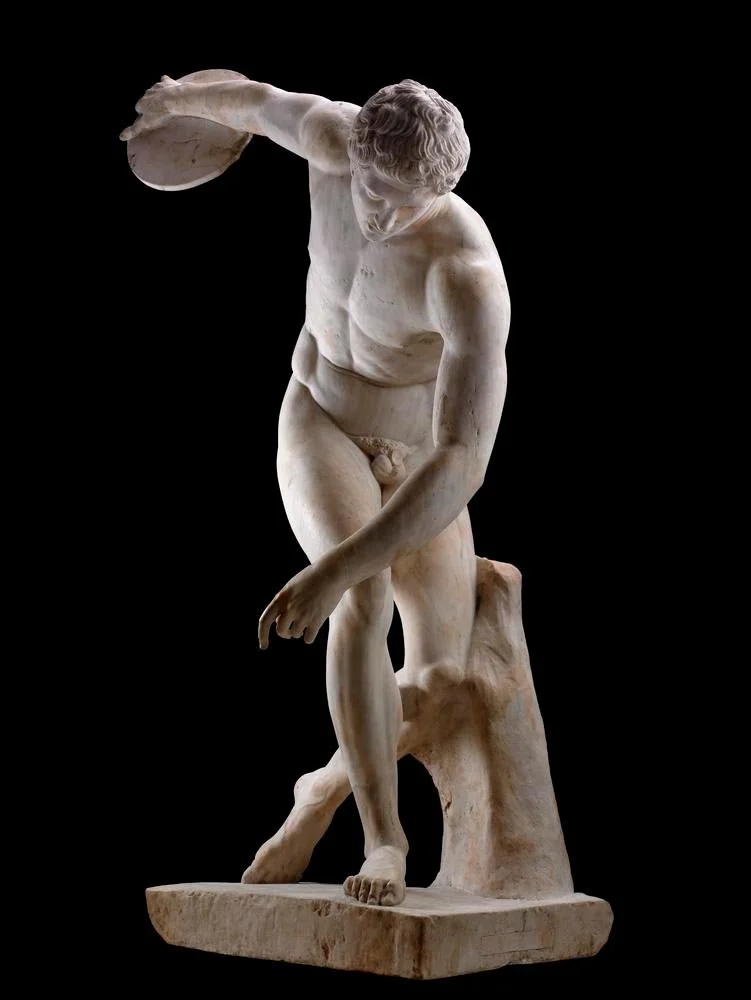
The statue is less about realistic throwing technique and more about perfect balance, tension, and rhythm.
What changed since Archaic bodies becomes obvious when you compare the Discobolus’ twist
It turns the body from a front-facing sign into a three-dimensional event.
The most radical thing about the Discobolus is not the discus. It’s the torsion.
Archaic figures often emphasize stability and frontality, even when they show a step forward. Myron pushes the figure into a twist that forces us to read the body as something happening in space, not something presented like a symbol.
That shift is the core story of what changed since Archaic bodies, and the Discobolus is one of the clearest “look, we can do this now” moments. The body is no longer a diagram. It’s an engineered spiral.
At the same time, the Discobolus doesn’t abandon order. That’s why it becomes iconic rather than chaotic. The twist is extreme, but the sculpture stays coherent. Your eye can follow it. The pose is complex, but the statue still reads as one unified body. That’s the Classical achievement.
So the Discobolus defines Classical motion because it proves a new balance:
the body can move dramatically
without losing harmony
and without needing emotional exaggeration to sell the action
That combination becomes a template for how Western art imagines athletic beauty for a very long time.

Conclusion
Myron’s Discobolus became an icon because it solves a hard problem: how to make motion believable in a still medium without turning the body into visual chaos. It captures potential energy, organizes it into rhythm, and keeps the face calm so the body can do the storytelling.
Once we read it this way, the Discobolus stops being “that famous discus statue.” It becomes a turning point in Classical art: movement as design, athleticism as civic ideal, and sculpture as a machine for convincing the eye.
FAQ
Who made the Discobolus?
Myron, a 5th-century BCE Greek sculptor associated with early Classical innovation.
Is the Discobolus we see today the Greek original?
Usually no. Most surviving versions are Roman marble copies of a lost Greek bronze.
Why is the Discobolus considered “Classical”?
Because it combines intense motion with balance, harmony, and a controlled, calm expression.
Why is the athlete nude?
Because Greek athletic nudity often symbolized excellence and virtue rather than vulnerability.
What’s the main artistic breakthrough of the Discobolus?
It makes a complex twist and imminent action feel coherent and readable from multiple angles.
Sources and Further Reading
British Museum — “Statue: Diskobolos (Discobolus)”.
Smarthistory — “Myron, Discobolus (Discus Thrower)”.
Cambridge University Press (Anna Anguissola) — “Roman copies of Myron’s Discobolus” (2005).
Oxford Classical Dictionary (Andrew F. Stewart) — “Myron (1)” (2015).
The Metropolitan Museum of Art — “The Art of Classical Greece (ca. 480–323 B.C.)” (2008).
Routledge (M. J. O’Mahony) — “In the Shadow of Myron: The Impact of the Discobolus…” (2013).
You may also like