Aphrodite of Knidos: Why This Statue Changed Greek Art
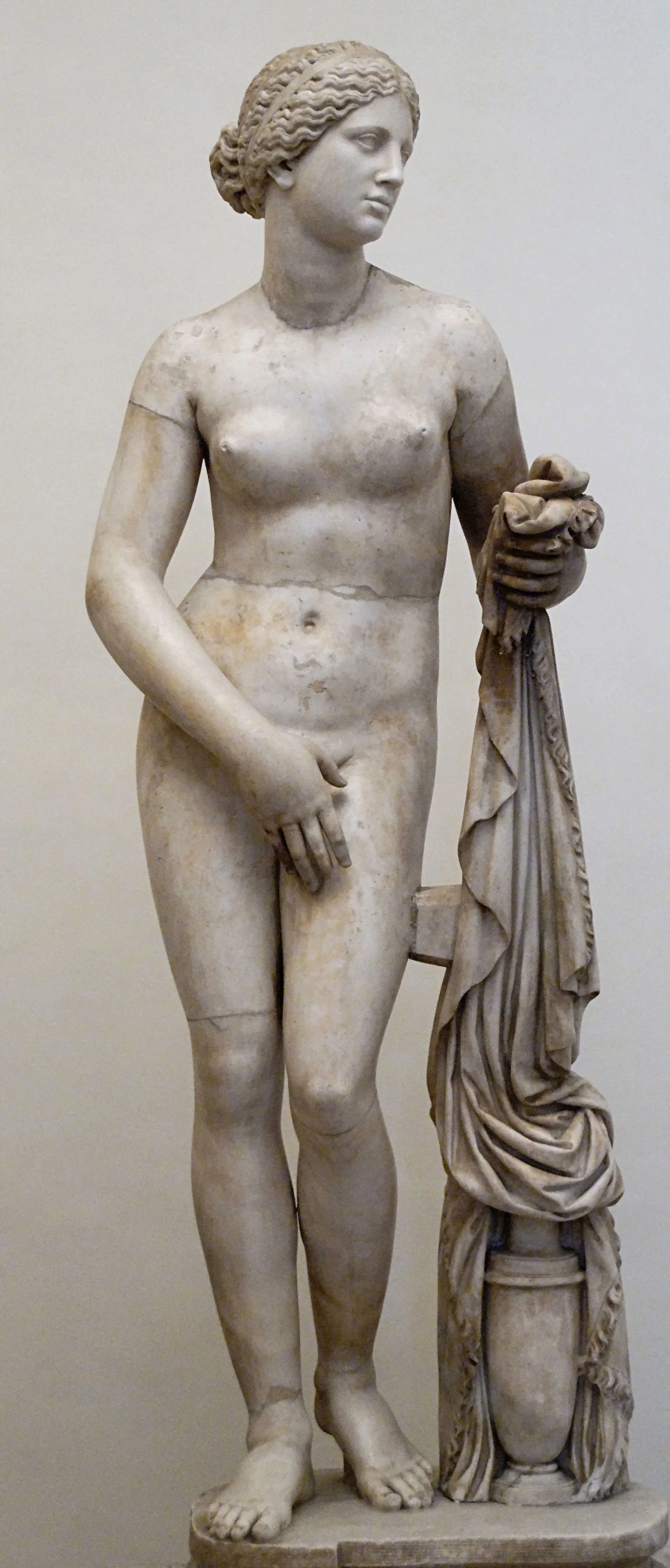
The Aphrodite of Knidos changed Greek art by making the female nude central, monumental, and unforgettable.
The Aphrodite of Knidos changed Greek art because it made something newly central: the monumental female nude. Greek artists had shown male nudity for centuries, but Praxiteles’ Aphrodite gave the Greek world a goddess whose naked body was not marginal, decorative, or secondary. It was the whole point. That single shift changed how beauty, divinity, and the female figure could be imagined in sculpture.
The statue itself is lost, which is part of what makes it so slippery for beginners. What we know comes from Roman copies, ancient descriptions, coins, and later finds connected to its sanctuary. But even through that broken record, its importance is unmistakable. The Aphrodite of Knidos became one of the most famous works of antiquity because it did more than show a beautiful body. It created a new way of seeing a goddess.
It was a statue of Aphrodite, but it did not show divinity in the old way
Before the Aphrodite of Knidos, Greek goddesses were usually shown clothed in major sculpture. That matters because Greek art was not shy about the human body in general. It had long explored idealized male nudity. The fact that female divinity remained largely draped tells you there was a strong visual boundary in place.
Praxiteles breaks that boundary.
His Aphrodite is not simply “undressed.” She appears nude in a way that still feels composed, controlled, and sacred. She is usually reconstructed in a moment associated with bathing, one hand moving to cover the pubic area in what later scholars call the pudica gesture, meaning a modesty pose. That gesture is important because it holds two things together at once: exposure and restraint. The goddess is visible, but not careless. The sculpture invites attention while also shaping how that attention works.
This is one reason the statue changed the history of female Greek statues. It did not simply introduce nudity. It introduced a new emotional formula for nudity: beauty made intimate, divine, and self-aware at the same time.
The sculpture became famous because it felt both sensual and sacred
What made the Aphrodite of Knidos so powerful was not only that it was new. It was that the newness was handled so intelligently.
Praxiteles did not make Aphrodite dramatic in a Hellenistic way or monumental in the older heroic way. He made her graceful, soft, and approachable. The body is idealized, but it does not feel distant. The goddess seems present in a human way without becoming ordinary. That balance is exactly what made the work revolutionary.
This helps explain why the statue matters so much within classical sculpture. It belongs to the late Classical world, where figures begin to feel softer, more relaxed, and more psychologically alive. The Aphrodite of Knidos takes that whole shift and gives it one unforgettable form.
It also changes the history of Greek god statues and ancient Greek statues of gods. A divine figure no longer had to project authority mainly through distance, armor, or drapery. She could project power through presence, bodily beauty, and controlled vulnerability.
That was a radical idea.
Knidos helped make the statue famous, not just the sculptor
The title matters. This is the Aphrodite of Knidos because the statue became associated with the city of Knidos, in Caria, on the coast of Asia Minor. Ancient writers tell us that Praxiteles made two versions of Aphrodite, one draped and one nude. The people of Kos chose the draped version, while the people of Knidos bought the nude one. Whether every detail of that story is exact or not, the tradition itself tells us a lot. The nude figure was understood as bold enough to require explanation.
Knidos then turned that boldness into prestige.
The statue became famous not just as an object, but as a destination. Visitors came to see it. Ancient authors wrote about it. The work seems to have been displayed in a shrine where viewers could move around it, which mattered enormously. This was not a relief or a façade figure. It was a freestanding marble presence designed for full bodily encounter.
That is part of why it had such a long afterlife. It was not just admired. It was experienced.
Even though the original is lost, its influence is everywhere
The original Aphrodite of Knidos no longer survives, but its type does. Roman copies preserve the basic body scheme, and later variations repeat its logic again and again. Once Praxiteles established this image of Aphrodite, the female nude became one of the great recurring themes of later Greek and Roman sculpture.
That means the statue matters far beyond its own date. It helped define a visual tradition. Later Aphrodite figures, and eventually Roman Venuses too, keep returning to the balance it discovered: nudity paired with modesty, ideal beauty paired with bodily immediacy.
This is also why the work belongs in the bigger story of ancient Greek sculpture. It is not just one famous masterpiece. It is a turning point.

Conclusion
The Aphrodite of Knidos changed Greek art because it made the female nude central, monumental, and unforgettable. It redefined how a goddess could appear, how beauty could function in sculpture, and how viewers could relate to divine presence. Instead of treating Aphrodite as a distant symbol, Praxiteles gave her a body that felt ideal, intimate, and alive.
That is why the statue became famous in antiquity and stayed famous long after the original disappeared. It did not just represent beauty. It changed its visual language.
FAQ
What is the Aphrodite of Knidos?
It is a famous lost Greek statue of Aphrodite made by Praxiteles, known today through Roman copies and ancient descriptions.
Why is the Aphrodite of Knidos important?
It is important because it was the first major monumental Greek statue to show a goddess nude, changing the history of Greek sculpture.
Who made the Aphrodite of Knidos?
It is attributed to Praxiteles, one of the most important sculptors of the 4th century BCE.
Where was the Aphrodite of Knidos located?
It was displayed at Knidos, in a sanctuary connected to Aphrodite, and became famous as a work people traveled to see.
Does the original statue still exist?
No. The original is lost, but Roman copies and ancient sources preserve its general appearance and importance.
Was the Aphrodite of Knidos originally painted?
Like many Greek marble statues, it may well have had painted details, even though the surviving copies now look plain white.
Sources and Further Reading
Encyclopaedia Britannica — “Aphrodite of Cnidus” (2026) (Encyclopedia Britannica)
The Metropolitan Museum of Art — “The Art of Classical Greece (ca. 480–323 B.C.)” (2008) (The Metropolitan Museum of Art)
Smarthistory — “Capitoline Venus (copy of the Aphrodite of Knidos)” (n.d.) (Smarthistory)
Encyclopaedia Britannica — “Cnidus” (2026) (Encyclopedia Britannica)
Encyclopaedia Britannica — “Temple of Aphrodite” (2026) (Encyclopedia Britannica)
You may also like