Hellenistic Sculpture: Why It Feels More Emotional and Theatrical
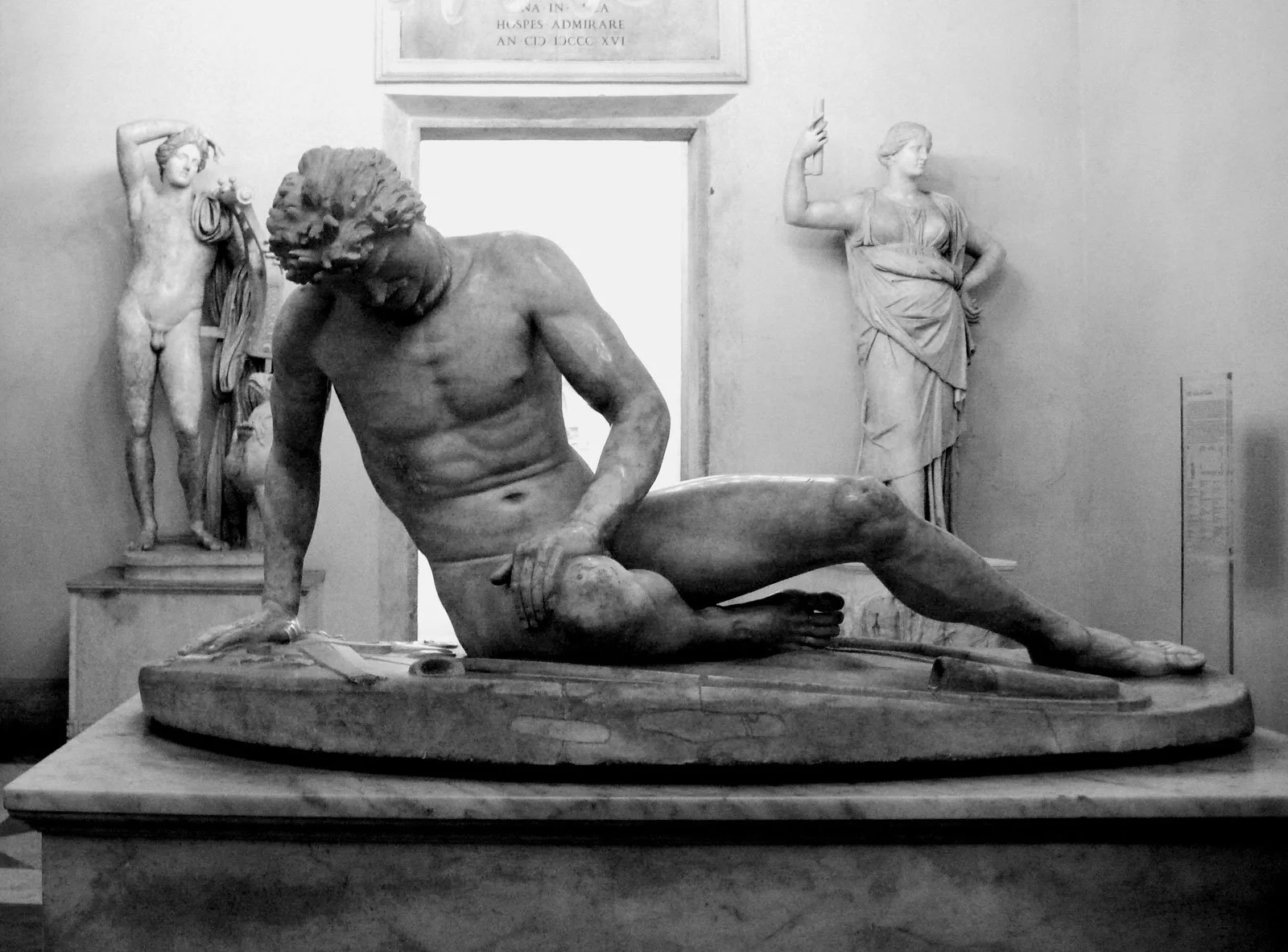
The Dying Gaul makes Hellenistic sculpture feel intensely human by combining pain, defeat, and dignity.
If Classical sculpture feels balanced, Hellenistic sculpture feels like balance under pressure. Bodies twist harder. Faces react more openly. Muscles strain, drapery whips, and the figure often seems caught in the middle of something rather than calmly existing outside time. That is the basic reason Hellenistic sculpture feels more emotional and theatrical than earlier Greek work.
In simple terms, Hellenistic Greek sculpture is the sculptural art of the Greek world after Alexander the Great, usually dated from 323 to 31 BCE. It grows directly out of earlier classical sculpture, but it pushes Greek art toward greater drama, stronger movement, wider subject matter, and a much more visible emotional range. It still knows how to make ideal bodies. It just no longer treats calm perfection as the only goal worth pursuing.
That is why these works can feel so alive. Hellenistic statues do not only show the body. They show the body responding: to pain, wind, struggle, desire, exhaustion, victory, danger, age, or sheer physical effort. Once you notice that shift, Hellenistic sculpture stops looking like a “late” version of Greek art and starts feeling like one of its boldest reinventions.
Hellenistic sculpture is still Greek sculpture, but the mood changes completely
The first thing to keep clear is that Hellenistic sculpture does not abandon Greek art. It extends it.
Everything that earlier Greek sculptors had already learned still matters here: anatomy, proportion, bodily structure, contrapposto, carving, bronze casting, and the ability to turn stone or metal into something convincing. Hellenistic sculptors inherit the long history of ancient Greek sculpture, and they inherit it at a very high level of technical confidence.
What changes is the emotional temperature.
Earlier Classical art often aims for stability, clarity, and controlled ideal beauty. Even active figures usually hold themselves together with remarkable calm. Hellenistic sculpture keeps that skill but loosens the restraint. The body can now look unstable, interrupted, or fully absorbed in an event. The face can show stronger feeling. The composition can push outward into real space rather than staying neatly contained.
That is why the period feels more theatrical. Theatrical here does not mean fake. It means sculptors care more openly about effect. They want the viewer to feel force, tension, suspense, pathos, or surprise. The statue becomes less like an isolated ideal and more like a scene unfolding in front of us.
So the question is not whether Hellenistic sculpture is still Greek. It absolutely is. The real question is what Greek sculpture becomes once it allows itself to be more intense.
The body stops posing and starts reacting
This is one of the clearest differences between Hellenistic and earlier Greek sculpture.
A Classical figure often feels complete in itself. It stands, turns, or moves in a way that still feels resolved. A Hellenistic figure more often feels interrupted by life. It reacts. It recoils. It lunges. It collapses. It leans into a force outside itself. That may sound like a small change, but it transforms the whole experience of looking.
You can feel it in the way torsos twist more sharply, in how limbs project into space, and in how balance becomes less serene and more precarious. The body is no longer only a structure to admire. It becomes a place where pressure is visible.
That pressure can take different forms. It may be physical, as in battle scenes or athletic strain. It may be emotional, as in grief or fear. It may even be environmental, as in sculptures where wind seems to shape the drapery and the body together. In all these cases, the figure feels less like a timeless type and more like a being caught in time.
This is why a single Greek statue from the Hellenistic world can feel so immediate. It often suggests what just happened, what is happening now, and what might happen next. The viewer is pulled into a sequence, not just presented with a finished ideal.
And that is one of the biggest secrets of Hellenistic sculpture: it does not simply represent life. It stages life under tension.
Emotion moves closer to the surface, and the face matters more
Hellenistic sculpture feels more emotional because emotion becomes easier to see.
Classical Greek sculpture is not emotionless, but it often keeps feeling under control. Hellenistic sculptors are more willing to let inner states register outwardly. The face can strain, the mouth can part, the brow can tighten, the eyes can deepen, and the whole head can become more active in carrying the meaning of the figure.
This is especially clear in works associated with pain or crisis, such as Laocoön and His Sons, where the emotional force is inseparable from the bodily struggle. But Hellenistic emotion is not only about agony. It can also be tenderness, weariness, drunkenness, longing, or sensuality. That is what makes the period so rich. It opens up the emotional vocabulary instead of just turning up the volume.
A famous example is the Boxer at Rest. His face is not ideal calm. It is battered, exhausted, and alert at the same time. Cuts and swelling matter. The body still shows strength, but strength is no longer abstract. It has been tested. That single shift changes the whole mood of the sculpture.
This is also where Hellenistic art becomes more psychologically interesting. The figure may still be idealized, but it often feels like it has an inner life that is not fully contained by ideal form. That inner life can remain mysterious, but it is present.
So when Hellenistic sculpture feels more human, it is not only because bodies move more dramatically. It is because feelings are allowed to register more openly across the whole figure.
Drapery, hair, and surface all become part of the drama
One of the best ways to spot Hellenistic style sculpture is to stop looking only at anatomy.
Hellenistic sculptors often use drapery, hair, and surface detail as active parts of the composition. Fabric does not just cover the body. It helps describe force, weather, motion, rhythm, and mood. Hair does not just sit on the head. It can fly outward, cling to the face, or intensify a sense of movement.
The Nike of Samothrace is the classic example. The body is already dynamic, but the sculpture would not feel the same without the drapery. The cloth stretches tight across some forms and explodes into folds around others, making wind itself feel sculptural. The result is not just a victorious figure. It is a figure arriving through resistance.
This is where Hellenistic sculpture becomes especially theatrical. It does not rely on one expressive tool. It layers them. Pose, anatomy, fabric, texture, and directional force all work together. The statue starts behaving almost like a visual event.
Surface matters in quieter works too. A Hellenistic female figure may not be violently dramatic, but the treatment of skin, cloth, and transition across the body can create a richer sensual presence than we often find in earlier Classical sculpture. The point is not simply more detail. The point is that detail now does more emotional work.
That is one reason the period can feel closer to later European art. The sculptor does not only build a form. The sculptor orchestrates effects.
The range of subjects gets wider, and that makes the sculpture world feel more alive
Hellenistic sculpture does not only change how it shows people. It changes who gets shown.
Earlier Greek sculpture often centers on gods, heroes, athletes, and ideal youths. Hellenistic sculpture still includes all of those, but it adds much more. Children, old people, defeated enemies, ordinary workers, drunken figures, portraits, and bodies marked by fatigue or social difference all enter the field more visibly.
That widened range matters because it changes the emotional possibilities of sculpture. Once art admits more kinds of bodies and more kinds of experiences, it also admits more kinds of response.
The Dying Gaul is a good example. He is not a triumphant Greek athlete. He is a defeated foreign enemy. Yet the sculpture asks us to see him with seriousness and dignity. That is a powerful emotional shift. The drama does not come only from motion. It comes from empathy.
Portrait sculpture also becomes more interesting in the Hellenistic world. Rulers still want idealized images, but portraits can now carry sharper individuality. The face may suggest calculation, age, fatigue, or authority more directly. The result is a more varied sculptural world, one less tied to a single model of perfect bodily beauty.
This is also why Hellenistic sculpture can feel more modern. It does not assume that the only worthy subject is the fully ideal figure. It opens the door to bodies shaped by story, status, and circumstance.
Bronze plays a major role in the period’s energy
If Hellenistic sculpture feels more dynamic, material has a lot to do with it.
Bronze is especially important here because it can hold more daring projections, thinner forms, and sharper spatial effects than marble can easily support. That makes it ideal for a sculptural world interested in movement, outward-reaching limbs, and strongly activated space. Many of the most vivid Hellenistic works were created in bronze, even if what survives today is often uneven.
This is exactly why Greek bronze statues matter so much for understanding the period. Bronze allows for a more immediate kind of physical energy. A boxer can sit with tense openness. A ruler can stand in a more projecting pose. A god can seem lighter, quicker, or more unstable. The medium supports the period’s appetite for drama.
Bronze also encourages detail. Inlays, mixed metals, and surface variation can heighten realism and emotional force. Lips, wounds, eyes, and other details can all become more convincing and more striking. That helps explain why Hellenistic bronze sculpture could be so affecting in person.
Marble still matters, of course, especially in famous statues like the Venus de Milo, but the larger point remains: Hellenistic sculpture’s emotional and theatrical range is closely tied to the possibilities of its materials. It is not just a matter of style. It is also a matter of what sculptors could make bodies do.
Color mattered too, even if museums make us forget it
It is easy to imagine Hellenistic statues as pure white marble because that is how many of them now appear in museums. But that image is incomplete.
Like earlier Greek sculpture, many Hellenistic works had color, added details, metal attachments, or richer surface effects than the bare stone suggests today. That means the original visual experience was often stronger and more layered than the modern museum version.
This is where painted Greek statues are worth keeping in mind. Color could clarify eyes, lips, garments, hair, wounds, and decorative edges. In other words, it could intensify exactly the kinds of emotional and theatrical effects Hellenistic sculpture already favored.
That matters because Hellenistic sculpture is often discussed as if its drama comes only from pose. In reality, the full impact would also have come from surface finish, color, contrast, and material richness. A battle-worn boxer, a windblown victory, or a sensuous goddess would not have been experienced as silent white abstractions.
Once you restore color mentally, the period makes even more sense. Hellenistic sculptors were not aiming for minimalism. They were creating presence.
Not every Hellenistic statue is loud, but even the quieter ones feel less sealed than Classical sculpture
This correction matters.
Hellenistic sculpture is famous for strong emotion, but not every work is extreme. Some are gentle, elegant, or restrained. The difference is that even quieter Hellenistic works usually feel less self-contained than Classical ones. They often carry a softer instability, a richer bodily presence, or a subtler emotional charge.
The Venus de Milo is a good example. She is not writhing in pain or lunging into battle. Yet she still feels different from a fifth-century goddess. The body is more tactile, the twist is more suggestive, and the whole figure has a slightly more open relationship to space. She belongs to a world in which beauty can be more sensuous and less formally closed.
That is why Hellenistic sculpture should not be reduced to one formula. What defines it is not constant noise. It is expanded expressive range. It can be violent or serene, monumental or intimate, sharply dramatic or quietly charged. What unites the period is the willingness to explore more emotional and spatial possibilities than earlier Greek sculpture usually allowed itself.
So the best way to understand Hellenistic sculpture is not to ask whether it is always theatrical. It is to ask how it makes the viewer feel a stronger sense of life pressing against form.
Hellenistic sculpture matters because it changes what Greek sculpture can be
This is the deepest takeaway.
Hellenistic sculpture matters because it proves Greek sculpture is not one timeless language of calm ideal beauty. It is a flexible tradition capable of absorbing emotion, social variety, bodily instability, and visual spectacle without losing technical intelligence.
That matters inside Greek art itself, because it expands the legacy of ancient Greek art. It also matters beyond Greece, because Roman collectors, patrons, and artists inherit a world already shaped by Hellenistic taste. Much later sculpture, too, will keep returning to these works whenever artists want bodies that feel intense, vulnerable, or dramatically alive.
For beginners, Hellenistic sculpture is often the moment Greek art suddenly becomes emotionally immediate. You no longer need to admire it only from a distance. You can feel pulled into it.
And that may be the most useful way to say it: if Classical sculpture often invites admiration, Hellenistic sculpture more often invites participation. It wants your eye, your body, and your sympathy.

Conclusion
Hellenistic sculpture feels more emotional and theatrical because it pushes Greek sculpture beyond calm ideal balance and into a wider world of movement, pressure, feeling, and staged effect. Bodies react instead of simply posing. Faces show more. Drapery and surface join the drama. Subjects become more varied. Bronze and color intensify the experience. Even quiet works feel more open, more tactile, and less sealed off from lived life.
Once you see that shift, Hellenistic statues stop looking like a late echo of Classical Greece. They become what they really are: Greek sculpture at the moment it discovers how to turn beauty into event.
FAQ
What is Hellenistic sculpture in simple terms?
It is the sculpture of the Greek world after Alexander the Great, known for stronger emotion, more movement, and a wider range of subjects than earlier Classical sculpture.
Why does Hellenistic sculpture feel more emotional?
Because it shows more visible feeling in faces, bodies, and compositions, including pain, exhaustion, tension, and sensuality.
How is Hellenistic sculpture different from Classical sculpture?
Classical sculpture usually prefers balance, restraint, and ideal calm, while Hellenistic sculpture often prefers stronger drama, spatial movement, and emotional intensity.
Were Hellenistic statues still idealized?
Yes. Many still use idealized bodies, but they combine that idealization with more visible pressure, individuality, or narrative force.
Why are bronze statues important for Hellenistic sculpture?
Bronze allows more daring poses, thinner extensions, and richer surface details, which suit the period’s energetic and theatrical style.
Is every Hellenistic sculpture dramatic?
No. Some are quiet and elegant. The key difference is that the period allows a much wider expressive range, even in its calmer works.
You may also like