Hellenistic Art: Why It Feels More Dramatic Than Classical Art
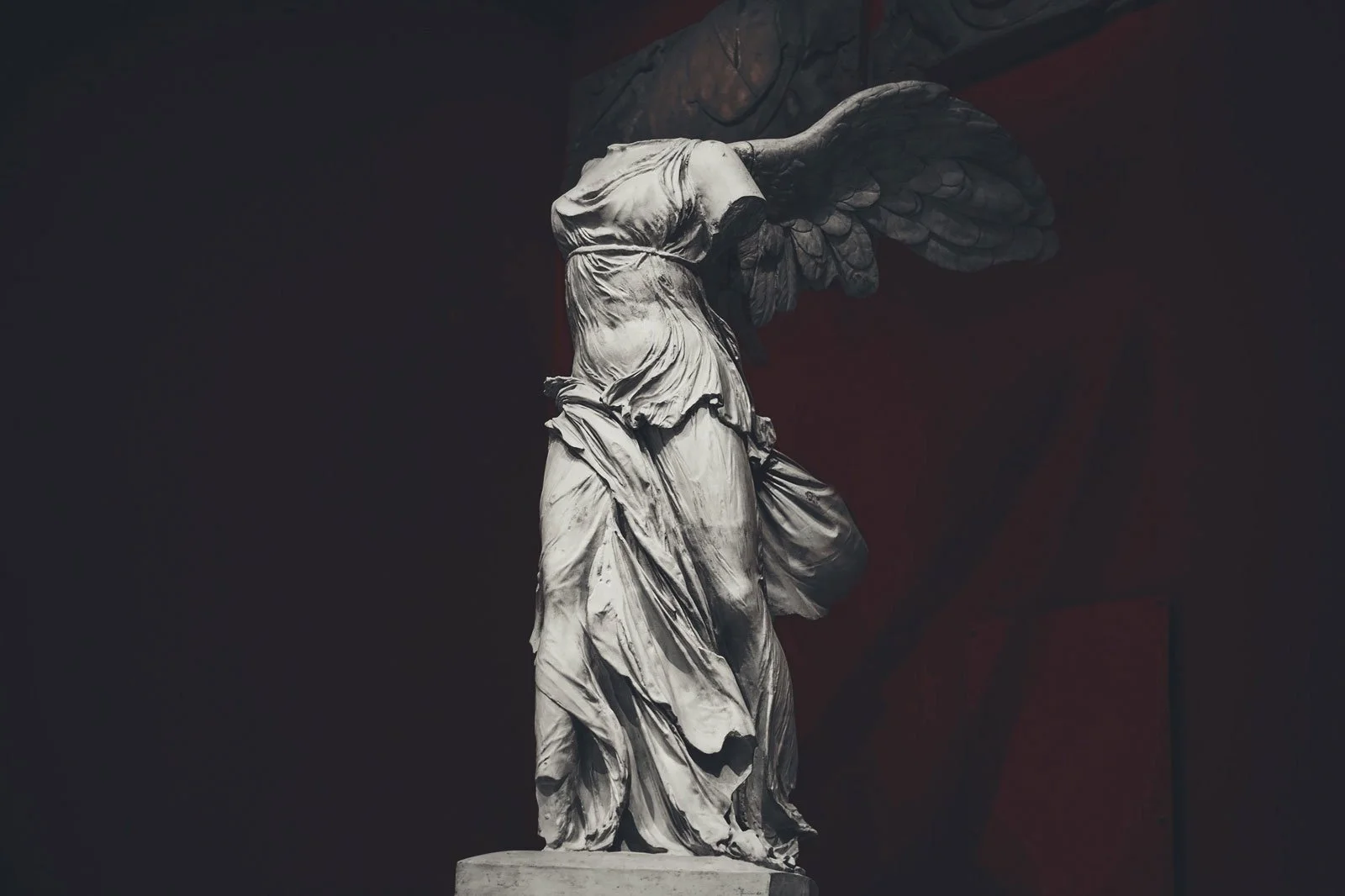
The Nike of Samothrace shows how Hellenistic art turns movement, wind, and victory into pure drama.
There is a reason Hellenistic art can feel almost cinematic when you first meet it. Bodies twist harder. Faces react more openly. Drapery whips through space. Old age, pain, desire, exhaustion, victory, and defeat all become more visible than they usually were in earlier Greek art. If Classical art often feels calm, balanced, and self-controlled, Hellenistic art feels more charged. It wants to move you, not just impress you.
In simple terms, Hellenistic art is the art of the Greek world after Alexander the Great, usually dated from 323 to 31 BCE. It grows out of the Classical tradition, but it pushes that tradition into a wider emotional range. The ideal body does not disappear. Beauty does not disappear. But Greek artists begin exploring drama, movement, tension, individuality, and the unstable moments of life much more openly.
That is why the art of the Hellenistic age feels so different from classical art. It belongs to a bigger, more mixed, more urban world, and it starts asking for a bigger emotional vocabulary too.
Definition: Hellenistic art feels more dramatic than Classical art because it turns up movement, emotion, contrast, and theatrical impact while expanding the range of subjects Greek art is willing to show.
Hellenistic art is still Greek art, but it changes the emotional temperature
The first thing to understand is that Hellenistic art does not reject Greek art. It extends it.
That matters because beginners sometimes imagine a clean break: Classical art is one thing, Hellenistic art is another, end of story. The real shift is more subtle and more interesting. Hellenistic artists inherit the achievements of earlier ancient Greek art: proportion, anatomical clarity, control of stone and bronze, idealized bodies, and a deep understanding of how forms work in space. But they use those tools differently.
If Classical Greek art often aims for harmonia, meaning balanced visual order, Hellenistic art often aims for intensity. It still knows how to be beautiful, but it no longer treats calm as the highest default mood. The body can now strain, collapse, twist, stagger, reach, recoil, or lean into a moment of extreme feeling.
This is why Hellenistic Greek art often feels more immediately “human” to modern viewers. It is less afraid of instability. It lets the body show effort. It lets the face show pain or excitement. It lets the scene feel like something is happening right now, not simply existing in an ideal state.
That change is one of the clearest differences between Hellenistic art and classical sculpture. Earlier Greek art often gives us figures that feel complete and self-contained. Hellenistic art often gives us figures caught in the middle of an event, a feeling, or a physical struggle. The ideal no longer has to look untouchable. It can now tremble, suffer, seduce, or surprise.
The world behind Hellenistic art is bigger, and the art feels bigger too
Hellenistic art becomes more dramatic because the Hellenistic world itself becomes wider, more mixed, and more ambitious.
After Alexander’s conquests, Greek culture spreads across a huge region that includes Egypt, the Near East, and parts of Asia. The Greek-speaking world is no longer centered only on the old city-state system. It becomes a network of kingdoms, royal courts, major cities, long-distance trade routes, and culturally mixed populations. Art now operates inside a world of larger audiences, stronger rulers, and more varied experiences.
That change affects what art needs to do. In a royal court, art can become more spectacular. In a huge city, monuments need stronger visual impact. In a mixed cultural landscape, artists encounter new tastes, new materials, new forms of patronage, and new types of subject matter. The result is a style that often feels more expansive, more experimental, and more visually assertive.
This is one reason Hellenistic style art can feel more theatrical. Theatrical here does not mean fake. It means art becomes more conscious of staging, impact, and emotional effect. A sculpture is no longer only an ideal figure placed in space. It may be a drama unfolding in space, designed to catch the viewer from multiple angles and to create a stronger physical response.
The Hellenistic world also encourages variety. Instead of one dominant civic mood, we get many centers of production, many patrons, and many local versions of Greek visual culture. That helps explain why Hellenistic art can include both monumental violence and tender intimacy, both royal luxury and scenes of ordinary life.
Movement becomes more complex, and the body starts acting rather than just standing
One of the fastest ways to feel the Hellenistic shift is to look at movement.
Earlier ancient Greek sculpture had already learned how to make bodies feel alive. Classical artists understood contrapposto, anatomy, and poised balance brilliantly. But Hellenistic artists often push movement further. They are more willing to show a body in unstable action, in deep twist, or in a moment of sharp transition.
You can see this in works like the Nike of Samothrace, where the figure seems to land against the wind, with drapery blown tightly across the body and streaming away from it at the same time. The sculpture does not just represent a goddess. It creates an event. The viewer feels pressure, air, motion, and forward force all at once.
The same is true of the Dying Gaul. The figure is not standing in ideal equilibrium. He is sinking. His body turns and collapses inward. The scene asks us to read a moment of defeat, pain, and dignity together. This is very different from the more stable bodily logic that often governs Classical art.
That is one of the signatures of Hellenistic artwork: the body becomes more narrative. It does not merely display beauty or proportion. It tells us what has just happened, what is happening, or what is about to happen. Limbs reach outward. Torsos rotate more sharply. Figures claim more surrounding space.
The result is a body that behaves less like a self-contained ideal and more like a participant in time.
Emotion moves closer to the surface, and that changes everything
This is probably the most famous thing about Hellenistic art. It lets emotion show more openly.
Classical art is not emotionless, but it usually keeps emotion under control. Even active figures often retain a calm face, a measured body, and an overall sense of order. Hellenistic art keeps the technical skill but relaxes that emotional restraint. It becomes more willing to show suffering, ecstasy, tension, fear, longing, old age, drunkenness, and vulnerability.
This is where the comparison with classical art becomes especially useful. Classical Greek art often asks us to admire the figure. Hellenistic art often asks us to feel with it.
The most extreme example is probably Laocoön and His Sons, where pain is no longer quiet. It is carved into the body and the face with full force. Muscles strain, heads turn, limbs resist, and the whole composition tightens around crisis. Even if you know nothing about the myth, the sculpture communicates struggle instantly.
But Hellenistic emotion is not only about agony. It can also be tender, sensual, playful, or introspective. The Barberini Faun feels abandoned to sleep. The Venus de Milo is more composed, but still carries a new softness and bodily presence that would feel different from the stricter logic of earlier Classical form. Portraits also become more individualized, suggesting age, thought, wear, or social role more directly.
This widening of emotion is one reason Hellenistic art feels so rich. It no longer assumes that greatness must always look serene. It allows greatness, beauty, or humanity to look strained, fragile, or psychologically complex.
The subject matter widens, and Greek art starts looking at more kinds of people
Hellenistic art also feels more dramatic because it broadens what is worth showing.
Earlier Greek art often focuses on gods, athletes, heroes, ideal youths, and highly controlled public identities. Hellenistic art still includes those subjects, but it adds much more. It becomes interested in children, elderly bodies, portraits, foreigners, drunken figures, theatrical characters, and scenes of poverty or social marginality. Not every example is realistic in a modern sense, but the range becomes much wider.
This matters because drama is not only a matter of pose. It is also a matter of what enters the field of art.
An elderly market woman carrying goods can create a different kind of intensity from a victorious athlete. A battered boxer, like the Boxer at Rest, produces a different emotional response from an idealized god. A ruler portrait can blend ideal beauty with sharper individual identity. The viewer is no longer asked to admire one narrow model of perfection. The viewer is asked to confront a more varied human world.
That does not mean Hellenistic art becomes “democratic” in a modern sense. It still serves kings, elites, sanctuaries, and major public spaces. But it becomes more willing to look beyond the old heroic default. And once art admits more kinds of people, it also admits more kinds of feeling.
This is one reason the period is so important for later visual culture. It proves that Greek art can be emotionally intense without giving up technical brilliance. It can remain highly crafted while becoming more socially and psychologically varied.
Space becomes more theatrical, and viewers are asked to move around the work
Hellenistic art often feels dramatic because it is less satisfied with a single perfect viewpoint.
Classical sculpture can certainly be rich from many angles, but it often preserves a stable frontality or a clear organizing axis. Hellenistic sculpture more often invites, or even forces, the viewer to move. Limbs project outward. Drapery opens into space. Figures turn, spiral, or interlock in ways that make the work unfold gradually as you walk around it.
This is especially important in large sculptural groups. A Hellenistic group may not reveal itself all at once. It may be designed as a sequence of discoveries: a face from one angle, a wound from another, a dramatic crossing of limbs from another. The sculpture becomes spatially active.
That is where the “theatrical” feeling deepens. Hellenistic art does not only stage emotion inside the figure. It stages emotion between the figure and the viewer.
Architecture and setting matter here too, even when we are focusing mostly on sculpture. A dramatic sculpture placed in a sanctuary, a city, or a royal environment can work almost like a performance image, amplifying movement and emotional effect through scale and placement. The Hellenistic world liked visual impact, and its art often behaves accordingly.
So if a work of Hellenistic Greek art feels like it is pushing outward into your space rather than resting quietly inside its own, that is not an accident. It is one of the period’s strongest habits.
Hellenistic art is not only sculpture, and its drama also appears in painting and luxury arts
Sculpture tends to dominate the conversation, but Hellenistic art is not sculpture alone.
The period also matters for painting, mosaics, metalwork, glass, terracotta, and luxury objects. That wider artistic world helps us understand why Hellenistic taste feels so varied and sensorial. A larger, wealthier, more connected world encourages experimentation across media.
This is where Greek paintings and ancient Greek paintings become especially useful reference points. Very little ancient panel painting survives, but later copies and related works suggest that Hellenistic painters were deeply interested in illusion, space, light, and narrative complexity. The famous Alexander Mosaic, though Roman in date, probably preserves the memory of a much earlier Greek painting tradition that already knew how to build drama through crowded action, directional movement, and intense psychological focus.
Mosaics matter for the same reason. They can create detailed scenes full of texture, shading, and visual tension. The Hellenistic world seems to enjoy richness, contrast, and the sensation of looking into another space. Painting and mosaic support that taste perfectly.
Luxury arts tell a similar story. Jewelry, vessels, and decorative objects become more elaborate and often more technically ambitious. This does not just reflect wealth. It reflects a broader Hellenistic appetite for refinement, display, and visual complexity.
So when we talk about the drama of Hellenistic art, we should not imagine only marble groups. We should imagine a whole artistic climate in which intensity, richness, illusion, and emotional effect become more desirable across many media.
Not every Hellenistic work is loud, but even its quieter works feel different from Classical art
This is an important correction.
Hellenistic art is famous for drama, but not every Hellenistic work is extreme. Some are gentle, elegant, or restrained. The period includes softness as well as spectacle. The difference is that even its quieter works often feel less bound to the old Classical ideal of stable perfection.
Take the Venus de Milo. She is not screaming, collapsing, or twisting violently. Yet she still feels different from a fifth-century Classical goddess. The body carries a more complex softness, a richer bodily presence, and a slightly more unstable sense of movement. She belongs to a world in which beauty can be more tactile, more sensuous, and less rigidly self-contained.
This is why it helps to avoid reducing Hellenistic art to one formula. Its true character is not just “lots of emotion.” It is expanded expressive range. It can be violent or tender, monumental or intimate, crowded or quiet. What unites the period is not a single mood but a larger willingness to explore.
That is also why the transition from classical sculpture to Hellenistic art is so fascinating. Hellenistic artists do not destroy the Classical inheritance. They keep testing its edges, stretching it into new emotional and visual territory.
Hellenistic art matters because it changes what Greek art can do
This is the biggest takeaway.
Hellenistic art matters because it proves that Greek art is not one timeless standard of calm ideal beauty. It is a living tradition that can become more emotional, more varied, more theatrical, and more psychologically open without losing technical discipline.
It also matters because later Roman art inherits a world already shaped by Hellenistic taste. Dramatic composition, expressive bodies, luxury display, portrait individuality, and rich visual storytelling do not disappear with the Hellenistic age. They travel forward.
For modern viewers, Hellenistic art is often the Greek art that feels most immediately gripping. It looks back to the Classical tradition, but it also looks forward to later visual cultures that care deeply about emotion, spectacle, and narrative force.
So if Classical art teaches us how Greek artists built ideal order, Hellenistic art teaches us how they made that order vibrate, strain, and come alive in new ways.

Conclusion
Hellenistic art feels more dramatic than Classical art because it widens the emotional, physical, and visual range of Greek art. Bodies move more forcefully. Feelings become more visible. Subjects become more varied. Space becomes more active. Painting, mosaics, and luxury arts join sculpture in creating a world that is richer, more theatrical, and more psychologically charged.
Once you see that shift, Hellenistic art stops looking like a late afterthought to Classical greatness. It becomes something more exciting: the moment Greek art learns how to heighten emotion without giving up intelligence, craft, or beauty.
FAQ
What is Hellenistic art in simple terms?
It is the art of the Greek world after Alexander the Great, known for stronger emotion, greater movement, and more varied subject matter than Classical art.
Why does Hellenistic art feel more dramatic?
Because it often shows intense movement, visible feeling, theatrical composition, and more unstable or emotionally charged moments.
Is Hellenistic art still Greek art?
Yes. It grows directly out of earlier Greek traditions, but it uses those traditions in a wider and more expressive way.
How is Hellenistic art different from Classical art?
Classical art usually prefers balance, restraint, and ideal calm, while Hellenistic art often prefers stronger emotion, more dynamic poses, and a broader range of subjects.
Is all Hellenistic art emotional and extreme?
No. Some Hellenistic works are quiet and elegant. The key difference is that the period allows a much wider expressive range.
What are famous examples of Hellenistic art?
Well-known examples include the Nike of Samothrace, the Dying Gaul, the Venus de Milo, Laocoön and His Sons, the Boxer at Rest, and the Alexander Mosaic.
Sources and Further Reading
The Metropolitan Museum of Art — “Art of the Hellenistic Age and the Hellenistic Tradition” (2007)
Smarthistory — “Empire and Art in the Hellenistic world (c. 350–31 B.C.E.)” (n.d.)
Encyclopaedia Britannica — “Hellenistic age: The arts” (2026)
Encyclopaedia Britannica — “Western sculpture: Hellenistic period” (2026)
The Metropolitan Museum of Art — “Painted Funerary Monuments from Hellenistic Alexandria” (2007)
The Metropolitan Museum of Art — “Art of the Hellenistic Kingdoms: From Pergamon to Rome” (2021)
You may also like