Greek Marble Sculpture: Why It Looks So Smooth, Soft, and Alive
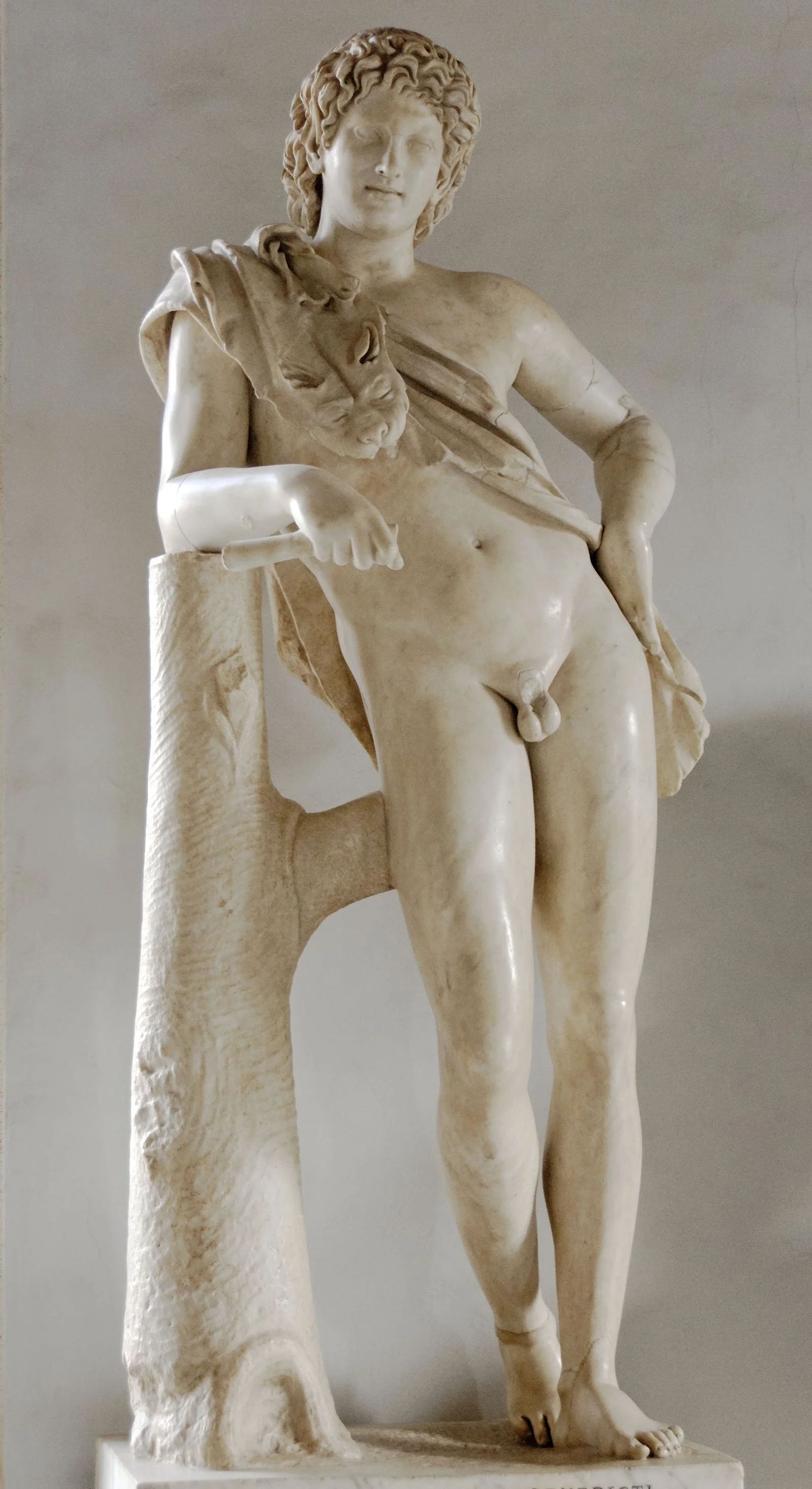
This satyr captures the softer, more relaxed mood often linked to Praxiteles.
Greek marble sculpture can feel strangely impossible the first time you really look at it. Stone should feel hard, cold, and resistant. But many Greek statues seem to do the opposite. Skin looks soft. Bodies seem to breathe under the surface. Drapery feels light even when it is carved from a heavy block. That is not an accident. It is the result of material, carving, finish, light, and a whole Greek way of thinking about ideal beauty.
So the short answer is this: Greek marble sculpture looks lifelike because Greek artists knew how to use marble’s special qualities to create smooth transitions, controlled surfaces, and a powerful sense of bodily presence. They were not making stone “realistic” in a modern documentary sense. They were shaping it so the figure would feel clear, harmonious, and alive to the human eye.
That is why Greek marble statues still have such force. They are not only beautiful objects. They are carefully engineered experiences of touch, light, and ideal form.
Praxiteles was a 4th-century Greek sculptor, but his fame comes through copies and texts
This is the first thing to understand clearly. Praxiteles was an Athenian sculptor active in the 4th century BCE, usually placed around 370 to 330 BCE. He belongs to the later phase of classical art, when Greek sculpture starts becoming softer and more psychologically subtle.
But there is a twist. Like many great Greek sculptors, Praxiteles is famous even though very little can be securely tied to his own hand. What we know about him comes from a combination of ancient writers, inscribed bases, later references, and Roman copies of lost Greek originals. That means his reputation is both real and complicated.
This matters because when people ask, “Who was Praxiteles?”, the answer is not just “a man with a few famous statues.” He is also a case study in how Greek art history works. Many of the works that shaped his legacy survive only indirectly. We are often reconstructing his style through echoes.
Still, those echoes are powerful enough that his artistic personality is remarkably clear. Even through copies, Praxiteles has a recognizable mood. His figures tend to feel relaxed, slim, and delicately modeled. They often lean rather than simply stand. Their surfaces feel smooth and almost skin-like. Their beauty is not severe. It is gentle.
That is why he stands out even within the broader story of ancient Greek sculpture. He is not just another skilled sculptor. He is one of the artists who changes the emotional temperature of Greek sculpture itself.
His style is graceful, soft, and quietly sensual
The easiest way to recognize Praxiteles’ style is to notice what is missing: hardness, tension, and emotional distance.
Praxiteles does not usually build bodies like monuments. He builds them like presences. His figures often have a relaxed posture, a gentle sway, and a softness that makes marble feel less like stone and more like flesh. This is one reason his work is so often described as graceful or sensuous.
A key term here is contrapposto, meaning weight shifted onto one leg. Earlier Greek sculptors already knew how to use it. Praxiteles takes that bodily logic and loosens it further. The figure can lean more freely, rest more fully, and seem less architecturally stable in the old Classical way. The body no longer just balances itself. It settles into itself.
This is part of what people mean when they talk about the “Praxitelean curve,” even if the phrase can oversimplify things. His figures often have a gentle, flowing line through the torso and hips. The result is not dramatic movement, but a kind of bodily ease.
His surfaces matter too. Praxiteles is famous for delicate modeling, meaning the forms transition softly rather than sharply. Muscles are not loudly announced. Limbs do not look rigidly structured. Everything feels more continuous and more tactile.
And then there is the mood. His gods are still beautiful, but they no longer feel far away. They feel youthful, intimate, and almost approachable. That shift is one of the main reasons his sculpture changed Greek art.
Praxiteles made the gods look more human without making them ordinary
This is probably the most important thing he did.
Greek artists had long created divine figures, and many of them were magnificent. But Praxiteles changes the emotional relationship between viewer and god. In his work, divine figures often seem less like remote authorities and more like living beings with bodies, moods, and private moments.
That change matters especially in the history of Greek god statues and ancient Greek statues of gods. A Praxitelean god is still idealized, still more beautiful than any ordinary person, but now that beauty is gentler and more relational. The figure may seem to pause, lean, glance, or rest. Instead of pure distance, we get intimacy.
This is what makes his sculpture so memorable. He does not “democratize” the gods in a modern sense, but he does humanize the experience of looking at them. Their divinity becomes something embodied, not just declared.
That shift had enormous consequences. Once gods can look softer, more sensual, and more psychologically present, the whole visual language of Greek sculpture starts opening in new directions.
His most famous work is the Aphrodite of Knidos, and it changed art history
If Praxiteles is known for one work above all, it is the Aphrodite of Knidos.
The original does not survive, but its fame in antiquity was extraordinary, and Roman copies preserve the general type. What made it so important was not only its beauty. It was the way Praxiteles presented the goddess. Aphrodite appears nude, in a large freestanding divine statue, with a mixture of modesty, vulnerability, and calm self-possession.
That was a major artistic event.
The statue did not simply show a female body. It created a new way of imagining divine beauty in sculpture. The figure is ideal, of course, but the mood is not cold or abstract. She seems caught in a moment, aware of her body without being reduced to it. That combination of sensuality and restraint became one of the most influential formulas in later art.
This is a good example of what makes Praxiteles sculpture so important. He does not just make a famous image. He changes the emotional vocabulary available to sculpture. After the Aphrodite of Knidos, the female divine body could be thought about differently, and artists kept returning to that possibility for centuries.
Apollo Sauroktonos and Hermes with Dionysus show his style in different ways
Two other works are especially useful for understanding Praxiteles.
The first is the Apollo Sauroktonos, or “Apollo the Lizard-Slayer.” In this type, Apollo appears as a youthful figure leaning against a tree, preparing to strike a lizard. The subject is surprisingly light, almost playful. More importantly, the pose is relaxed and slender, with a bodily softness very different from the stricter authority we might expect from a god. Apollo is not distant here. He is elegant, youthful, and caught in a small moment.
The second is Hermes Carrying the Infant Dionysus, found at Olympia. This work is especially interesting because it may be an original by Praxiteles, though that question remains debated. Whether original or not, it gives a powerful idea of the Praxitelean mood: Hermes stands in an easy, almost languid pose, with the child Dionysus in his arm. The body is beautifully modeled, the balance is relaxed, and the interaction has real tenderness.
Together, these works show that Praxiteles art is not only about sensual beauty. It is also about changing scale and tone. Gods can now inhabit quieter, more intimate scenes. Sculpture can suggest charm and softness, not only grandeur.
Praxiteles matters because he changed the direction of Greek sculpture
Praxiteles did not invent Greek beauty. He changed what Greek beauty could feel like.
Earlier sculpture had already mastered ideal proportion and bodily balance. Praxiteles inherits all of that, but he shifts the emphasis. He gives Greek sculpture more softness, more tactile charm, and more emotional nearness. He helps move the tradition away from purely public monumentality and toward a more personal and sensuous experience of the figure.
That is why his influence reaches far beyond his own lifetime. Later Greek and Roman artists keep returning to his figure types, especially Aphrodite and Apollo. His way of handling marble, posture, and divine presence leaves a long afterlife in the visual tradition.
So when we ask why he matters, the answer is not just that he made famous statues. It is that he altered the mood of sculpture itself. He proved that ideal bodies could also feel intimate, and that gods could be graceful without losing their power.

Conclusion
Praxiteles was the Greek sculptor who made the ideal figure softer, more graceful, and more human. Working in the 4th century BCE, he transformed the tone of Greek sculpture through delicate modeling, relaxed bodily rhythm, and an unusually intimate treatment of divine subjects. His most famous works, especially the Aphrodite of Knidos, the Apollo Sauroktonos, and the Hermes Carrying the Infant Dionysus, helped redefine what sculpture could do emotionally.
That is why Praxiteles still matters. He did not simply carve beautiful bodies. He changed the feeling of beauty in Greek art.
FAQ
Who was Praxiteles in simple terms?
Praxiteles was a famous 4th-century BCE Greek sculptor known for making figures softer, more graceful, and more human in mood.
What is Praxiteles most famous for?
He is best known for the Aphrodite of Knidos, as well as the Apollo Sauroktonos and the Hermes Carrying the Infant Dionysus.
Why is Praxiteles important?
He changed Greek sculpture by making gods and ideal figures feel more intimate, sensuous, and psychologically alive.
Did any original sculptures by Praxiteles survive?
Possibly the Hermes Carrying the Infant Dionysus at Olympia, though its attribution is still debated. Much of his fame comes through Roman copies and ancient texts.
What does Praxiteles’ style look like?
His style is usually graceful, delicate, softly modeled, and relaxed, with figures that lean gently and feel less severe than earlier Classical sculpture.
Was Praxiteles still part of Classical Greek art?
Yes. He belongs to the later phase of Classical Greek art, even though his work points toward later developments in Greek and Roman sculpture.
You may also like