Greek Marble Sculpture: Why It Looks So Smooth, Soft, and Alive
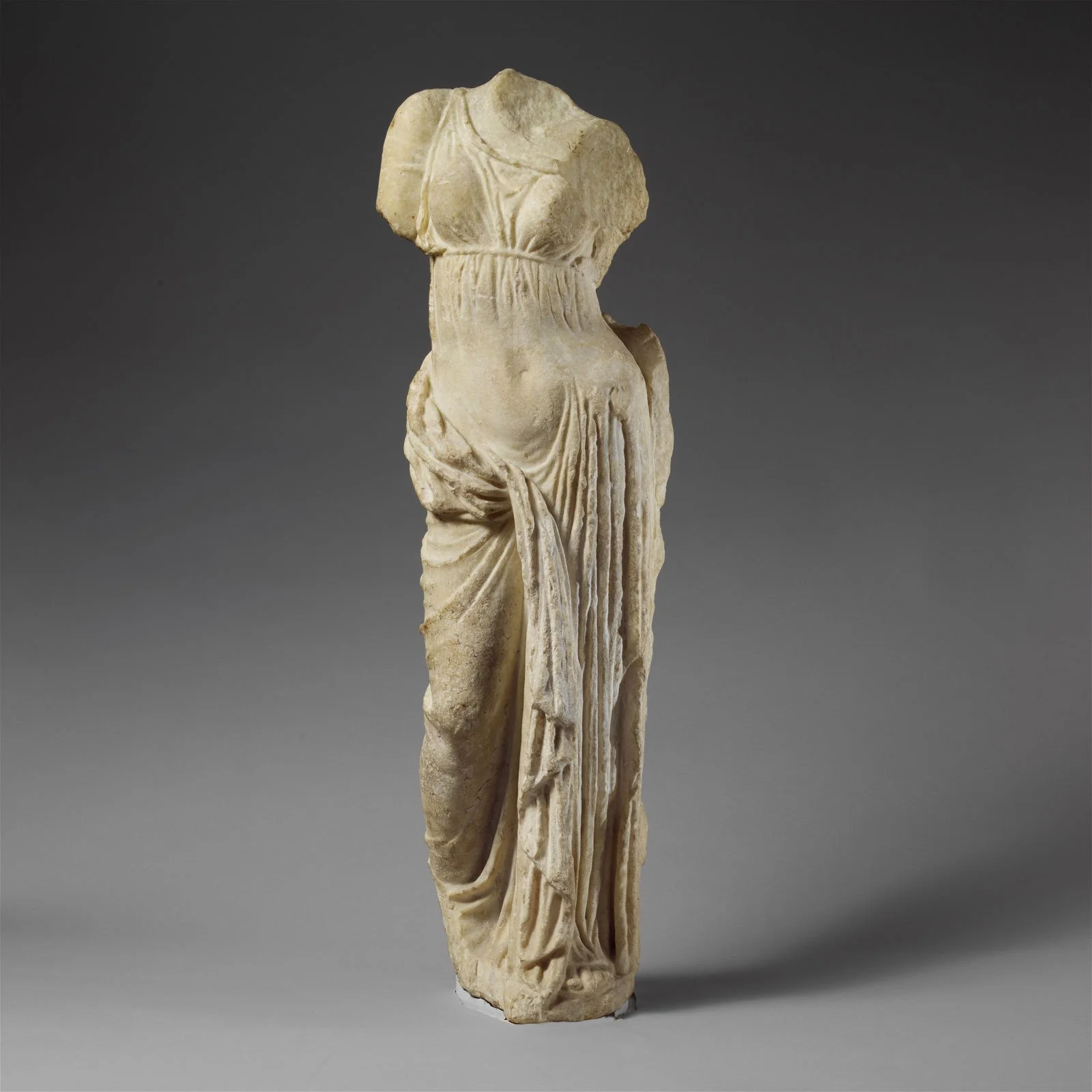
Even as a fragment, this Aphrodite shows how Greek marble can feel smooth, light-sensitive, and almost alive.
Greek marble sculpture can feel strangely impossible the first time you really look at it. Stone should feel hard, cold, and resistant. But many Greek statues seem to do the opposite. Skin looks soft. Bodies seem to breathe under the surface. Drapery feels light even when it is carved from a heavy block. That is not an accident. It is the result of material, carving, finish, light, and a whole Greek way of thinking about ideal beauty.
So the short answer is this: Greek marble sculpture looks lifelike because Greek artists knew how to use marble’s special qualities to create smooth transitions, controlled surfaces, and a powerful sense of bodily presence. They were not making stone “realistic” in a modern documentary sense. They were shaping it so the figure would feel clear, harmonious, and alive to the human eye.
That is why Greek marble statues still have such force. They are not only beautiful objects. They are carefully engineered experiences of touch, light, and ideal form.
Marble mattered because it could hold both clarity and softness
Marble was not the only important material in Greek sculpture, but it became one of the most powerful because it could do two things at once. It could preserve clean structure, and it could soften that structure visually.
That matters because Greek artists cared deeply about the body. Whether they were carving male Greek statues or female Greek statues, they wanted the figure to feel legible from a distance and convincing up close. Marble helped them do that. It could take a sharp edge when needed, but it could also be worked into smooth transitions that made flesh feel continuous rather than mechanical.
Greek sculptors also had access to high-quality white marble from quarries such as Paros and Pentelikon. These stones were valued not just because they were beautiful in some abstract sense, but because they responded well to carving and light. Fine marble could hold subtle detail while still producing a luminous, unified surface.
That is one reason a Greek statue can feel more alive than we expect from stone. The material itself allows artists to move between structure and softness without losing either one.
Smoothness is not “natural marble”; it is the result of carving and finishing
One of the biggest beginner mistakes is assuming Greek statues look smooth because marble is naturally smooth. It is not. Freshly quarried marble is rough, heavy, and stubborn. The softness we associate with marble statue Greece is the product of enormous labor.
Greek sculptors shaped marble in stages. They roughed out the block, then refined forms gradually with tools such as the point chisel, tooth chisel, drill, rasp, and abrasives. Each step reduced the figure from a mass of stone into a more precise body. The final result depended not only on anatomy, but on how transitions were handled. A shoulder had to melt into an arm. A thigh had to turn under the light without becoming blunt. A cheek had to feel rounded without becoming vague.
This is why Greek marble sculpture does not usually look “cut out.” It looks modeled. Modeled means shaped with gradual surface changes rather than harsh visual breaks. That quality is one of the main secrets of its lifelike effect.
The finish mattered too. Polishing could heighten the sense of skin, especially on exposed flesh, while other areas might be left differently worked to create contrast. Hair, cloth, and flesh did not all have to behave the same way. The sculptor could use the finish itself to guide the eye.
So when Greek marble looks soft, it is not because the stone stopped being stone. It is because the artist made the surface carry the sensation of life.
Marble works so well because Greek sculpture depends on light
Greek marble sculpture does not just exist in space. It performs in light.
That is one of the most important reasons these works feel alive. Marble catches and reflects light in a way that gives forms a subtle visual vibration. Curved areas brighten gently. Recesses deepen into shadow. Muscles and bones do not need to be sharply outlined if the light can describe them for you.
This is especially important in ancient Greek sculpture, where artists were often more interested in ideal clarity than in showing every tiny surface fact. Marble lets the body remain simplified without becoming dead. The figure feels complete because light keeps activating it.
Think about what happens on a Greek torso. The chest is not usually carved like a medical diagram. It is shaped as a set of broad, connected planes. That lets light travel smoothly across it. The same is true of legs, hips, and faces. Marble helps the figure read as one living whole rather than as a collection of isolated parts.
This is also why Greek drapery can feel so magical. Heavy cloth can look light because the folds are designed to catch shadow rhythmically. The sculptor is not only carving fabric. The sculptor is carving a pattern of light and dark that the eye reads as motion, weight, or softness.
Marble allowed Greek artists to idealize the body without making it feel dead
Greek sculpture is rarely about raw realism. It is about bodies edited toward clarity, balance, and beauty. Marble was perfect for that goal.
Bronze could do many things marble could not, especially daring extensions and thinner projections, which is why Greek bronze statues were so important. But marble had a different strength. It could make the body feel calm, coherent, and tactile. It encouraged a kind of beauty built from continuity.
That is why marble becomes such a powerful medium for ideal figures. It lets the sculptor remove the messy accidents of individual flesh while keeping enough softness for the body to remain believable. The result is not a portrait of one person exactly as they are. It is a perfected body that still feels inhabitable.
This helps explain why so many of the most famous Greek and Greek-derived statue types survive as marble forms. Even when we are looking at later Roman marble statues that copy lost Greek bronzes, the marble version often preserves something essential about Greek bodily logic: the desire for clarity, harmony, and visible life.
So marble shaped Greek art deeply not because it was the only material that mattered, but because it matched one of Greek sculpture’s core ambitions so well: to make the ideal body feel present.
Greek marble was not just white, and that changes how we read it
This is the correction that changes everything.
When we imagine Greek marble sculpture, we often imagine clean white figures in museum galleries. But many ancient statues were originally painted. Marble was not always meant to remain visually bare. Color could emphasize hair, eyes, lips, garment borders, patterns, jewelry, and other details that are easy to miss today.
That is why painted Greek statues matter so much for understanding marble. The “alive” effect did not come from carving alone. It also came from the added color and finish that completed the figure.
This does not cancel the importance of marble itself. It deepens it. Marble provided the body’s structure, its softness, and its relationship to light. Paint sharpened identity and detail. Together they created a much richer image than the plain white modern afterlife suggests.
So if Greek marble sculpture seems impossibly smooth and alive today, it would often have seemed even more vivid in antiquity.
Marble copies shaped what we think Greek sculpture looks like
There is one more twist that is worth knowing. A lot of what we call “Greek sculpture” survives through later Roman marble copies.
That matters because many famous Greek originals were made in bronze and then lost. Later sculptors reproduced them in marble for Roman patrons who admired Greek art. Those copies preserved important figure types, but they also had to adapt them to marble’s limits. Marble is heavier and more fragile than bronze, so copied figures often required supports such as tree trunks, struts, or connecting elements.
This is one reason marble has so deeply shaped our image of Greek art. We often meet Greek sculptural ideas through later marble bodies. In other words, the history of Greek sculpture and the history of marble are tightly entangled, even when the original masterpiece may have been made in another material.
That does not make marble secondary. Quite the opposite. Marble became one of the main ways Greek art survived, spread, and kept teaching later cultures how the body could be shaped into beauty.

Conclusion
Greek marble sculpture looks smooth, soft, and alive because marble gave Greek artists exactly what they needed: a material that could hold clear form, subtle transitions, and light-sensitive surfaces all at once. Through careful carving, polishing, and finishing, sculptors turned rough stone into bodies that seem tactile, calm, and vividly present. And when we remember that these statues were often painted too, the effect becomes even more convincing.
So the magic of Greek marble is not really a mystery. It is the meeting point of material, skill, and a very specific artistic goal: to make ideal beauty feel like something you could almost touch.
FAQ
Why does Greek marble sculpture look so smooth?
Because Greek sculptors carefully refined and polished the marble in stages, using tools and abrasives to create soft transitions across the surface.
Why does marble make Greek statues feel alive?
Marble responds beautifully to light, which helps bodies feel rounded, unified, and active instead of flat or rigid.
Were Greek marble statues originally white?
Not always. Many were painted, and some details were much more colorful than modern museum displays suggest.
Why did Greeks use marble instead of bronze?
They used both. Marble was especially good for calm, luminous, tactile surfaces, while bronze allowed more daring poses and thinner projections.
Are many famous Greek marble statues actually Roman copies?
Yes. Many well-known marble works are Roman copies of earlier Greek originals, often made in bronze.
What kind of marble did Greek sculptors use?
Important sources included fine white marble from places like Paros and Pentelikon, both prized for sculpture.
Sources and Further Reading
The Metropolitan Museum of Art — “The Art of Classical Greece (ca. 480–323 B.C.)” (2008)
The Metropolitan Museum of Art — “Roman Copies of Greek Statues” (2002)
Smarthistory / The J. Paul Getty Museum — “Carving marble with traditional tools” (2015)
The Metropolitan Museum of Art — “Ancient Greek Sculpture in Color” (2022)
British Museum — “Paint and the Parthenon: conservation of ancient Greek sculpture” (2018)
Smarthistory — “War, democracy, and art in ancient Greece, c. 490–350 B.C.E.” (2022)
You may also like