Roman Arch: How the Structure Worked and Why Rome Used It Everywhere
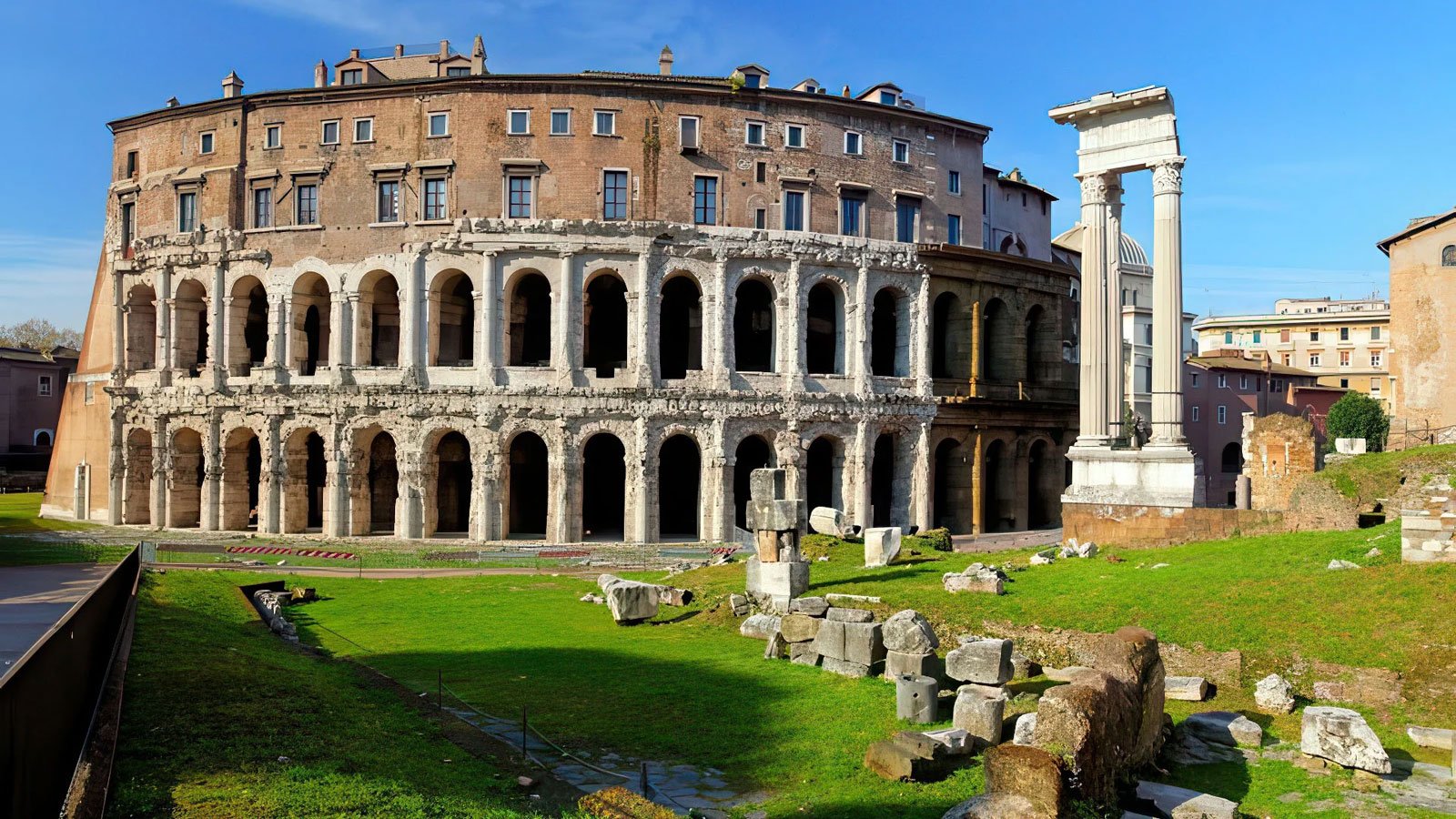
The Theatre of Marcellus shows how the Roman arch worked not as a single feature, but as a repeatable system across a whole façade.
The Roman arch is one of the clearest ways to understand Roman building. It looks simple: a curved opening made from wedge-shaped pieces. But that small structural idea had enormous consequences. It helped the Romans span wider spaces, carry heavier loads, build more durable infrastructure, and create architectural forms that would define not only the Roman world, but much of later Western architecture too.
That is why the arch matters so much. It was not just a decorative shape repeated on facades. It was a practical structural tool. Once Roman builders learned how to use it confidently and systematically, they could apply it to bridges, aqueducts, gateways, arcades, vaults, and monumental buildings. In other words, the arch helped turn Roman construction into a more flexible and ambitious system.
It also helps explain why Roman architecture often feels so different from earlier traditions centered mainly on post-and-lintel building, where a horizontal beam rests on vertical supports. The Roman arch allowed weight to move differently. That change opened the way to larger spans, repeated bays, and eventually to the vaults and domes that define so much of Roman space.
What is a Roman arch?
A Roman arch is a curved structural opening built from separate wedge-shaped blocks or units that press against one another. Instead of carrying weight through a straight horizontal beam, the arch redirects that weight outward and downward into its supports.
That basic definition matters because the Roman arch is not just a Roman motif. It is first of all a structural device. The curve is not there only for appearance. It helps the arch work. Each block presses into the next, and the load above strengthens that compressive relationship rather than simply snapping a beam in the middle.
In Roman building, arches could be made in stone, brick, or concrete-faced systems, depending on the context. Some were freestanding and monumental. Others were embedded inside walls, corridors, substructures, and long arcades. Some framed passages. Others supported bridges or carried water channels. Some were purely structural. Others also became symbolic, especially in commemorative monuments.
This is why the Roman arch belongs at the center of Roman architecture. It is not one isolated feature among many. It is one of the tools that helped Roman building become more infrastructural, more repeatable, and more spatially ambitious.
How does an arch work?
At the simplest level, an arch works by turning vertical load into compression and sideways thrust. Compression means squeezing force. Instead of a straight beam bending under weight, the arch channels force through its curved form and into the supports at each side.
In simple terms
An arch holds because its wedge-shaped parts push into one another and send weight sideways into the supports instead of straight down through a fragile horizontal span.
The individual wedge-shaped pieces are called voussoirs. The central upper block is the keystone. If you want a closer look at that element itself, see keystone arch. The points where the curve begins to rise from the vertical supports are often called the springing points.
This is where the Roman arch becomes especially elegant. A heavy load above the arch does not automatically weaken it. In many cases, it helps lock the blocks more tightly together. But there is a condition: the arch also creates outward pressure. That sideways force has to be resisted by thick walls, piers, neighboring arches, or buttressing masses. Without that resistance, the arch can spread and fail.
So the Roman arch is never only the visible curve. It includes the supports, the surrounding wall mass, and the foundations below. This is one reason Roman builders used it so effectively. They did not treat the arch like a graphic symbol. They understood it as part of a complete structural system.
Did the Romans invent the arch?
No. The Romans did not invent the arch from nothing. Arches existed in earlier cultures, and forms of arch construction were already known in the ancient Mediterranean and Near East long before the Roman Empire reached its height.
What the Romans did was something different, and in many ways more important. They adopted, refined, standardized, and multiplied the arch on a huge scale. They made it one of the basic tools of construction. That is why the Roman arch feels so central to Roman identity, even though its deeper history is older.
In Italy, the Etruscans were especially important to this story. Roman builders inherited a great deal from neighboring Italic traditions, and the arch is one of the clearest examples. If you want to follow that earlier background, it helps to look at the Etruscan arch, Etruscan architecture, and the broader Etruscan influence on Roman architecture.
That inheritance matters because Roman architecture rarely grows through total invention. More often, it grows through adaptation and expansion. The Romans took existing forms and turned them into a larger building language. They were not content to use the arch occasionally. They used it in roads, bridges, arcades, baths, amphitheaters, basilicas, gateways, and commemorative monuments. The scale and consistency of that use is what makes the Roman arch such a defining feature of their world.
So the right conclusion is not “the Romans invented the arch.” It is closer to this: they made the arch one of the main structural and visual engines of architecture.
Why did Rome use arches everywhere?
The short answer is that arches were efficient, strong, and versatile. They allowed Roman builders to span openings more effectively than a single stone lintel could, especially when working with relatively small units of stone or brick rather than one huge block.
That gave the arch several advantages. It could carry substantial loads. It could be repeated in a row to create arcades. It could be scaled up or down depending on the building. It worked in practical infrastructure and in monumental architecture. And once builders mastered its geometry and construction, it became a dependable solution across many contexts.
This repeatability mattered enormously in the Roman world. Rome was not building only temples or elite tombs. It was building roads, harbors, bridges, aqueducts, baths, theaters, amphitheaters, basilicas, warehouses, and urban substructures. The empire needed a structural tool that could appear again and again in different places and still work. The arch was perfect for that.
It also paired well with Roman materials, especially concrete, brick, and masonry construction. Once arches could be combined with thick walls and concrete cores, Roman builders were no longer limited by the same strict dependence on cut-stone beam construction. The arch fit naturally into a broader Roman shift toward mass construction and spatial engineering.
There is also a visual reason. Repeated arches create rhythm. They can make an aqueduct look legible across a landscape. They can give a bridge or a facade a sense of order. They can turn a long structural sequence into a recognizable architectural image. Roman builders were practical, but they were also very aware of monumentality. The arch served both needs at once.
Where do Roman arches appear?
One reason the Roman arch is so useful as a study topic is that it appears in so many building types. Once you learn to see it, you begin to notice it everywhere in the Roman world.
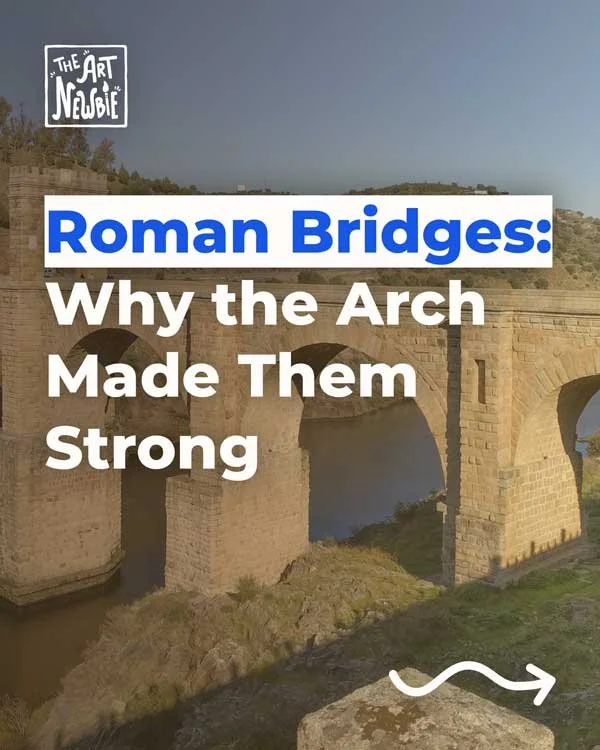
Bridges are an obvious example. In Roman bridges, arches help carry the roadway while allowing water to pass below. The curved form suits masonry construction especially well, and it allows multiple spans to be linked in a durable sequence.
Aqueducts are another classic case. In Roman aqueducts, arches are often stacked in arcades that carry a water channel across valleys or uneven ground. Not every aqueduct needed visible arches, but where height and topography demanded them, the arch became a practical and highly recognizable solution.
The arch also appears in arcades, corridors, market structures, amphitheaters, and bath complexes. In these contexts, the arch is not only spanning an opening. It is organizing circulation, supporting upper levels, and creating repeated structural modules. This is part of what makes Roman architecture feel so systematic. A structural idea can move from one type of building to another without losing its usefulness.
Then there are monumental arches. A triumphal arch takes the structural form of the arch and turns it into a commemorative monument. The opening still matters, but now the arch also frames movement, honors victories, and projects political meaning. The most famous surviving examples show how a structural form can become a symbolic one without stopping being architecture. A later imperial example such as the Arch of Constantine shows just how durable and adaptable that monument type became.
How did arches lead to vaults?
This is where the Roman arch stops being only a single element and starts becoming a generator of whole spaces. A vault is, in simple terms, an arch extended through depth. Instead of one curved opening, you get a continuous curved roof or ceiling.
That transformation is one of the most important consequences of the Roman arch. Once builders understood how an arch worked, they could repeat and extend that logic to create corridors, halls, and substructures covered by continuous masonry forms. If you want to follow that development directly, see Roman vaults.
This mattered because vaults changed interior architecture. With them, Roman builders could roof long passages, create massive enclosed halls, support seating systems, and organize complex circulation routes. The arch, then, was not just a solution for openings. It was the starting point for a broader world of curved construction.
And once that world existed, Roman architecture could move toward even more ambitious forms, including domes. The step from arch to vault to dome is not just a technical sequence. It is also a spatial one. Roman architecture becomes increasingly able to create interiors that feel unified, expansive, and dramatically enclosed.
So when people say the Roman arch changed architecture, they usually mean more than the arch alone. They mean the whole chain of possibilities that followed from it.
Why did the Roman arch matter politically?
The Roman arch was practical, but it was never only practical. In the Roman world, architecture often carried political meaning, and the arch was especially good at doing so because it could combine structure, movement, and monumentality in a single form.
A triumphal arch is the clearest example. These arches did not merely decorate the city. They marked passage, framed processional movement, and turned military or imperial achievement into permanent urban memory. A victory parade is temporary. A monument is not. The arch gave Rome a way to convert an event into stone.
That is one reason the form became so influential. A freestanding arch is easy to recognize, easy to monumentalize, and easy to place along a street or route. It can act like a gate without actually being a city gate. It can be both passage and proclamation.
The Arch of Titus is especially revealing here. It shows how the Roman arch could function not only as a structural opening, but as a carefully staged political statement embedded in the city’s ceremonial geography. Later arches continue that logic, each adapting the form to new rulers and new messages.
This political use of the arch also helps explain why the form had such a long afterlife. Later cultures repeatedly borrowed Roman arches because they condensed so much into one architectural gesture: power, movement, memory, and public display.
Why does the Roman arch still matter?
The Roman arch still matters because it sits at the meeting point of engineering and architecture. It is simple enough to grasp quickly, but powerful enough to explain an entire shift in building culture.
It also teaches an important lesson about architecture in general. Not every major architectural change begins with ornament or style. Sometimes it begins with a structural idea that quietly changes what buildings can do. The arch is one of those ideas. Once builders could span more confidently, repeat more efficiently, and extend arches into vaults, architecture itself changed.
That is why the Roman arch remains such a useful starting point for beginners. It makes large historical questions visible. How does weight move? Why do some cultures build differently from others? What happens when a structural solution becomes widespread enough to shape cities, monuments, and infrastructure?
The Roman answer was remarkably clear. Use the arch not just once, but everywhere it can solve a problem, improve a span, organize movement, or make power visible. That decision helped shape bridges, aqueducts, baths, amphitheaters, commemorative monuments, and later architectural history far beyond Rome itself.

Conclusion
The Roman arch was a compact structural idea with very large consequences. By redirecting weight through a curved form and into its supports, it allowed Roman builders to span more effectively, build more repetitively, and develop the vaulted and infrastructural world that defines so much of Roman architecture.
That is why Rome used it so widely. The arch was strong, versatile, and adaptable. It solved practical problems, shaped monumental forms, and helped turn architecture into a more ambitious system of space, movement, and public meaning.
FAQ
What is the Roman arch in simple terms?
The Roman arch is a curved structural opening made from wedge-shaped elements that press into one another and carry weight into the supports on each side.
Did the Romans invent the arch?
No. Arches existed before Rome. The Romans adopted and developed them so effectively that the arch became one of the defining features of Roman building.
Why was the Roman arch better than a lintel?
A lintel is a straight horizontal beam, which is more limited in span and more vulnerable to bending. An arch redirects load through compression, which lets it carry weight more effectively.
What is the keystone in a Roman arch?
The keystone is the central block at the top of the arch. It helps lock the arch’s wedge-shaped units into a stable compressive form.
Why did Romans use arches in aqueducts and bridges?
Arches were strong, repeatable, and well suited to masonry construction. They allowed Roman builders to create multiple spans and durable structures across uneven ground or waterways.
How are Roman arches connected to vaults?
A vault is essentially an arch extended through depth. Roman mastery of the arch made it possible to create vaulted corridors, halls, and large interior spaces.
Sources and Further Reading
You may also like