Etruscan Arch: Why the Gate at Perugia Matters
The gate at Perugia shows how Etruscan architecture could be defensive, monumental, and urban at the same time.
The so-called Etruscan Arch at Perugia matters because it turns a big architectural question into something you can actually see. It is not just an old gate. It is a surviving piece of Etruscan urban engineering, a monument to how city walls and entrances were designed, and a rare place where the afterlife of Etruscan building can be read through later Roman additions. If you want one compact example of why Etruscan architecture still matters, this is it.
It also helps clear up a common misunderstanding. The arch at Perugia is often used in broad claims about the Etruscans and the arch itself. The real story is more interesting than a simple invention myth. What makes this monument important is not that it magically explains all Roman architecture in advance, but that it shows how Etruscan builders handled masonry, monumentality, defense, and civic identity in a way Rome would later develop much further.
The gate matters because it preserves Etruscan city architecture unusually well
Yes, that is the first reason it stands out. Much of Etruscan architecture survives unevenly, especially when compared with Greek or Roman stone monuments. Temples often survive only in foundations and fragments. Houses are hard to reconstruct. Gates, walls, and tombs are often where the clearest evidence remains. The gate at Perugia is therefore precious because it preserves an actual urban threshold, not just a scattered architectural trace.
Built as part of the city walls of ancient Perusia, modern Perugia, the monument belongs to a larger fortified system that shaped how the city was entered, defended, and presented to outsiders. It was not an isolated decorative structure. It controlled passage through the walls and marked one of the main access points into the city. That alone makes it architecturally important.
If you want the wider background first, Etruscan architecture explains the broader building culture to which this gate belongs.
What you see at Perugia is a monumental gate built with clarity and force
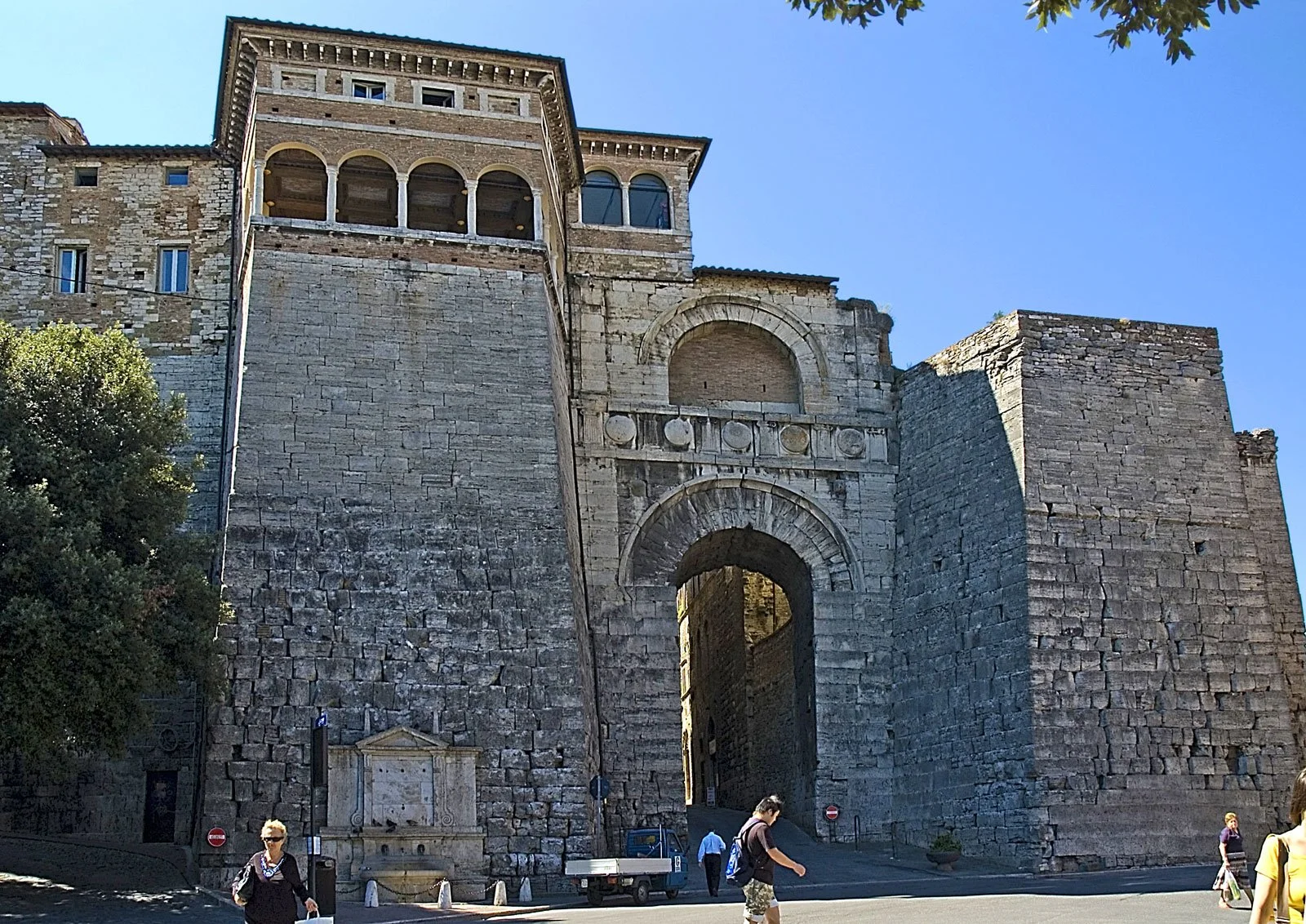
The monument is powerful because its design is so legible. It is built in large stone blocks and framed by two trapezoidal towers, with the central passage treated as a grand architectural façade rather than just a hole in a wall. The gate feels defensive, but it also feels ceremonial. That combination is exactly what makes it such a strong example of Etruscan urban design.
The main opening is formed by a rounded arch, and above it rises a second arched level that adds height and visual emphasis. The overall effect is vertical, compact, and highly controlled. This is not architecture trying to disappear into the wall. It is architecture announcing the city.
That is why the monument works so well as a teaching example. You can immediately see that Etruscan gates were not only practical barriers. They were civic statements. They organized movement, but they also projected dignity, order, and power.
The “Etruscan arch” matters most as a sign of building knowledge in Italy
Yes, the arch itself is one of the reasons this gate is famous, but it should be understood carefully. The Etruscans did not invent the idea of the arch in an absolute global sense. What makes the Perugia gate important is that it shows the Etruscans using the true stone arch in a major urban setting in Italy. That is a more precise and more useful point.
At Perugia, the arch is not just a structural solution. It is part of a monumental city entrance. It shows how masonry, geometry, and urban image could work together. That matters because Roman architecture would later make the arch central to bridges, aqueducts, amphitheaters, gates, and vaults. The gate at Perugia does not contain all of that future development, but it does show an earlier Italian mastery that belongs to the same story.
This is exactly why Etruscan influence on Roman architecture matters here. The connection is real, but it is best understood as transmission and development, not as a simple one-step invention tale.
The Roman inscriptions make the gate even more revealing
One of the most interesting things about the monument is that it is not only Etruscan. It also carries Roman history on its surface. The inscription Augusta Perusia records the city’s Roman refoundation after the Perusine War in the late 1st century BCE, when Augustus reshaped the city after conflict. A later inscription, Colonia Vibia, records another Roman layer in the gate’s long life.
This matters because the monument becomes a visible record of continuity and reuse. The gate was not erased when Rome took control. It was retained, reinscribed, and folded into a Roman civic identity. In other words, the structure itself is Etruscan, but its later history shows how Roman power often worked: by absorbing existing urban fabric and marking it anew.
That makes the gate especially valuable for anyone thinking about Etruscan influence on Rome. Influence is not always abstract. Sometimes it survives in stone, with later rulers writing themselves onto earlier architecture.
Why this one gate still matters
The gate at Perugia matters because it condenses several big ideas into one monument: Etruscan fortification, urban identity, stone construction, the architectural role of the arch, and the Roman habit of reusing and transforming earlier forms. It is small enough to grasp quickly, but rich enough to open a much larger history.
That is what makes it such a good beginner object. You can stand in front of it and understand that Etruscan architecture was not vague, primitive, or lost beyond recovery. It was technically serious, urban in scale, and important enough that Rome did not simply destroy it and start over. Rome built on top of that world, and the gate at Perugia is one of the clearest places where that process still shows.

Conclusion
The Etruscan Arch at Perugia matters because it is more than a surviving gate. It is a precise lesson in how Etruscan cities were built, how monumental entrances could combine defense with civic display, and how Roman rule often absorbed rather than erased earlier architecture. Its stonework, towers, arched passage, and later inscriptions make it one of the clearest surviving bridges between Etruscan building culture and the Roman world that followed.
FAQ
What is the Etruscan Arch at Perugia?
It is a monumental gate in the ancient walls of Perugia, originally built in the Etruscan period and later modified under Roman rule.
Why is it called the Arch of Augustus too?
Because it bears the inscription “Augusta Perusia,” added after the city’s Roman reorganization under Augustus.
Did the Etruscans invent the arch?
Not in an absolute sense. But they played an important role in developing and using the true stone arch in Italy.
Why is the gate important for Roman architecture?
Because it shows an Etruscan building tradition in stone and urban design that Rome later inherited and developed further.
Is the monument purely Etruscan?
Its core structure is Etruscan, but the inscriptions and some later additions belong to Roman and later periods.
Sources and Further Reading
Comune di Perugia — “Arco Etrusco o di Augusto” (n.d.)
MuseiAppPerugia — “Etruscan Arch” (n.d.)
Umbria Tourism — “Etruscan arch of Perugia” (n.d.)
Encyclopaedia Britannica — “Perugia” (2026)
You may also like