Roman Aqueducts: How Rome Moved Water Across Distance
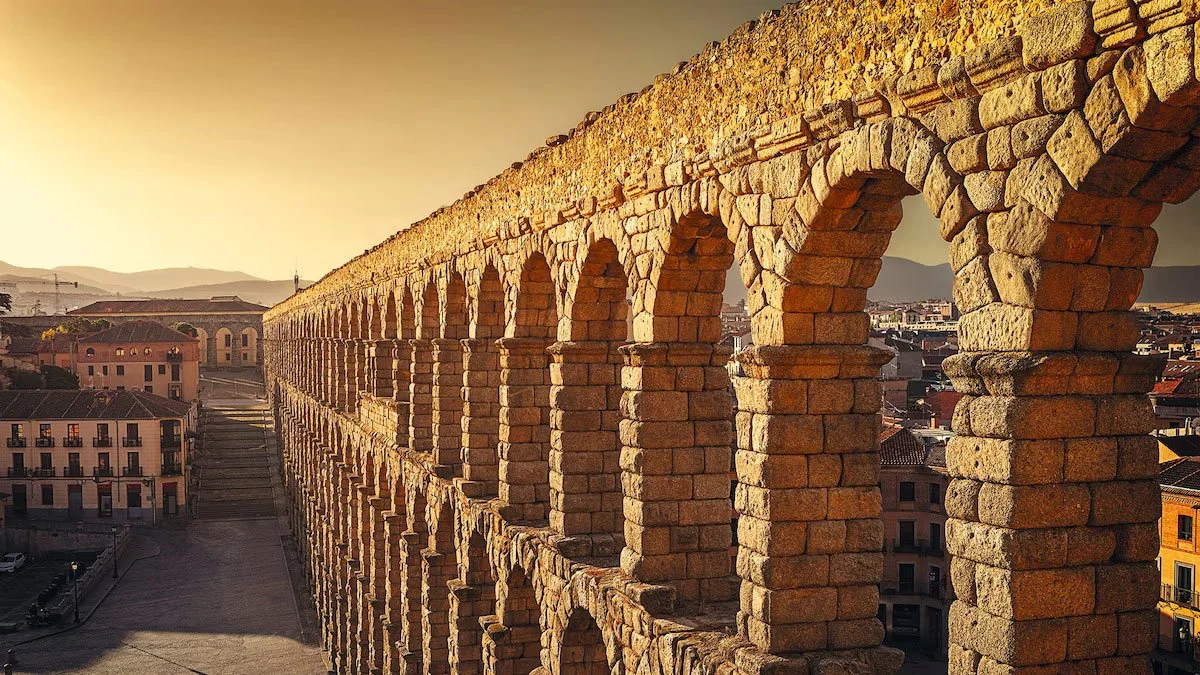
An image like this makes Roman aqueducts easier to understand because you can read the steady rhythm of arches carrying water across distance.
Roman aqueducts were one of the clearest expressions of Roman infrastructure thinking. They were not just impressive stone arcades crossing valleys. They were carefully planned water-supply systems designed to bring fresh water from distant sources into towns and cities by using gravity, steady gradient, and durable engineering. That is why they matter so much. Roman aqueducts did not only solve a technical problem. They helped make Roman urban life possible at a much larger scale.
A city with a reliable water supply could sustain baths, fountains, workshops, gardens, households, and public buildings more effectively. It could grow, function more regularly, and project a stronger image of order and civic care. In that sense, aqueducts belong to the same world as roads, bridges, baths, and forums. They are one of the ways Rome turned territory into system.
Quick answer
Roman aqueducts worked by carrying water from a source at higher elevation to a city at lower elevation through a carefully controlled gradient. Most of the system was underground or at ground level, while arches were used only where the terrain made them necessary.
What is an aqueduct?
An aqueduct is a system for transporting water from one place to another. In the Roman world, that usually meant carrying fresh water from springs or upland sources to towns and cities through channels designed to maintain a steady flow.
This definition matters because many people picture an aqueduct as a row of monumental arches. That image is understandable, but it is incomplete. The aqueduct is the whole water route, not only the visible bridge-like section. In many cases, most of the line ran underground or in built channels close to the ground. The famous arches were only the parts that crossed depressions, valleys, or uneven terrain.
That broader view makes Roman aqueducts more interesting. They were not isolated monuments dropped into the landscape. They were territorial systems. A source had to be found, the route had to be surveyed, the gradient had to be controlled, and the water had to be delivered into the city in a usable way.
This is one reason aqueducts belong inside the larger story of Roman architecture. They may not look like temples or basilicas, but they are still architectural in the deepest sense. They shape territory, support urban life, and reveal how Roman building connected technical performance to civic ambition.
How did Roman aqueducts work?
The basic principle was simple: gravity. Roman aqueducts worked by moving water from a higher source to a lower destination through a channel that maintained a very slight and carefully controlled downward slope.
That simplicity can be deceptive. Gravity may sound straightforward, but making it work across long distances requires precision. If the slope is too steep, the water can move too quickly and damage the system. If the slope is too shallow, the water may slow too much or fail to flow properly. Roman engineers therefore had to survey land carefully and keep the gradient remarkably steady over many kilometers.
This is why Roman aqueducts are such a good example of ancient Roman engineering. Their success depended less on one dramatic invention than on sustained technical discipline. Builders had to understand terrain, levels, materials, maintenance, and the behavior of moving water.
The water usually traveled in a channel called a specus, often lined with waterproof mortar. Along the route, the system might include covered channels, tunnels cut through hills, bridges, arcades, settling tanks, and distribution structures. So when people ask how did Roman aqueducts work, the best answer is not “they used arches.” The better answer is “they used gravity, careful surveying, and a sequence of engineered solutions adapted to the land.”
Why were arches only part of it?
This is one of the most useful corrections for beginners. The arches are famous because they are visible and dramatic, but they are not the whole story. In fact, they were often only a small part of the total route.
Roman engineers preferred to keep water channels as stable and efficient as possible. That often meant running them underground or close to the ground, where they were protected and easier to control. If the route crossed a valley, though, the system needed another solution. In those cases, arcades of arches could support the water channel at the correct level while spanning the low ground below.
That is why Roman aqueducts are such a striking mix of hidden system and visible monument. Most of the work may be invisible, but the exposed sections make the logic of the whole system legible.
The arches also reveal how closely aqueducts are related to other Roman structures. The same structural confidence that appears in bridges, vaults, and arcades appears here too. An aqueduct crossing on arches is not simply picturesque. It is a way of keeping the water line continuous while respecting the demands of topography.
Famous examples make this especially clear. The Pont du Gard is so memorable because it turns a water conduit into a monumental landscape structure. The Segovia Aqueduct shows the same principle in a different urban setting. In both cases, the visible arches are spectacular, but their beauty comes from technical necessity.
How was the water kept clean?
Roman aqueducts did not deliver modern purified water, but Roman engineers did pay close attention to water quality, route selection, and maintenance. The first step was choosing a good source, often a spring rather than stagnant water. A spring offered a steadier and generally cleaner supply.
Once inside the system, the water moved through channels that could include settling tanks, where heavier particles had time to sink before the water continued onward. The route itself also mattered. A covered channel protected the water better than an open one, reducing contamination and limiting evaporation.
Maintenance was essential too. Channels could collect mineral deposits, sediment, or damage over time. Roman aqueducts therefore needed inspection and repair. Access points and maintenance shafts helped workers reach parts of the system that otherwise remained hidden.
This point matters because aqueducts are sometimes imagined as perfectly self-operating monuments. In reality, they depended on continuous oversight. They worked well not only because they were engineered, but because they were managed.
That is one reason aqueducts tell us so much about Roman administration. A city with multiple aqueducts was not just technically advanced. It also needed organization, labor, and authority to keep the system functioning.
How did aqueducts enter the city?
Bringing water to the edge of a city was only part of the job. Once the water arrived, it had to be received, distributed, and used.
Roman aqueducts often fed into distribution points, sometimes called castella, from which water could be directed toward fountains, baths, public buildings, and in some cases private users. The exact pattern varied from city to city, but the larger principle remained the same: the aqueduct was not just a line ending at the walls. It was part of a wider urban water network.
This is where aqueducts connect closely to Roman city planning. A city with abundant water could support more public baths, more fountains, more ornamental display, and more reliable daily service. Water shaped how a city worked and how it was experienced.
It also connects to drainage and waste systems. Supplying fresh water is only one side of urban hydraulic planning. Cities also had to manage runoff, wastewater, and sewage. That relationship becomes clearer when you look at how sewers were built in Rome. Aqueducts and sewers are not the same thing, but together they show Rome’s larger concern with the practical life of the city.
In other words, an aqueduct does not matter only because it brings water in. It matters because it changes everything that can happen once that water arrives.
Why did cities depend on them?
Roman cities depended on aqueducts because dense urban life requires a reliable water supply. Wells and local sources could help, but they often were not enough for large populations or for the scale of public amenities that Roman civic culture valued.
Baths are the clearest example. Large bath complexes consumed enormous quantities of water. Without aqueducts, that kind of architecture would have been much harder to sustain. Public fountains also mattered, not just as decoration, but as practical points of access for everyday users. Workshops, gardens, and some private residences could benefit too.
This helps explain why aqueducts were not merely technical works at the edge of the city. They were central to the identity of urban Roman life. A city with good water could support more comfort, more cleanliness, more social life, and more monumental public services.
That is why the history of Roman aqueducts is also the history of civic ambition. Rome itself gradually accumulated multiple aqueducts, including the Aqua Appia, Aqua Marcia, Aqua Virgo, and Aqua Claudia. Each of these systems added capacity and helped sustain the expanding city.
So when we ask why aqueducts mattered, the answer is not only “because people needed water.” It is also “because Roman urbanism depended on water at a scale that required infrastructure.”
How did Romans build them?
Building an aqueduct began with surveying. Engineers had to locate a source, study the land, and trace a route that could preserve the necessary gradient over long distance. That alone required a high level of practical knowledge.
Once the route was established, the system could be built in different ways depending on local conditions. In flatter or more protected stretches, the channel might run underground. In rocky terrain, tunnels could be cut. Where depressions interrupted the line, walls or arcades might raise the channel to the correct level.
Materials mattered too. Roman builders often used masonry and waterproof mortar to form the specus. The inside needed to resist leakage, while the structure as a whole had to resist weather, movement, and time. In highly visible arcades, careful stone or masonry work could also give the aqueduct a monumental presence.
This variety is important. Roman aqueducts were not built from one single standard formula. They were built through adaptation. The route stayed conceptually continuous, but the construction method shifted according to terrain.
That flexible intelligence is one reason Roman aqueducts still impress today. They show how Rome could combine strict technical demands with pragmatic local solutions.
Which Roman aqueducts are most famous?
Some Roman aqueducts are famous because they served Rome itself, while others are famous because their surviving structures are so visually striking.
Within Rome, the Aqua Appia matters because it was the city’s earliest aqueduct. The Aqua Marcia became especially valued for the quality of its water. The Aqua Virgo is notable for its long historical afterlife, while the Aqua Claudia is one of the grandest monumental systems associated with imperial Rome. Looking at Aqua Appia, Aqua Marcia, Aqua Virgo, and Aqua Claudia helps make the broader topic much more concrete.
Beyond Rome, the Pont du Gard in southern France is one of the most famous surviving aqueduct bridges in the world. Its stacked arcades make the system’s logic easy to see. The aqueduct of Segovia is equally important because its long line of arches has become inseparable from the image of the city itself.
These examples matter because they show two sides of Roman aqueduct history at once. Some aqueducts are remembered mainly as urban systems. Others are remembered through spectacular surviving structures. Together, they remind us that Roman aqueducts were both infrastructural networks and architectural landmarks.
Why do Roman aqueducts still matter?
Roman aqueducts still matter because they reveal how deeply Roman civilization depended on infrastructure. They remind us that architecture is not only about temples, statues, and monumental facades. It is also about water, territory, maintenance, and the systems that make urban life possible.
They also matter because they help correct a narrow image of Roman achievement. Rome did not succeed only by building big monuments. It succeeded by connecting technical intelligence to everyday use. Aqueducts are one of the clearest examples of that connection.
For beginners, they are especially useful because they make Roman thinking visible. A road organizes movement. An aqueduct organizes water. A forum organizes civic life. A bath organizes social and bodily routines. Each piece belongs to a larger built world. Aqueducts show that Roman power was not only symbolic. It was infrastructural.
That is why they remain so compelling. They are elegant, impressive, and often beautiful, but their deeper force comes from something even more interesting: they made cities work.

Conclusion
Roman aqueducts carried water across distance by using gravity, controlled gradient, and carefully adapted construction. Most were not just rows of arches, but complete territorial systems made of channels, tunnels, bridges, and distribution points.
Their real importance, though, lies in what they made possible. Roman aqueducts helped sustain baths, fountains, households, and urban growth at a much larger scale. They were not only feats of engineering. They were one of the foundations of Roman city life.
FAQ
What is an aqueduct in simple terms?
An aqueduct is a system that carries water from a source to another place, usually by using gravity and a carefully controlled slope.
How did Roman aqueducts work?
Roman aqueducts worked by moving water from a higher point to a lower one through channels that maintained a steady gradient. Arches were used only where the land dropped too much for the channel to stay at the right level.
Were all Roman aqueducts above ground?
No. Much of many aqueduct systems ran underground or close to ground level. The famous arches are only the most visible parts.
Why were Roman aqueducts important?
They gave cities a more reliable water supply, which supported baths, fountains, households, workshops, and public life on a larger scale.
Did Roman aqueducts use pumps?
In general, Roman aqueducts mainly relied on gravity rather than pumps. Their success depended on surveying and maintaining the right slope.
What are the most famous Roman aqueducts?
Among the best known are the Aqua Appia, Aqua Marcia, Aqua Virgo, Aqua Claudia, the Pont du Gard, and the aqueduct of Segovia.
Sources and Further Reading
You may also like