Roman Concrete: Why It Changed Architecture Forever
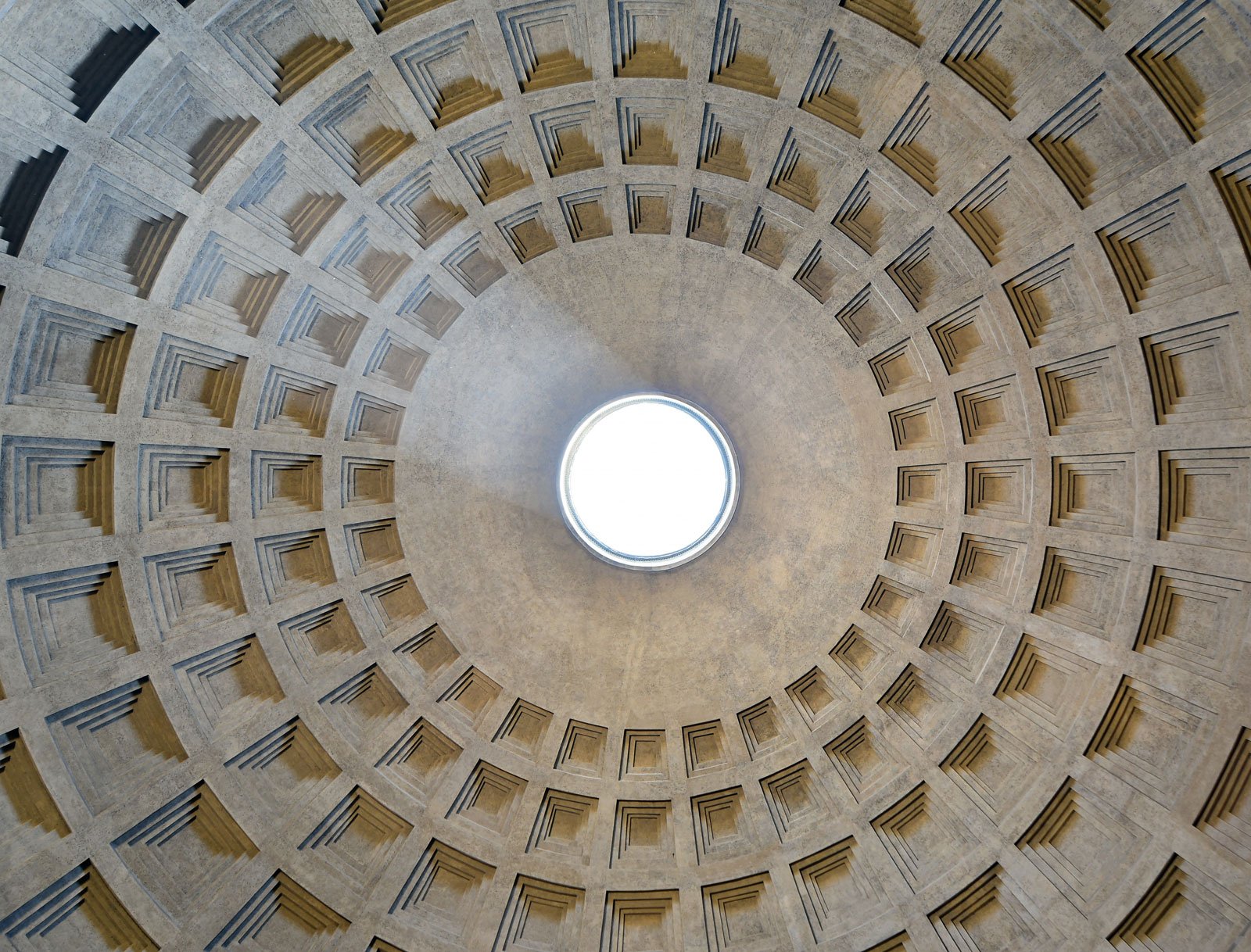
The Pantheon makes Roman concrete easy to grasp because the material is doing something radical here: it becomes a dome and a room at the same time.
Roman concrete was not just a useful ancient material. It changed what Roman builders could build, how they could build it, and how Roman space could feel. Once concrete became a mature part of Roman construction, architecture no longer had to rely so heavily on cut stone and straight beams alone. Walls could become structural masses. Arches could multiply. Vaults could stretch across baths and basilicas. Domes could cover spaces that still feel astonishing now.
That is why Roman concrete matters so much. It did not simply make Roman building more practical. It helped create a new architectural logic. Material, structure, and space became more deeply connected. If Roman architecture often feels more expansive, more engineered, and more spatially ambitious than earlier traditions, concrete is one of the main reasons why.
It also helps clear up a common confusion. People sometimes say Roman cement, but Roman concrete is the better term for the material used in walls, vaults, and domes. Cement is only the binder inside concrete, not the whole thing. That distinction matters because Roman concrete was not just a paste or powder. It was a complete building method.
What was Roman concrete?
Roman concrete, often called opus caementicium, was a mixture of lime, water, aggregate, and often volcanic ash. Aggregate means the larger pieces mixed into the mass, such as fragments of stone, brick, or terracotta. Once the material hardened, it formed a dense, stone-like body that could be used for walls, foundations, vaults, and domes.
What made it so important was not only strength. It was also adaptability. Roman concrete did not depend on carefully cut blocks fitted one by one. It could be laid, packed, and formed into place. That gave Roman builders much more freedom to create thick walls, curved structures, and large continuous interiors.
In many cases, Roman concrete formed the core of a wall, while the outer face was made of stone or brick. So the visible surface of a Roman building was often only the skin. The structural body behind it could be concrete. That is one reason Roman architecture can be misleading at first glance. The true technical story is often inside the wall, not just on its surface.
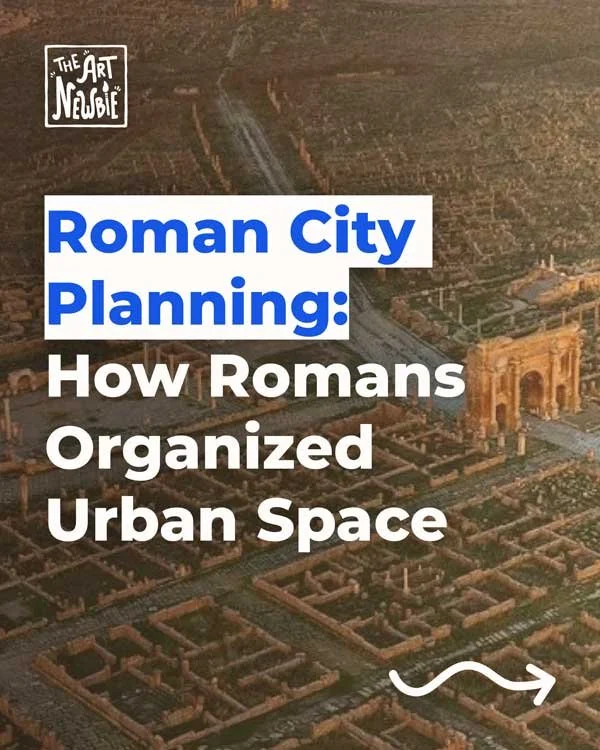
If you want the wider setting for this material, it helps to start with Roman architecture. Roman concrete makes the most sense when you see it as part of a broader building culture, not as an isolated technical trick.
When did Romans start using it?
Roman concrete did not appear in one sudden moment. Like many major building technologies, it developed gradually. The Romans did not jump directly from traditional masonry to giant domes. They refined mortar-based construction over time, improved its ingredients, and learned how to use it with growing confidence.
Concrete became especially important from around the second century BCE onward. From that point, it starts to appear more clearly as a major Roman construction technique rather than a minor practical aid. Over time, Roman builders became better at combining concrete with wall facings, formwork, and structural planning. As that knowledge spread, concrete became central to both public and private architecture.
This gradual growth matters because Roman concrete was never a single fixed formula. Its composition could vary. Its uses could vary. A harbor installation, a house wall, and an imperial dome did not all use the material in exactly the same way. So the story of Roman concrete invention is really the story of a technology becoming more refined, more systematic, and more architecturally ambitious.
That process is one of the reasons Roman architecture changed so much over time. Once builders could trust concrete more fully, they could think differently about mass, enclosure, and scale.
Why did pozzolana matter so much?
One of the most important ingredients in ancient Roman concrete was pozzolana, a volcanic ash mixed into the binder. This ash mattered because it helped create a hydraulic material, meaning one that could set and harden effectively even in wet conditions.
That property had major consequences. It improved durability and helped Roman builders work in damp environments. It also made some of Rome’s most impressive infrastructure possible, especially in relation to water and harbor construction. Roman concrete was not magical, but pozzolana gave it a level of performance that helped distinguish it from many simpler lime-based mixtures.
This also shows how closely Roman technology depended on geography. Volcanic materials from central Italy, especially from areas around the Bay of Naples, played a major role in the development of the material. Roman innovation was not only about clever design. It was also about understanding and exploiting local resources.
At the same time, pozzolana should not be turned into a mythic secret that explains everything by itself. Roman concrete worked well because of the whole system: the lime, the aggregate, the ash, the way the material was mixed, how it was laid, and how it was integrated into broader structural design. The volcanic ash was crucial, but it was still only one part of a larger building intelligence.
To place it in context, it also helps to look at Roman building materials. Roman construction was rarely about one pure material. Concrete worked alongside stone, brick, timber, marble, and terracotta, each with a different role.
How was Roman concrete actually used?
A lot of people imagine Roman concrete as if it were poured exactly like modern concrete. That image is not quite right. Roman concrete was often laid and packed into place within a more layered construction system.
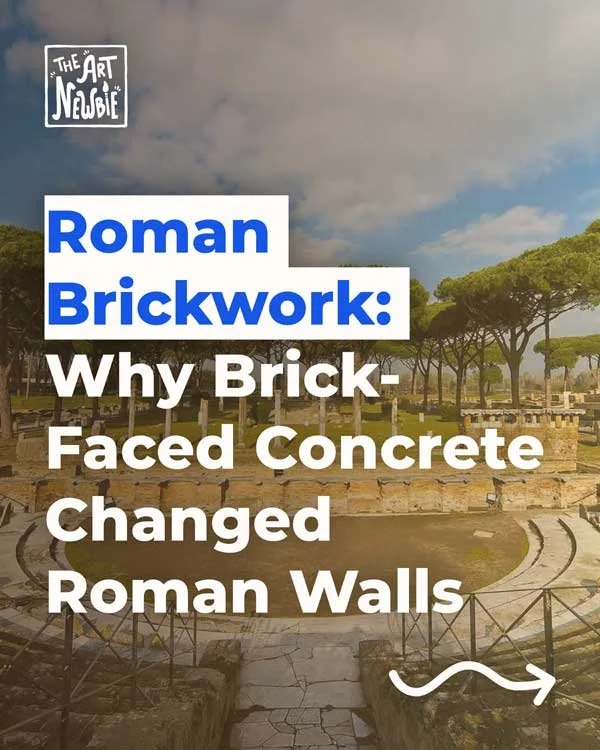
A common method was to build a concrete core between two outer faces. Those outer faces could be made in different ways depending on period and context. In early work, builders often used irregular stone facings known as opus incertum. Later, there was opus reticulatum, with its neat net-like surface pattern. In many imperial buildings, brick-faced concrete became especially common. You can follow these shifts more closely in Roman opus types, Roman wall construction, and Roman brickwork.
This matters because Roman concrete was often a hidden structure rather than an exposed finish. The outer face organized and protected the wall, while the concrete gave it mass and strength. Many Roman walls were then covered further with stucco, paint, or revetment. So Roman concrete usually sat inside a more complete architectural skin.
Formwork was also essential. Temporary wooden frameworks could hold the material while it set. That made it easier to shape curved or massive forms, especially in vaults and domes. Once Roman builders became more confident with these methods, concrete could move far beyond simple foundations and retaining walls. It became a way to create ambitious interior architecture.
So Roman concrete was never just a recipe. It was a construction practice. It depended on method, sequencing, containment, and a clear understanding of how the material would behave within the larger building.
What did Roman concrete make possible?
This is the real turning point. Roman concrete did not matter only because it was durable. It mattered because it changed space.
Once Roman builders could combine concrete with the Roman arch, they were no longer limited in the same way by post-and-lintel construction, where a horizontal beam spans between upright supports. Arches redirect weight sideways. When extended, they become Roman vaults. When rotated around a central point, they become the Roman dome. Concrete made all of those forms easier to build at larger scale.
That had huge architectural consequences. Interiors no longer needed to depend so heavily on rows of columns. Spaces could become broader, more continuous, and more varied. Architecture could turn into a sequence of halls, niches, corridors, chambers, and soaring vaulted rooms.
This is one reason Roman architecture feels so spatially ambitious. Baths needed large roofed interiors. Basilicas needed wide civic halls. Monumental public buildings needed to manage movement, scale, and enclosure. Concrete helped make all of that possible.
It also encouraged experimentation. Builders could vary aggregate, control wall thickness, and adapt structures to different scales and uses. In that sense, Roman concrete did not only solve technical problems. It made new architectural ideas practical.
Which buildings show it best?
Some Roman buildings reveal the importance of concrete especially clearly because they turn the material into a spatial statement.
The Pantheon is the most famous example. Its great dome and rotunda show what Roman concrete could do when material and geometry were pushed to an extraordinary level. The effect is not just structural. It is also spatial and emotional. The dome creates a single, unified interior that still feels radical. If you want the chronology of the monument itself, see when was the Pantheon built.
Roman baths are another essential example. Bath complexes needed large halls, service systems, water management, and heavy daily use. Concrete worked especially well in that environment because it supported both monumental space and practical engineering.
The Basilica of Maxentius is just as important. Even in ruin, it still shows the enormous scale Roman concrete could support in civic architecture. Its vaulted structure makes visible the connection between material mass and public monumentality.
These examples matter because they show different strengths of the material. In the Pantheon, concrete supports a revolutionary dome. In baths, it helps create large functional interiors. In the Basilica of Maxentius, it magnifies civic scale. Together they show that Roman concrete was not tied to one single building type. It shaped many of the most characteristic forms of Roman architecture.
Roman concrete vs modern concrete
This comparison is useful, but only if it stays precise. Roman concrete vs modern concrete is not a simple contest between ancient genius and modern decline.
Modern concrete is usually based on Portland cement and is often reinforced with steel. It is engineered for modern demands such as speed, standardization, long spans, high-rise systems, and large-scale infrastructure. Roman concrete had different ingredients, different placing methods, and different structural goals.
Roman concrete also was not perfectly uniform. Recipes varied depending on place, period, and use. A marine concrete, a wall core, and a dome did not all behave in the same way. So broad claims that Roman concrete was simply “better” than modern concrete are too vague to be helpful.
What can be said more carefully is that Roman concrete proved remarkably durable in many contexts, especially when well matched to local materials and construction methods. That long durability is one reason it continues to attract scientific interest today.
A better conclusion is that Roman and modern concretes belong to different building cultures. Roman concrete helped create massive masonry-like architecture with thick walls, vaults, and domes. Modern concrete often belongs to a world of reinforced frames and very different engineering priorities. The comparison is interesting, but only when it respects those differences.
Why did it change architecture forever?
Roman concrete changed architecture because it brought together material freedom, structural ambition, and spatial possibility. It allowed walls to become coherent masses, helped arches and vaults operate at larger scale, and made possible the great domed and vaulted interiors that define so much of Roman architecture.
It also changed the relation between architecture and engineering. Concrete was not about surface appearance alone. It belonged to foundations, supports, infrastructure, circulation, and the practical realities of building. That is why Roman architecture often feels so system-oriented. Material, structure, and use are tightly linked.
Most importantly, Roman concrete expanded what architecture could be. It helped move construction away from a world dominated by cut stone and straight beams toward one where curved, continuous, and monumental interior space became normal. That change shaped baths, basilicas, domes, retaining systems, and civic complexes across the Roman world.
So yes, Roman concrete changed architecture forever. Not because it was mysterious, and not because every Roman building depended on it equally, but because it gave builders a new way to think. It made architecture less about assembling separate pieces and more about forming space through mass.

Conclusion
Roman concrete was more than a durable ancient mix. It was one of the key materials behind Rome’s architectural transformation. By combining lime, aggregate, and often volcanic ash into a structural mass, Roman builders gained new freedom to shape walls, arches, vaults, domes, and large public interiors.
That is why the material matters so much. Roman concrete did not simply support Roman architecture. It helped redefine what architecture could do.
FAQ
What was Roman concrete made of?
Roman concrete was made from lime, water, aggregate such as stone or brick fragments, and often volcanic ash called pozzolana.
Is Roman concrete the same as Roman cement?
Not exactly. Roman concrete is the fuller and more accurate term for the building material. Cement is only the binder inside the mix.
Did the Romans invent concrete?
Not in the broadest sense. Earlier cultures used mortar-based construction, but the Romans developed concrete into a far more powerful architectural system.
Why was pozzolana important?
Pozzolana helped Roman concrete harden effectively, even in wet conditions, and contributed to the durability that made many Roman structures last so long.
Why was Roman concrete important for domes?
It made it easier to build thick curved masses and large continuous forms, which helped Roman builders develop vaults and domes at impressive scale.
Is Roman concrete better than modern concrete?
Not simply. Modern concrete is designed for different engineering goals. Roman concrete is especially admired for its durability and for how well it supported Roman masonry architecture.
Sources and Further Reading
You may also like