Pediments of the Parthenon: What Each End of the Temple Shows
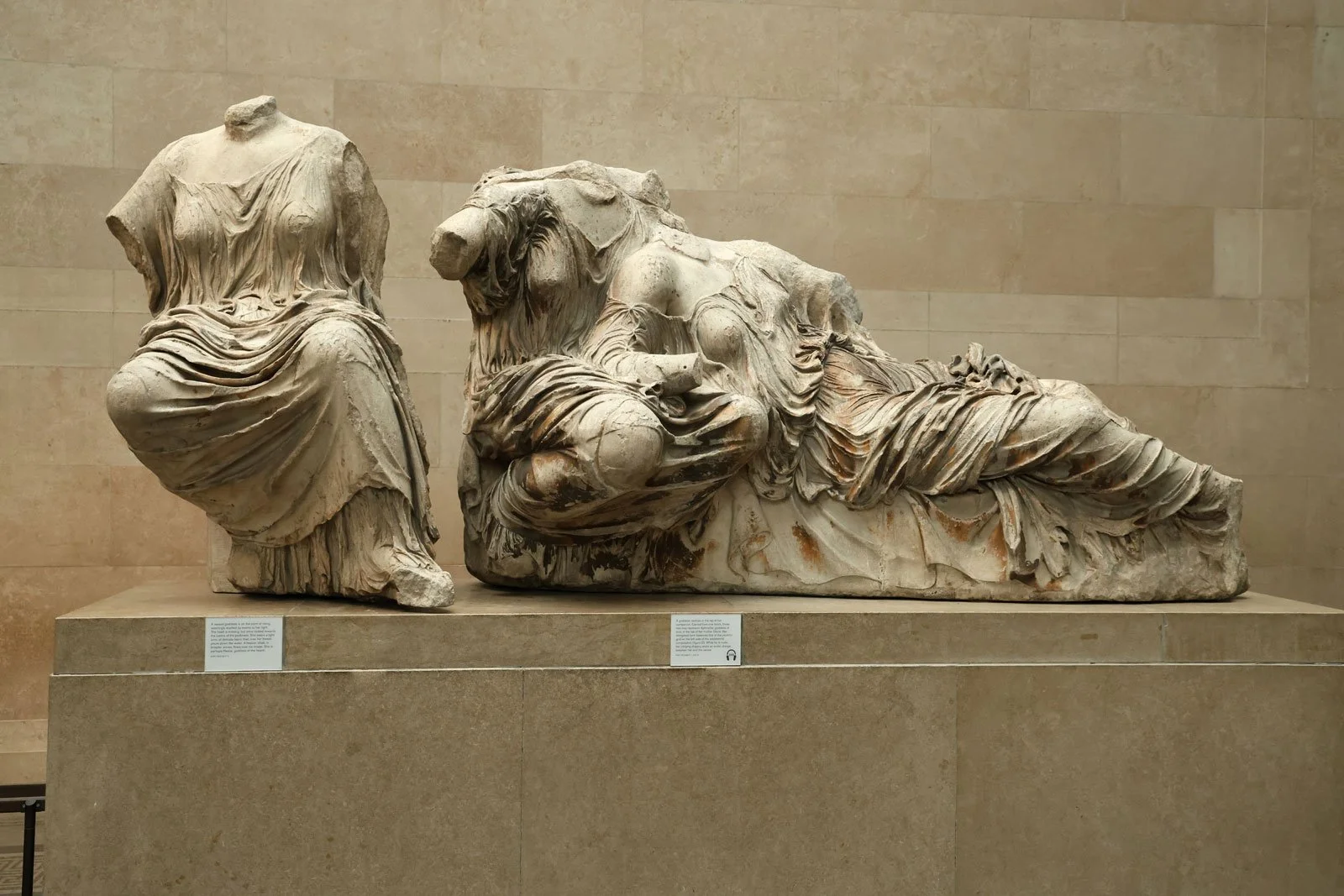
The east pediment is usually read as Athena’s birth, with gods arranged across the triangular space.
The Parthenon pediments are like two giant headlines at either end of the temple. They sit high, they face outward, and they tell you what kind of world you’re entering before you’ve even seen a single metope or frieze block.
What’s tricky is that the pediments are also the Parthenon’s most damaged sculptural zone. We’re reconstructing from fragments, early drawings, and the logic of Greek myth imagery. So this is an evidence-forward guide: what the east and west pediments are believed to show, how scholars reach those conclusions, and why those myths mattered for Athens.
Definition: A pediment is the triangular sculpted space at a temple’s end.
The pediments frame Athena’s identity from two angles: origin and ownership
This is the simplest way to read them, and it stays true even with missing pieces.
The Parthenon is Athena’s temple. So the pediments do not pick random myths. They pick the myths that justify Athena’s authority and Athens’ relationship to her. If you want the “why this matters” layer for the whole building, keep why these myths matter in mind.
One pediment shows Athena entering the world as a divine force. The other shows Athena winning the city.
That pairing is not subtle. It says: Athena is legitimate in the cosmos, and Athena is legitimate in Athens.
And if you’re ever in doubt about which figure is Athena in a fragmentary scene, it helps to have the quick attribute checklist from spot Athena fast. Helmet, aegis, shield language, and a commanding central placement are your best visual anchors.

The west pediment is usually reconstructed as Athena and Poseidon competing for Athens.
East pediment: Athena’s birth, staged as a cosmic event
The east pediment (the front-facing end of the temple) is traditionally identified as the birth of Athena.
In myth, Athena is born fully armed from Zeus’s head. That’s already a strong message: she is not a child deity growing into power. She arrives as wisdom and war in one instant, already complete.
The way pediments work supports this story. A pediment needs a central climax, with figures cascading outward into the corners. A divine “burst” event fits the triangle perfectly. Zeus can occupy the center as the authority figure. Athena’s emergence becomes the dramatic moment. Other Olympian gods, attendants, or personifications can fill the flanks and corners, reacting and balancing the composition.
Because the scene is heavily fragmentary, some details remain debated: who sits where, which secondary figures are present, and how certain personifications are identified. Still, the consensus identification of the scene as Athena’s birth is strong, partly because it matches the Parthenon’s dedication and because ancient viewers would have expected a foundational Athena myth in that prime location.
It also works thematically with the rest of the temple: an exterior program that consistently elevates Athens’ patron goddess to cosmic legitimacy.
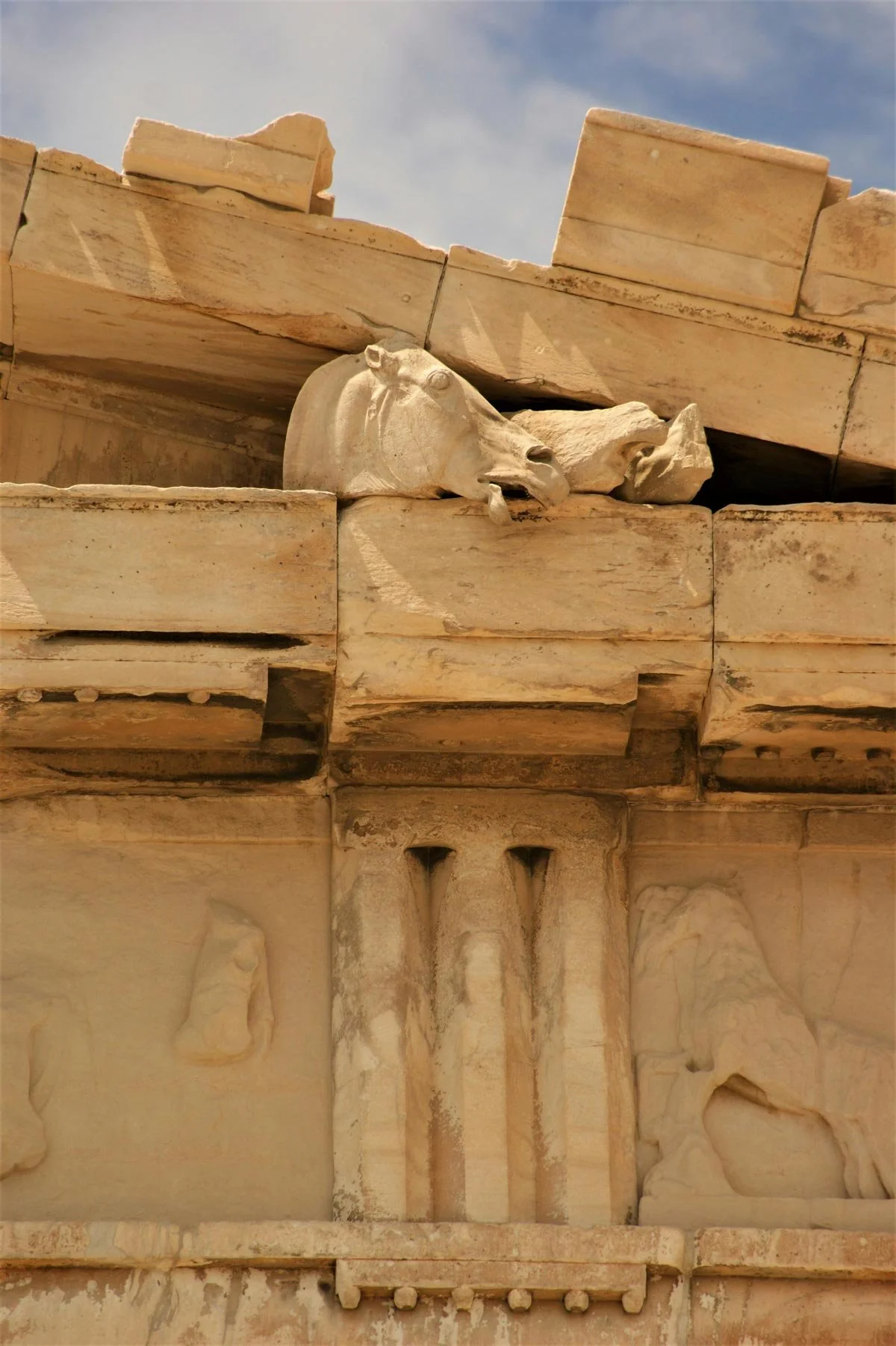
Horse fragments like this show how the pediment scenes pushed all the way into the corners.
West pediment: Athena vs Poseidon, the myth of choosing Athens
The west pediment (the end facing outward toward the Acropolis approach routes) is commonly identified as the contest between Athena and Poseidon for patronage of Athens.
In the myth, both gods offer a “gift.” Athena’s olive tree is associated with prosperity and civic life. Poseidon’s gift is linked to the sea, often represented as a salt spring or a horse in later retellings. Athena wins, and the city becomes hers.
As an image on a temple, this does something very direct: it makes Athens’ identity look divinely settled. The city is not just powerful because it is powerful. It is powerful because the gods chose its patron and its values.
Visually, this is also a perfect pediment scene because it’s dynamic and symmetrical: two deities confront each other at the center, often with diagonal energy and strong gestures, while secondary figures populate the sides. Those flanking figures are often thought to include local heroes, river gods, or personifications tied to Attica and its landscape.
This is where myth becomes almost geographic. The west pediment isn’t only “a god fight.” It’s a myth that explains why Athens belongs to Athena, and why Athena belongs to Athens.
The pediments “speak” differently from the metopes and frieze, but they’re part of one program
If the metopes show conflict and the frieze shows civic order, the pediments provide foundations.
The metopes dramatize mythic battles. That’s why the metopes as myth battles often feel more violent and immediate. They stage “order vs chaos” in a series of discrete punches.
The frieze, by contrast, is civic rhythm and procession. It makes Athens look orderly, unified, and worthy.
The pediments sit above both and do something different. They provide the mythic “why.” Athena’s birth gives her cosmic legitimacy. Athena’s contest gives her civic legitimacy. That’s why, as a reading system, the pediments are not optional. They’re the temple’s identity statement in myth form.
If you want the entire sculptural system as one integrated argument, this is exactly what how it fits the program lays out: different sculptural zones doing different jobs, all reinforcing one message.
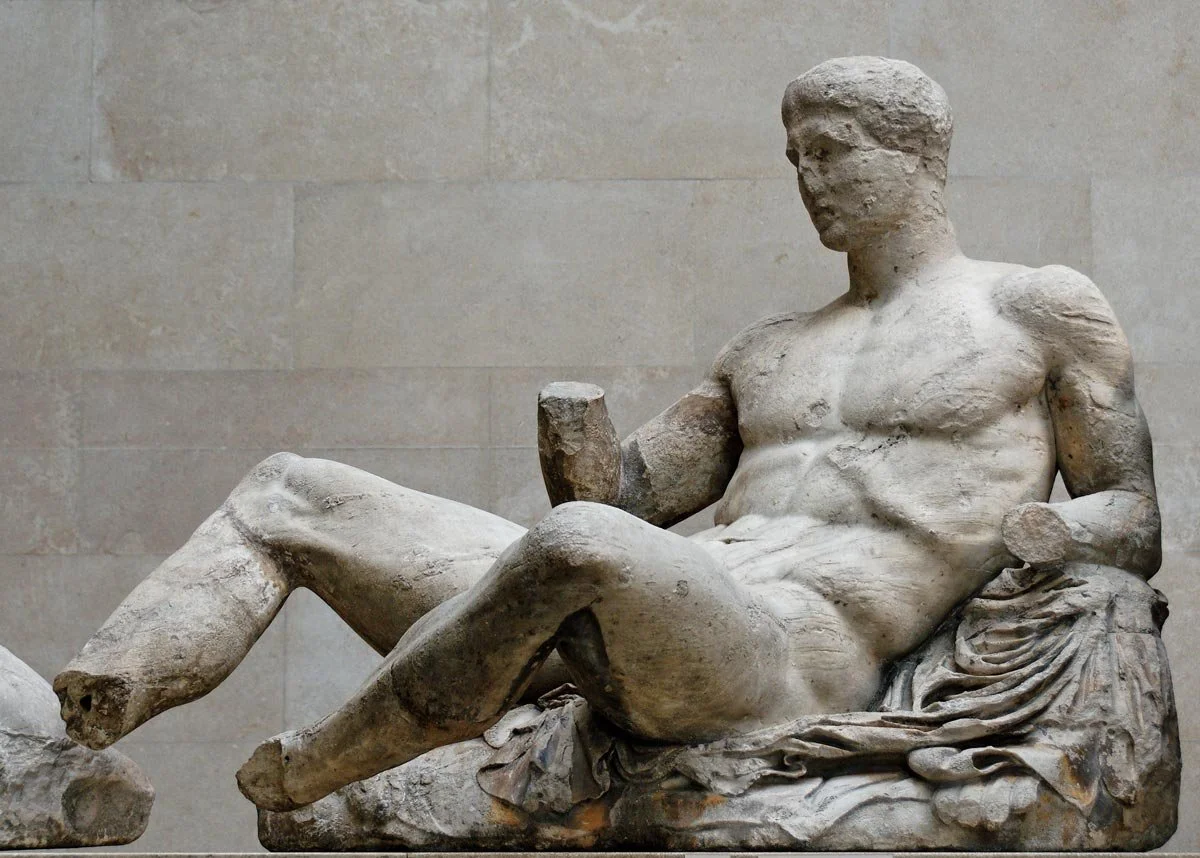
Reclining figures solved a practical problem: the pediment corners are too low for standing bodies.
These myths also show how older stories keep feeding later Greek art
A final note that’s easy to miss: Classical Athens didn’t invent myth. It curated myth.
Greek artists repeatedly reuse older stories and reshape them for new contexts. Myths survive by being retold, not by staying fixed. Even “monster” myths and Bronze Age narrative worlds keep echoing into later Classical art, where they become symbols, metaphors, and cultural memory.
If you want a strong example outside the Parthenon context, how older myths survive into later Greek art shows this continuity beautifully. The Parthenon is doing the same thing, but with Athena-centered myths that serve a specific civic purpose.
So yes, the pediments are about Zeus, Athena, Poseidon, and divine drama. But they’re also about Athens choosing which myths will define its public self-image.

Conclusion
The Parthenon’s pediments are believed to show two foundational Athena myths: the east pediment frames Athena’s birth as a cosmic event, and the west pediment frames Athena’s contest with Poseidon as the myth of Athens’ patronage. Even though the sculptures are fragmentary, the scene identifications are strong because they match the temple’s dedication, the logic of pediment composition, and the Parthenon’s broader ideological program.
Read together, the pediments tell us what Athens wanted the Parthenon to say before anything else: Athena is legitimate in the universe, and Athens is legitimate under her protection.
FAQ
What do the Parthenon pediments depict?
The east pediment is generally read as Athena’s birth, and the west pediment as Athena’s contest with Poseidon for Athens.
Why are the pediments harder to “read” than the frieze?
They’re more fragmentary today, and reconstructions rely on surviving pieces, early drawings, and scholarly interpretation.
Which side is the east pediment?
The east pediment is on the main front of the temple, traditionally the most sacred-facing orientation.
How do the pediments connect to the rest of the sculpture program?
They provide the mythic foundations that support the metopes’ conflict imagery and the frieze’s civic ritual imagery.
Sources and Further Reading
Acropolis Museum. “The pediments” and “Parthenon. West pediment. Ilissos.” Accessed 21 February 2026.
British Museum. “The Parthenon Sculptures.” Accessed 21 February 2026.
Smarthistory (Beth Harris and Steven Zucker). “Phidias, Parthenon sculpture (pediments, metopes and frieze).” 25 November 2015. Accessed 21 February 2026.
Jenifer Neils. The Parthenon Frieze. Cambridge University Press, 2001.
Jeffrey M. Hurwit. The Acropolis of Athens in the Age of Pericles. Cambridge University Press, 2004.
You may also like