Statue of Zeus at Olympia: What the Ancient Wonder Was Like
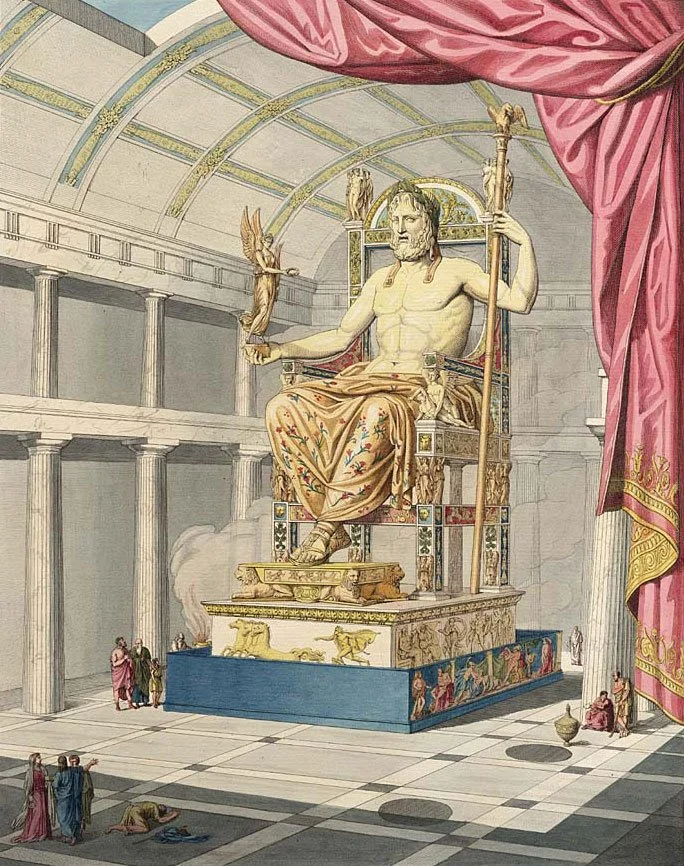
The Statue of Zeus at Olympia was imagined as a colossal seated god filling the temple cella.
Imagine walking into a temple and realizing the god inside is so large he almost doesn’t fit. That was the Statue of Zeus at Olympia. Not standing heroically, but seated and colossal, like a king who doesn’t need to prove anything.
When people ask what the ancient wonder was like, they usually want a picture. We can’t fully give them that, because the original is lost. But we can reconstruct a surprisingly detailed “feel” of it from descriptions, archaeological traces, and the way Greek cult statues were meant to work on the mind.
This was a cult statue designed to overwhelm, not a sculpture designed to travel
Yes, it was made to be seen, but it was also made to be encountered.
A cult statue is the main sacred image in a sanctuary. It’s the focus of ritual attention. That’s why the Statue of Zeus at Olympia wasn’t just “a masterpiece by Phidias.” It was the beating heart of the Temple of Zeus during the Olympic sanctuary’s peak.
Quick facts (the stuff we can say with high confidence):
Where: inside the Temple of Zeus at Olympia
When: made in the 430s BCE (best scholarly range)
Who: Phidias (and a workshop)
How big: about 12 meters tall, seated
Material:gold-and-ivory over a core
To understand why this mattered, it helps to remember why cult images mattered. Greek temples weren’t primarily indoor congregational spaces. The interior was special, controlled, and charged. The statue didn’t need to “tell a story” like a frieze. It needed to make the god present.

Coins from Elis are one of the main pieces of evidence used to reconstruct Phidias’s lost Zeus.
The gold-and-ivory technique made Zeus look alive in a way marble can’t
This statue didn’t read as “white.” It read as luminous.
Gold-and-ivory (often called chryselephantine) construction is, in plain words, precious skin over a structure. Ivory for flesh. Gold for garments, hair, and divine shine. The result is not subtle. Even in low light, the materials would catch and return attention.
This is why visitors remembered it as a wonder. You’re not looking at “stone shaped like Zeus.” You’re looking at a crafted presence that blurs into something more-than-human.
And it also places the statue inside the broader ecosystem of Classical cult statues, where the goal isn’t raw realism. The goal is controlled power: calm face, overwhelming scale, and surfaces that signal divinity.
Myth vs Fact
Myth: Ancient wonders were “primitive” versions of later art.
Fact: Zeus at Olympia used advanced materials and staging to shape perception.
The iconography was simple: kingship, victory, and a readable Zeus “signature”
What did Zeus actually look like? Ancient descriptions converge on a consistent set of signs.
If you want a beginner-friendly “spotting method,” this is where a god attributes guide becomes useful. Greek gods can look similar until you know what to scan for.
For Zeus, the statue emphasized the essentials:
a wreath (described as olive) that signals sacred authority
Nike (Victory) in his right hand, like power made visible
a scepter in his left, topped with an eagle
an elaborate throne, treated like a second artwork
Those details also match the broader pattern of how Zeus is shown across Greek art: rulership, control, and the ability to “hold” victory rather than chase it.
One of my favorite reported impressions is the ancient joke that if Zeus stood up, he’d break the roof. Whether that line is perfectly literal or slightly theatrical, it tells us how viewers felt: the statue wasn’t just big. It was architecturally dominant.
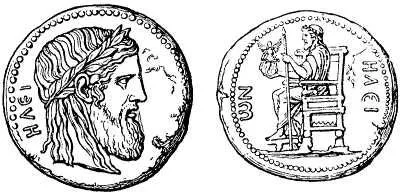
Later enthroned statues help us recognize the standard visual type associated with Zeus.
Olympia made this statue panhellenic, not just local
Why did this Zeus become a world-famous wonder?
Because Olympia wasn’t just a city sanctuary. It was a panhellenic stage. People came from across the Greek world for the Games, and the sanctuary framed those contests as sacred. That means the audience wasn’t one community. It was many communities, repeatedly, over centuries.
So Zeus at Olympia worked like a shared reference point. A “this is what Zeus looks like” moment, built at the scale of collective imagination.
This is also where money and prestige enter the story. Wonders don’t happen in poor, quiet decades. They happen when communities are willing to fund enormous public statements. Put simply: it belonged to the world that funded wonders, when Greek states were pouring resources into monuments that could compete for cultural authority.
The statue disappeared because its materials were valuable and its survival was fragile
Here’s the hard truth about ancient masterpieces: gold invites recycling, and ivory demands careful conditions.
We have no surviving original, and the end of the statue is still discussed in “most likely” terms. Some accounts suggest it may have been destroyed when the sanctuary suffered major damage in Late Antiquity. Other traditions suggest it could have been moved and then lost in a later fire.
What we can say confidently is that its fame outlived its physical body. People kept describing it, coins likely echoed its composition, and later writers treated it as a benchmark for what divine majesty in art should feel like.
That’s a strange kind of survival, but it’s real.

Conclusion
The Statue of Zeus at Olympia was a colossal gold-and-ivory cult image designed to overwhelm: Zeus seated as king, holding Victory, crowned, enthroned, and staged inside a temple where the encounter itself carried meaning. Its power came from more than size. It came from materials, controlled visibility, and the panhellenic context of Olympia.
Even as a lost object, it’s still one of the clearest examples of what Greek sacred art could do: make belief feel tangible.
FAQ
Was the Statue of Zeus at Olympia real, or mostly legend?
It was real, widely described in antiquity, and treated as one of the Seven Wonders.
How tall was the Statue of Zeus at Olympia?
Ancient and modern summaries usually put it at about 12 meters tall, seated.
What was it made of?
Gold and ivory over a structural core (a gold-and-ivory, chryselephantine technique).
Who made it?
Phidias is traditionally credited, working with a workshop.
Why did it become so famous?
Because Olympia was panhellenic, and the statue combined scale, precious materials, and divine iconography into an unforgettable encounter.
Sources and Further Reading
Encyclopaedia Britannica —“Statue of Zeus” (2025).
UNESCO World Heritage Centre —“Archaeological Site of Olympia” (1989).
Pausanias (trans. W.H.S. Jones & H.A. Ormerod) —“Description of Greece 5.11.1 (Zeus at Olympia)” (1918).
Richter, Gisela M. A. (Hesperia) —“The Pheidian Zeus at Olympia” (1966).
Penn Museum (Tom Tartaron) —“Great Wonders: The Statue of Zeus at Olympia” (2015).
Edinburgh Scholarship Online (Oxford Academic) —“Zeus at Olympia” (2010).
You may also like