Apollo Statue: How to Identify Apollo in Greek Sculpture
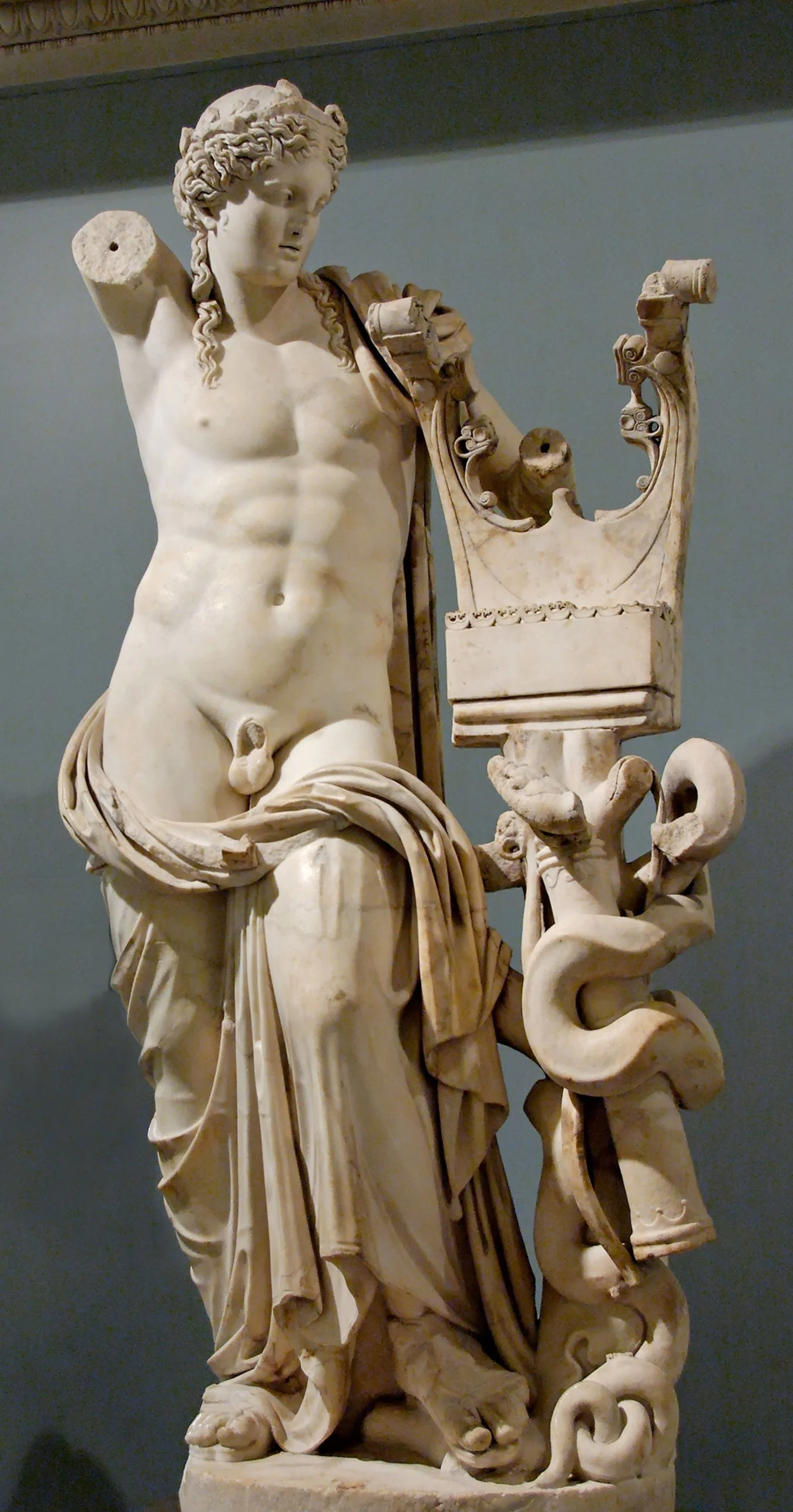
A kithara or lyre is one of the clearest ways to identify Apollo.
Apollo is the kind of god we think we’ll recognize instantly. Youthful face, perfect hair, effortless beauty, some kind of music energy. Then we get to a museum, see a smooth young male statue missing its hands, and suddenly Apollo looks… like every other smooth young male statue.
So let’s make this easy in a way that still respects the myth. Apollo isn’t just “pretty.” He is a god of order. Order in sound (music). Order in knowledge (prophecy). Order in the body (ideal form). Greek sculptors built those ideas into a repeatable visual costume.
We’re going to retell the myth threads that shaped his image, then turn them into a practical identification checklist you can use in ten seconds.
Apollo’s story makes him readable because his powers are objects
Apollo’s identity isn’t hidden in his facial features. It’s carried by what he does, and what he holds.
In myth, Apollo arrives fast and fully formed. One of the most influential stories places his birth on Delos, then immediately makes him claim space in the world as a god who demands recognition. This “arrival energy” becomes a visual habit: Apollo is often shown as youthful and self-possessed, not aged, not chaotic, and rarely uncertain.
Then the myth gives him two huge roles that are easy to translate into sculpture:
Apollo as music: harmony that civilizes.
Apollo as prophecy: knowledge that organizes.
So sculptors give him instruments and ritual signs. A lyre (small string instrument) or kithara (larger professional lyre) is basically the loudest “this is Apollo” label in Greek art. And once you know that, you start seeing Apollo’s statues as a kind of myth in shorthand: the god who makes the world intelligible.
If you want the wider toolkit for how gods get “labeled” in art, this is where Apollo’s attributes becomes useful. Apollo is one of the clearest because his symbols are so consistent.
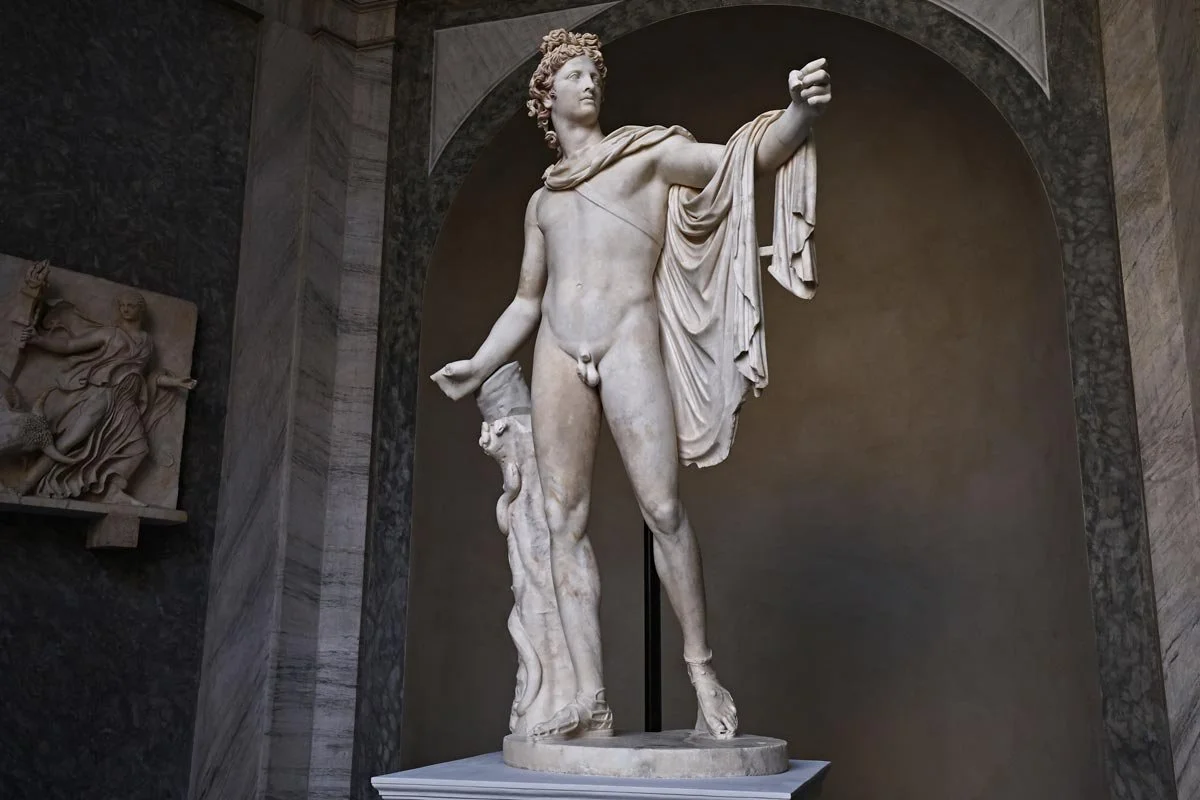
Apollo is often shown as a youthful ideal body with a calm, controlled presence.
Apollo’s face stays calm because Classical art treats control as beauty
Here’s the strongest claim: Apollo looks “calm” because calm is part of the message.
Apollo is not only a myth character. In Greek visual culture, he becomes the embodiment of measured harmony. That’s why, across the Classical era, Apollo’s statues often show a controlled expression and an idealized body, even when he is doing something powerful like aiming a bow.
In other words: Apollo is not the god of raw emotion. He is the god of form.
This is exactly the aesthetic you see in the Classical ‘calm’ look, where artists push for lifelike bodies but keep the overall mood stable. And it ties directly into Greek beauty ideals, the idea that “perfect” doesn’t mean hyper-real. It means coherent, balanced, edited.
Myth vs Fact
Myth: Apollo is identifiable because he’s simply “the beautiful one.”
Fact: Apollo is identifiable because beauty is paired with symbols of order.
So if you’re looking at a statue and thinking “this guy is too calm to be in an action scene,” that’s not a problem. That’s a clue.
Laurel is Apollo’s quiet badge, and its myth explains why it sticks
If the lyre is Apollo’s loudest label, the laurel is his most poetic one.
Laurel is, in plain words, a sacred victory plant associated with Apollo. In myth, it’s tied to transformation and desire, the famous story where Daphne becomes a laurel tree and Apollo adopts the laurel as his emblem. That story is doing two things at once:
It explains the symbol.
It frames Apollo as a god whose desire turns into ritual.
So in sculpture, laurel can appear as a wreath, a sprig, or a subtle head adornment. It’s especially helpful when the statue’s hands are missing. A missing lyre is tragic for identification. A surviving laurel crown can save you.
This is also where we should be gentle with ourselves. Laurel wreaths can appear with other figures too. They are not exclusive. But laurel plus youthful calm plus even one additional Apollo clue (lyre, bow, or prophetic context) creates a strong identification.
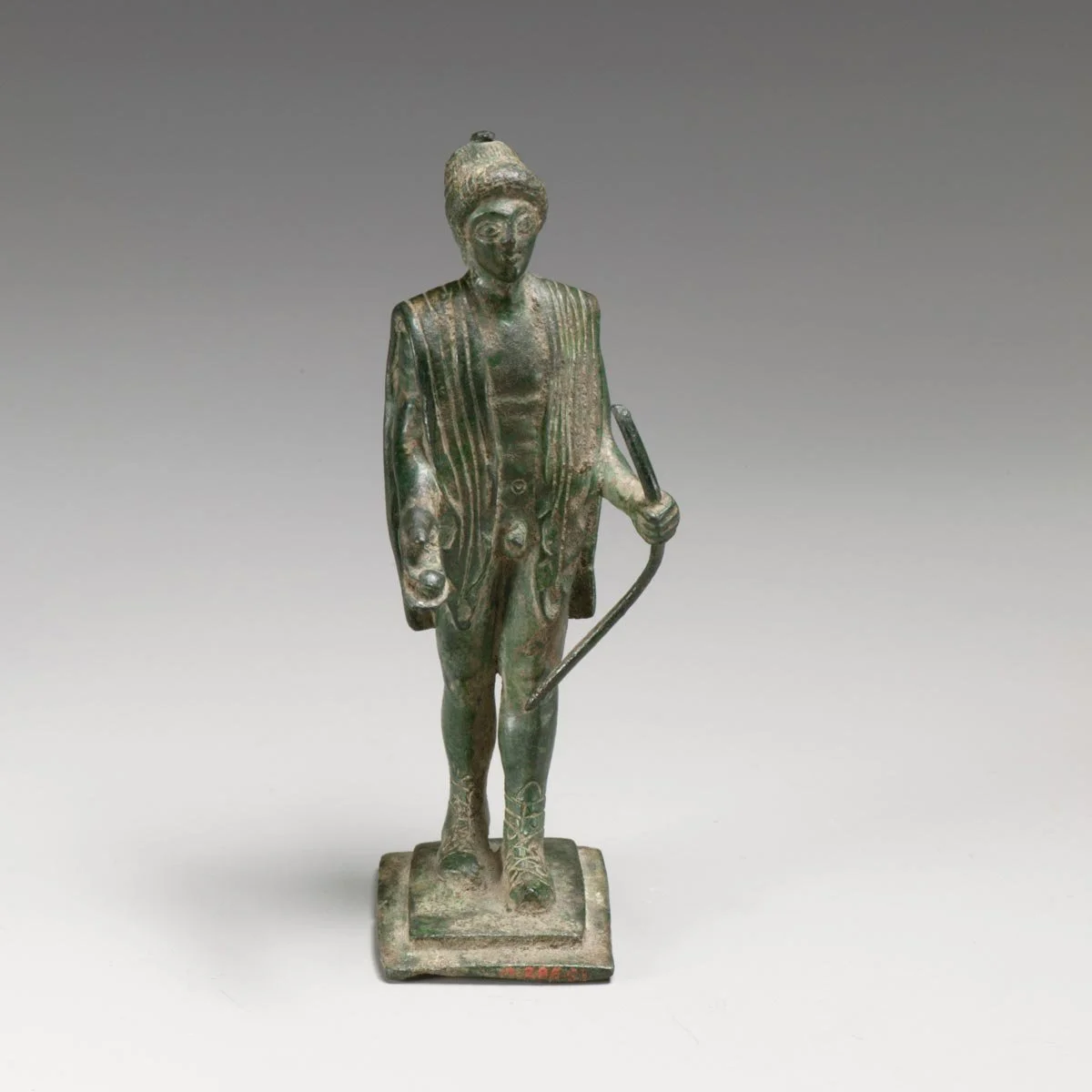
In small bronzes, Apollo is often identified by youthful nudity and a lost bow or musical attribute.
Bow and arrows can mean Apollo, but only if the statue feels “ordered”
Apollo is also a god of archery, and that can confuse things, because Artemis (his twin) is also an archer.
So the trick is not “bow = Apollo.” The trick is “bow + Apollo vibe.”
Apollo is often represented as:
youthful male body
clean, controlled posture
minimal clutter
idealized anatomy rather than rugged physical strain
That is why later famous “Apollo types” in Roman art, like the Apollo Belvedere tradition, lean into poised archery rather than gritty battle. Even when the weapon is present, Apollo reads as a god of precision, not chaos.
If you’re stuck between Apollo and Artemis, look for gendered conventions in Greek sculpture (Apollo usually read as youthful male; Artemis as youthful female, often in a short hunting garment in some media). And if the figure is missing too much to be sure, don’t force certainty. Greek identification is often a probability game.
Apollo’s myths show up in images long before the “perfect statue” does
If we only learn Apollo through marble statues, we miss how deeply his story lived in everyday imagery.
Greek pottery is one of the best places to see Apollo acting: playing music, holding ritual objects, participating in divine scenes, or appearing alongside other gods where his attributes help us identify him. That’s why Apollo and myth on vases is such a good companion lens. Painted scenes make the narrative clearer. Once you recognize Apollo there, statues become easier because you already know what the symbols are trying to say.
This also explains why Apollo “looks consistent” over time. His myth roles are stable, so his attributes are stable. Different workshops stylize him differently, but the identity kit keeps returning.
And Greek architecture does something similar at a bigger scale: it turns myth into public statement. Temple sculpture uses gods and stories as civic language, which is why even a Parthenon-focused discussion of myth scenes in sculpture can help your Apollo eye. The habit is the same: myths become visual shorthand for values.
Here’s the Apollo checklist you can actually use in a museum
If you want the practical version, scan in this order. You’re looking for combinations, not single proof points.
Lyre or kithara: the strongest identification clue.
Laurel: wreath or sprig, especially with youthful calm.
Bow: works best when paired with poised, idealized stance.
Youthful male type: smooth face, athletic but not bulky body.
Overall mood: controlled, orderly, “perfected” rather than gritty.
If you get two of these clearly, Apollo is a strong bet. If you get three, you can feel confident.
And if you want to zoom back out to “how does this fit into Greek sculpture as a whole,” Apollo’s image makes the most sense when you read it through Greek beauty ideals. Apollo isn’t just a character. He’s a visual argument for harmony.

Conclusion
Identifying an Apollo statue becomes easy the moment we stop searching for a unique face and start searching for a myth-made costume. Apollo is the youthful god of order, and Greek sculptors signal that order through the lyre, the laurel, the poised archer body, and the Classical calm that keeps power under control.
Once you learn that language, Apollo stops blending into “generic beautiful youth.” He becomes instantly readable, and honestly, a lot more interesting, because we’re no longer admiring a body. We’re reading a god’s job description in stone.
Sources and Further Reading
The Metropolitan Museum of Art — “Greek Gods and Religious Practices” (n.d.)
The Metropolitan Museum of Art — “The Art of Classical Greece (ca. 480–323 B.C.)” (2008)
Oxford Classical Dictionary (Fritz Graf) — “Apollo” (n.d.)
Scaife Viewer (Perseus Digital Library) — “Hymn 3 to Apollo” (n.d.)
The British Museum — “Statue of Apollo (from the Temple of Apollo, Cyrene)” (n.d.)
Acropolis Museum — “Statuette of Apollo” (n.d.)
Vatican Museums — “Apollo del Belvedere” (n.d.)
You may also like