Sarcophagus of the Spouses: Why This Smiling Couple Became an Icon
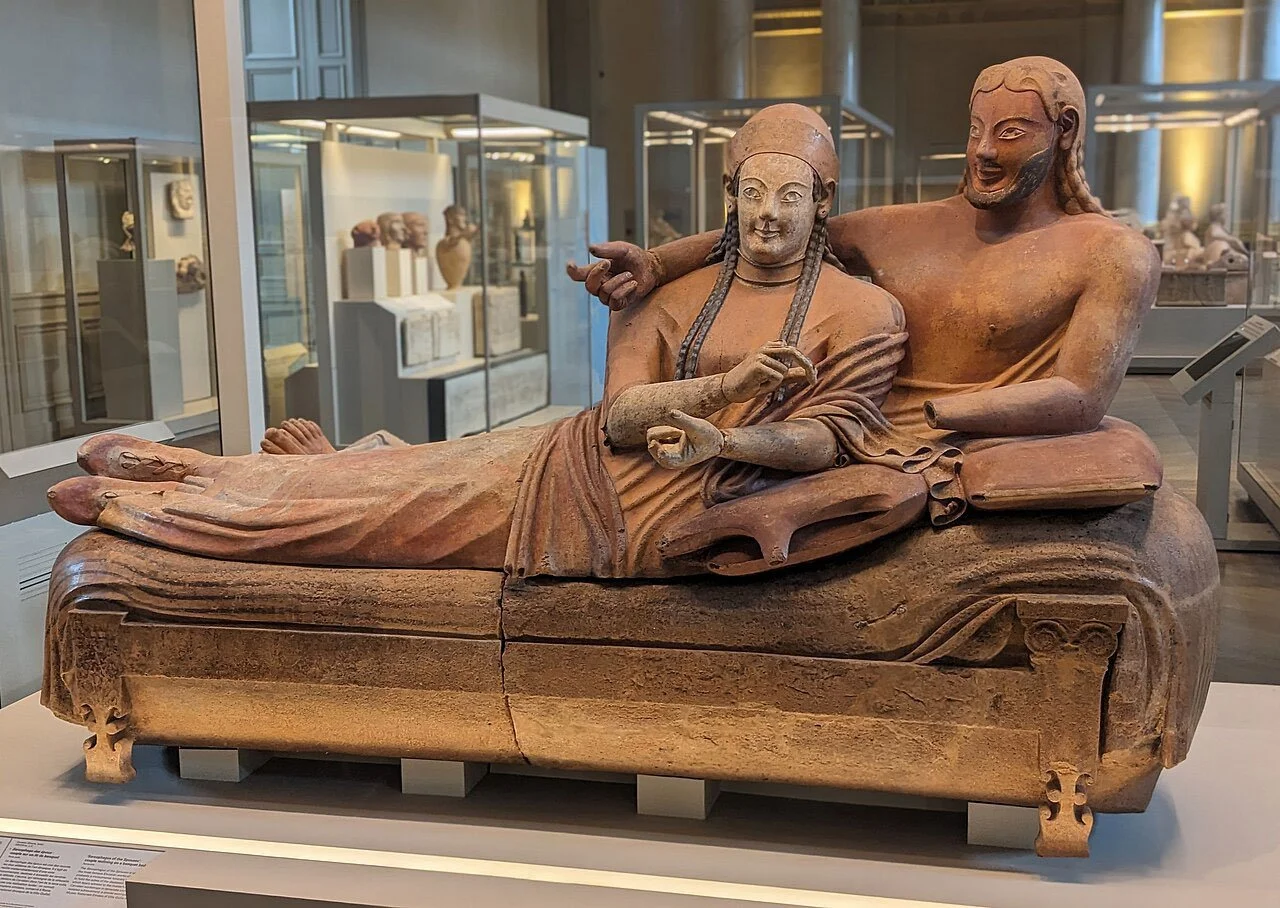
This full view makes it easy to see why the Sarcophagus of the Spouses became an icon of Etruscan funerary art.
The Sarcophagus of the Spouses became an icon because it does something ancient funerary art does not always do so openly: it feels warm, social, and almost conversational. Instead of showing death as silence or separation, it shows a reclining couple sharing space, gesture, and presence. That is the first thing most people notice, and it is exactly why the work stays in memory.
It is also an ideal introduction to Etruscan art. Made in painted terracotta around 530–520 BCE and found at Cerveteri, this famous monument turns burial into a scene of human closeness. The couple reclines on a banqueting couch, once holding small objects in their hands, and faces us with the stylized smile and elongated bodies typical of Archaic Etruscan sculpture. The result feels formal and intimate at the same time. That unusual balance is what made the object famous far beyond specialist archaeology.
The work matters because it presents the dead as still socially present
Yes, that is the core of its power. The couple is not shown lying flat in death or withdrawn from the viewer. They are half-reclining, upright through the torso, alert, and engaged. Their gestures suggest that they are participating in a banquet, or at least in the memory of one. This is funerary art, but it does not feel cut off from life.
That matters because the object reveals a lot about Etruscan attitudes toward burial. The dead were not always imagined only through loss or finality. They could also be represented through continuation: the continuation of family, social identity, shared ritual, and elite life. In that sense, the Sarcophagus of the Spouses fits perfectly into the wider world of Etruscan funerary art, where burial often preserves not just bodies but a whole way of living and being remembered.
Its style is unforgettable because it is stylized, tactile, and emotionally direct
Yes, the style is a huge part of why this work became so famous. The bodies do not aim for the naturalistic anatomy that later Greek Classical sculpture would prize. The legs are simplified under the drapery, the proportions are elongated, and the faces are stylized. But none of that weakens the work. It gives it a different kind of strength.
What the sculpture emphasizes instead is presence. The upper bodies lean forward slightly. The hands once held offerings or banquet items. The faces are animated by the familiar Archaic smile. The figures are not anatomically perfect, but they are communicative. They seem to address us rather than withdraw from us.
This is one reason the work is so important within Etruscan art. It shows clearly that Etruscan artists often cared less about ideal bodily perfection than about gesture, relation, and the social energy of the figure.
The material matters because terracotta was central to Etruscan art
Yes, the fact that this is made of terracotta, fired clay, is essential. In many beginner accounts of ancient art, the great masterpieces are imagined in marble or bronze. The Sarcophagus of the Spouses reminds us that the Etruscans worked differently. Terracotta was not a lesser substitute. It was one of their major artistic materials.
That choice shaped the look of the object. Terracotta allows for broad modeling, expressive surfaces, and painted detail. The monument was originally brightly colored, and even if much of that color is now lost or weakened, it mattered to the original effect. The sculpture was never meant to be seen as bare clay alone.
There is also a practical side to this. The famous Rome example was discovered in many fragments and had to be reassembled, which tells you something about both its fragility and its scale. What survives today is therefore not only a masterpiece of Etruscan art, but also a remarkable act of archaeological recovery.
It is linked to Cerveteri, and that funerary context changes how we read it
Yes, the object makes the most sense when placed back into the world it came from. It was found at Cerveteri, ancient Caere, one of the major Etruscan cities, and it belongs to the same broad funerary culture as the Banditaccia Necropolis. That context matters because the sculpture was not made as a stand-alone gallery piece. It belonged to a burial environment.
This also helps explain why the monument is often called a sarcophagus even though, more precisely, it functioned as a large cinerary container for cremated remains. The lower box-like body and reclining lid create the form of a sarcophagus, but its funerary use belongs to the specific burial habits of Etruria. In other words, the object sits right at the meeting point between sculpture, container, and ritual monument.
That larger setting connects it naturally to Etruscan tombs, because the object is one of the clearest single examples of how Etruscan burial could combine architecture, image, and social meaning.
Why this smiling couple became an icon
The Sarcophagus of the Spouses became an icon because it condenses so much into one work. It is technically impressive, visually distinctive, and emotionally immediate. It tells us about terracotta sculpture, about Etruscan funerary practice, about elite banqueting culture, and about how men and women could be represented together in a way that feels unusually visible and balanced for the ancient world.
That last point is often what surprises modern viewers most. The couple appears together, on the same scale, sharing the same couch and the same image-space. We should be careful not to turn that into a simplistic claim that Etruscan society was fully equal in modern terms. But it is still true that the monument gives unusual prominence to the pair as a pair, and that visual decision is part of its enduring fascination.

Conclusion
The Sarcophagus of the Spouses became iconic because it shows funerary art doing something rare and memorable: presenting the dead not as absent, but as vividly present together. Its terracotta material, stylized forms, banqueting pose, and Cerveteri burial context make it one of the clearest introductions to Etruscan art and belief. More than a famous object, it is a compact lesson in how the Etruscans turned burial into image, memory, and human presence.
FAQ
What is the Sarcophagus of the Spouses?
It is a famous Etruscan terracotta funerary monument showing a reclining couple on a banqueting couch.
Where was the Sarcophagus of the Spouses found?
It was found at Cerveteri, ancient Caere, one of the major Etruscan cities.
Why is it so famous?
It is famous for its unusual warmth, its expressive Etruscan style, and the way it presents a couple together in a funerary context.
Is it really a sarcophagus?
It is commonly called a sarcophagus, but more precisely it functioned as a large funerary container associated with cremated remains.
Why do the figures look stylized rather than realistic?
Because the work belongs to the Archaic period, when Etruscan sculpture emphasized gesture, pattern, and presence more than later naturalistic anatomy.
Sources and Further Reading
Smarthistory — “Sarcophagus of the Spouses (Rome)” (2015)
Smarthistory — “Sarcophagus of the Spouses (Louvre)” (2015)
Ministero della Cultura — “Sarcofago degli Sposi” (n.d.)
Ministero della Cultura — “Al via il restauro del Sarcofago degli Sposi, capolavoro del Museo Nazionale Etrusco di Villa Giulia” (2025)
Musée du Louvre — “Sarcophage des époux” (n.d.)
You may also like