Necropolis of Tarquinia: Why These Painted Tombs Matter
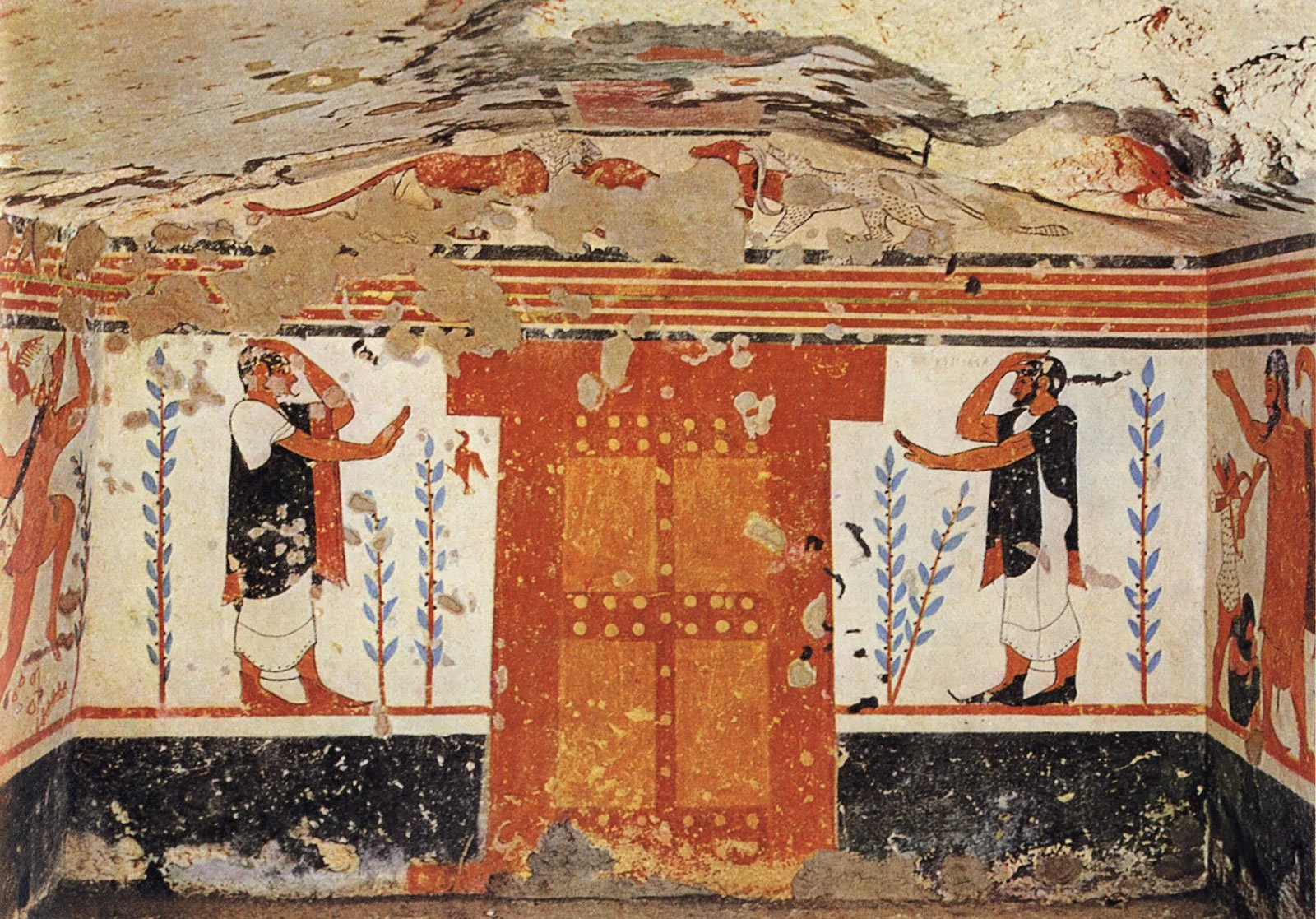
The Tomb of the Augurs shows how Tarquinia matters not just for burial, but for the survival of Etruscan wall painting.
The Necropolis of Tarquinia matters because paint survived there. That may sound simple, but it changes everything. While so much ancient painting has disappeared, Tarquinia preserves a rare body of Etruscan tomb wall paintings that still show color, movement, ritual, and scenes from daily and ceremonial life. If you want to understand what Etruscan image-making looked like beyond objects in a museum case, this is one of the most important sites in Italy.
It matters for another reason too. Tarquinia is not only a place of beautiful tombs. It is one of the clearest places where burial, art, and belief meet. These are funerary chambers, but they are full of dancers, banqueters, musicians, hunters, animals, and later darker visions of the afterlife. That tension is exactly what makes the site so powerful. The dead are present, but so is life.
Tarquinia matters because it preserves the painted side of Etruscan culture
Yes, this is the central point. The Etruscans are often introduced through tombs, terracotta sculpture, bronzes, and architectural fragments. But Tarquinia gives something rarer: painted interiors. The tombs of the Monterozzi necropolis preserve one of the richest surviving groups of wall paintings from the pre-Roman Mediterranean.
That is why the site matters so much for art history. Ancient painting is fragile. It disappears more easily than stone and bronze. At Tarquinia, enough survived to show that Etruscan visual culture was not secondary or decorative in a minor sense. It was vivid, deliberate, and central to how burial space was imagined.
If you want the medium itself in broader terms, Etruscan frescoes gives the larger introduction. Tarquinia is one of the places where that topic becomes most concrete.
The site is important because the tombs show more than death
No, these painted chambers are not only gloomy spaces about loss. That is one of the first misconceptions worth dropping. Many of the best-known tombs at Tarquinia show banquets, music, athletic scenes, animals, and moments of movement that feel surprisingly alive. The famous Tomb of the Triclinium, for example, is remembered for reclining banqueters and attendants, not for a cold image of burial.
That liveliness matters because it reveals how the Etruscans thought about memory and the afterlife. A tomb could preserve the social world of the dead, not just their remains. Feasting, dancing, performance, and outdoor imagery all suggest a continuity between life and death, or at least a desire to represent the dead through the most meaningful and prestigious parts of life.
This is why the site belongs naturally beside Etruscan funerary art. Tarquinia shows that funerary art in Etruria was never only about mourning. It was also about status, ritual, identity, and the visual shaping of memory.
The painted tombs matter because they reveal an entire visual language
Yes, Tarquinia is important not only for what it shows, but for how it shows it. The paintings rely on strong contour, bold color, rhythmic placement, and highly legible gesture. Figures move clearly across the wall. They do not usually depend on deep illusionistic space. Instead, they create an active surface that is easy to read and hard to forget.
That visual language is one of the clearest windows into Etruscan painting. Bodies are stylized, but rarely inert. Birds, plants, banqueters, and attendants are arranged with a confidence that makes the chamber feel inhabited by images. The result is both decorative and meaningful. The wall is not treated as a neutral background. It becomes part of the tomb’s emotional and ritual atmosphere.
This is one reason Tarquinia is so valuable beside broader discussions of Etruscan tombs. Other sites may preserve architecture more strongly. Tarquinia preserves pictorial thinking.
Tarquinia also matters because it shows change over time
Yes, the site is historically rich, not just visually rich. The necropolis contains thousands of tombs, and the painted tombs span several centuries. That long development matters because the imagery is not static. Earlier tombs often emphasize banquets, games, dancing, and outdoor scenes. Later tombs can move toward more complex and sometimes darker visions of the afterlife, with underworld figures and more explicit funerary symbolism.
That shift tells us something important. Etruscan attitudes toward death were not fixed. The imagery evolved, and Tarquinia lets us track that change in ways few sites can. The tomb paintings are therefore not only beautiful survivals. They are historical evidence for changing beliefs and emotional tone.
Why this site still matters
The Necropolis of Tarquinia matters because it preserves something ancient art almost never gives us in such quantity: painted rooms that still communicate. It shows that the Etruscans thought visually, architecturally, and ritually about death. It also shows that funerary space could be full of life, movement, and memory rather than silence alone.
For a beginner, that is the key takeaway. Tarquinia is not just an archaeological site in Tarquinia, Italy. It is one of the clearest places where the lost world of ancient painting becomes visible again. If Cerveteri helps explain the architecture of Etruscan burial, Tarquinia helps explain its images.
An Etruscans map can also help place the site geographically, because Tarquinia’s position in central Italy matters to the larger network of Etruscan city-states and necropolises.

Conclusion
The Necropolis of Tarquinia matters because it preserves the painted side of Etruscan civilization with unusual clarity. Its tombs show banquets, music, ritual, movement, and changing ideas about the afterlife, all within funerary chambers cut into the rock. More than almost any other site, Tarquinia proves that Etruscan burial was also a world of images. That is why these painted tombs remain essential for understanding Etruscan art, belief, and visual imagination.
FAQ
Where is the Necropolis of Tarquinia?
It is in Tarquinia, in Lazio, central Italy, at the Monterozzi necropolis outside the ancient city.
Why is Tarquinia famous?
It is famous for its Etruscan painted tombs, which preserve one of the most important surviving bodies of pre-Roman wall painting in the Mediterranean.
What do the painted tombs show?
They often show banquets, dancers, musicians, athletes, animals, and, in later phases, more explicit underworld imagery.
Why are these tombs so important for art history?
Because very little ancient wall painting survives, and Tarquinia preserves a rare and extensive visual record of Etruscan painting.
Is Tarquinia mainly important for architecture or painting?
Both matter, but Tarquinia is especially important for painting, while sites like Cerveteri are especially important for tomb architecture and necropolis layout.
Sources and Further Reading
UNESCO World Heritage Centre — “Etruscan Necropolises of Cerveteri and Tarquinia” (2004)
Smarthistory — “Tomb of the Triclinium” (2015)
Encyclopaedia Britannica — “Tarquinia” (2026)
Ministero della Cultura — “Necropoli dei Monterozzi di Tarquinia” (n.d.)
UNESCO World Heritage Centre — “Cerveteri and Tarquinia (Italy) No 1158” (2003)
You may also like