Tomb of the Reliefs: A House for the Dead in Cerveteri
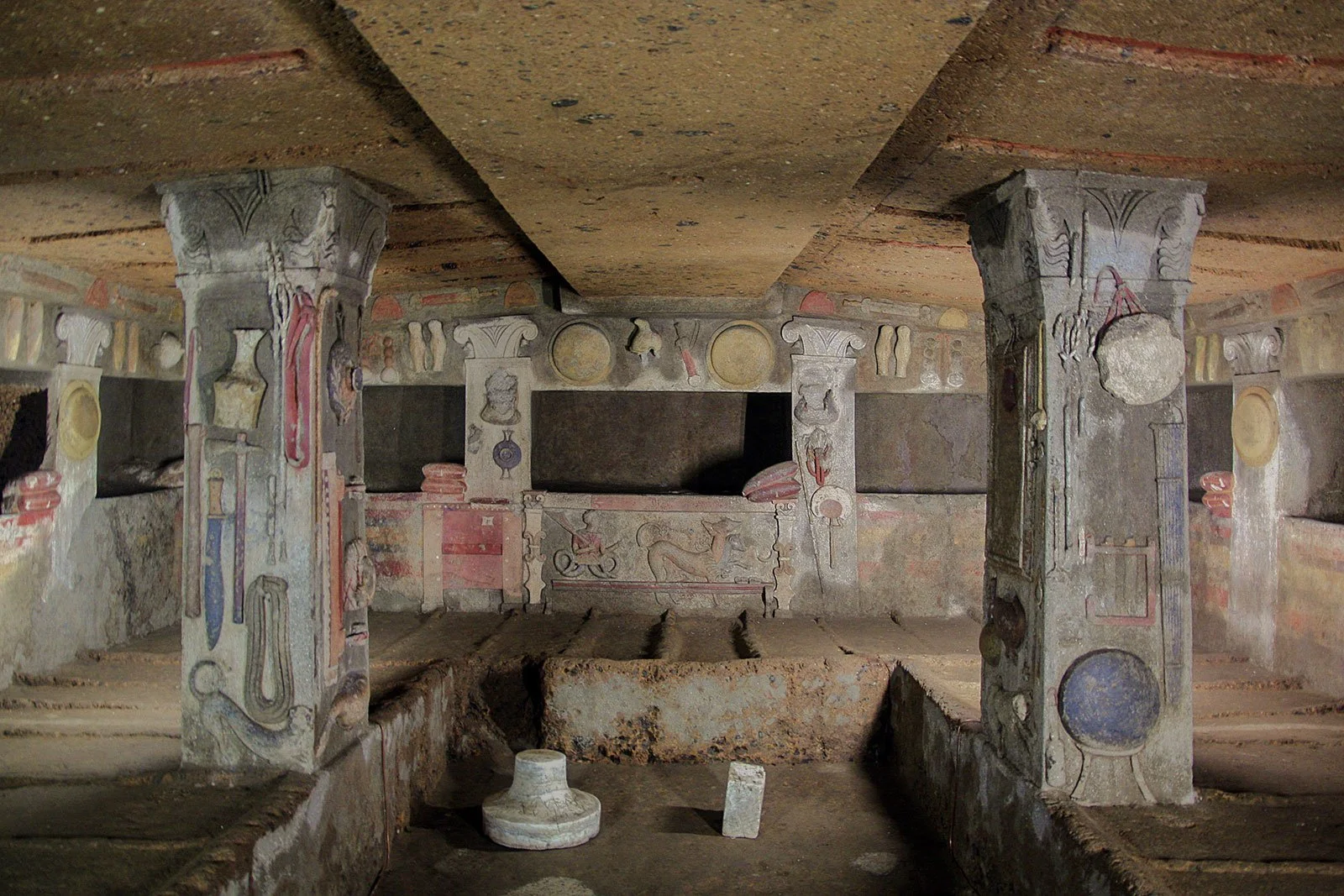
The Tomb of the Reliefs feels almost like a house because its walls are filled with the objects of aristocratic life.
The Tomb of the Reliefs is one of the most unforgettable Etruscan tombs because it feels strangely familiar at first. You step into a burial chamber, but what you see looks almost domestic: tools, cups, weapons, cushions, animals, and everyday objects arranged as if life had simply been paused and stored on the walls. Then the mood shifts. This is not a house. It is a tomb, built for the dead, and that tension between homelike comfort and funerary theater is exactly what makes it so powerful.
Located in the Banditaccia Necropolis at Cerveteri and usually dated to the late 4th or early 3rd century BCE, the tomb belongs to the later phase of Etruscan civilization. By this point, the Etruscan world was under increasing Roman pressure, yet the Tomb of the Reliefs shows that Etruscan funerary culture could still be bold, inventive, and deeply self-aware. It is not a modest burial chamber. It is a family statement in architecture, image, and memory.
The tomb matters because it turns burial into an interior world
Yes, that is the clearest way to understand it. The Tomb of the Reliefs is not remarkable because it is large alone. It matters because it transforms the inside of a tomb into a richly staged environment. Carved from tufa rock and reached by a steep descending passage, the chamber opens into a space organized around burial niches and a central mass supported by two pillars. But the real surprise is the decoration.
The walls and pillars are covered with painted stucco reliefs representing objects from aristocratic life: shields, helmets, vessels, strainers, tools, cords, animals, and domestic equipment. Instead of painting scenes across the walls in the way Tarquinian tombs often do, this tomb gives you a three-dimensional inventory of a household and its world. The effect is almost theatrical. The chamber becomes a set, a place arranged for memory and status.
That is why the tomb is so useful for understanding Etruscan funerary art. It shows that funerary art in Etruria was not limited to sarcophagi or painted scenes. It could also take the form of an entire environment designed to surround the dead with the signs of identity and belonging.
What makes the decoration so unusual is that it feels both everyday and symbolic
Yes, many of the reliefs depict familiar things, and that is part of the tomb’s force. Cups hang ready for a banquet. Armor is displayed on the walls. Implements and objects of use appear as if stored in a lived interior. The chamber does not feel empty. It feels provisioned.
But this is not realism for its own sake. These objects are not there to recreate a simple room. They are there to project a world. The tomb belonged to the Matuna family, one of the elite families of Caere, and the reliefs help turn burial into a statement about family standing, social role, and continuity after death. The objects suggest aristocratic life, but they also imply memory, order, and permanence. What mattered in life is gathered and fixed here for the dead.
This is why the tomb can feel almost domestic at first glance and then strangely ceremonial. It borrows the language of the house, but it uses it inside a funerary setting. The result is more intense than either one alone.
The architecture matters too, because the chamber was designed like a place of ongoing family burial
Yes, the decoration gets most of the attention, but the tomb’s layout matters just as much. This is a family tomb built for multiple burials, not a one-time grave. Burial niches line the chamber, and the whole structure suggests repeated use across generations. That long-term use is essential to its meaning.
The chamber’s organization reinforces the idea that the dead remain within a family space. The central niche on the rear wall seems especially important, and the area beneath it introduces a darker note: figures linked to the underworld appear there, including Cerberus and a demon-like being. So even in a tomb so full of household and banquet imagery, the reality of death is not removed. It is simply integrated into the larger interior world.
This balance is what makes the tomb so rich. It is not only a comforting house for the dead, and it is not only a frightening underworld chamber. It holds both ideas at once.
The Tomb of the Reliefs makes the Banditaccia Necropolis easier to understand
Yes, one of the reasons this tomb matters so much is that it clarifies the larger site around it. The Banditaccia Necropolis is often described as a city of the dead, and the Tomb of the Reliefs shows why. Etruscan burial architecture was not just about placing bodies underground. It was about building lasting spaces for family memory.
This tomb also helps explain the relationship between different burial types. It is not itself a tumulus in the simple visible-mound sense. It is a rock-cut chamber tomb. Yet it belongs to the same funerary world in which tumuli, chamber tombs, and necropolis planning work together. That is why Etruscan tumulus and Etruscan tombs are useful companion pieces. The Tomb of the Reliefs is one of the clearest places where that larger burial culture becomes vivid and specific.
Why this tomb still matters
The Tomb of the Reliefs still matters because it preserves an idea that is easy to miss in ancient funerary art: the dead were not imagined as cut off from the world of objects, family, and social identity. They were placed within a carefully built interior that echoes life while acknowledging death. That tension is what makes the tomb unforgettable.
For a beginner, it is one of the best single monuments for understanding the Etruscans. It gives you architecture, symbolism, family memory, underworld imagery, and everyday objects all in one chamber. It is not only a burial site. It is a complete visual argument about what it meant to die and still belong.

Conclusion
The Tomb of the Reliefs is one of the most remarkable Etruscan tombs because it turns burial into a fully staged interior world. Its carved and painted reliefs of tools, armor, vessels, animals, and domestic objects make the chamber feel almost like a house, while its funerary layout and underworld imagery remind us that this is a place for the dead. In Cerveteri, few monuments show more clearly how Etruscan burial could combine architecture, family memory, and symbolic richness in a single space.
FAQ
Where is the Tomb of the Reliefs?
It is in the Banditaccia Necropolis at Cerveteri, the ancient Etruscan city of Caere in central Italy.
Why is the Tomb of the Reliefs famous?
It is famous for its painted stucco reliefs showing household objects, weapons, animals, and other items arranged across the walls of the burial chamber.
Who owned the tomb?
The tomb belonged to the Matuna family, an elite family of ancient Caere.
Is the Tomb of the Reliefs a tumulus?
No. It is a rock-cut chamber tomb, although it belongs to the same larger funerary culture as the tumulus tombs of Cerveteri.
Why does the tomb feel so domestic?
Because its decoration imitates the interior world of aristocratic life, turning the burial chamber into a house-like space for family memory and the afterlife.
Sources and Further Reading
Smarthistory — “Tomb of the Reliefs” (2015)
UNESCO World Heritage Centre — “Etruscan Necropolises of Cerveteri and Tarquinia” (2004)
Italia.it — “The Etruscan Necropolis of Cerveteri and Tarquinia” (n.d.)
Ministero della Cultura — “La Tomba dei Rilievi a Cerveteri” (2020)
Ministero della Cultura — “Necropoli della Banditaccia” (n.d.)
You may also like