Etruscan Necropolis: Why Cities of the Dead Matter
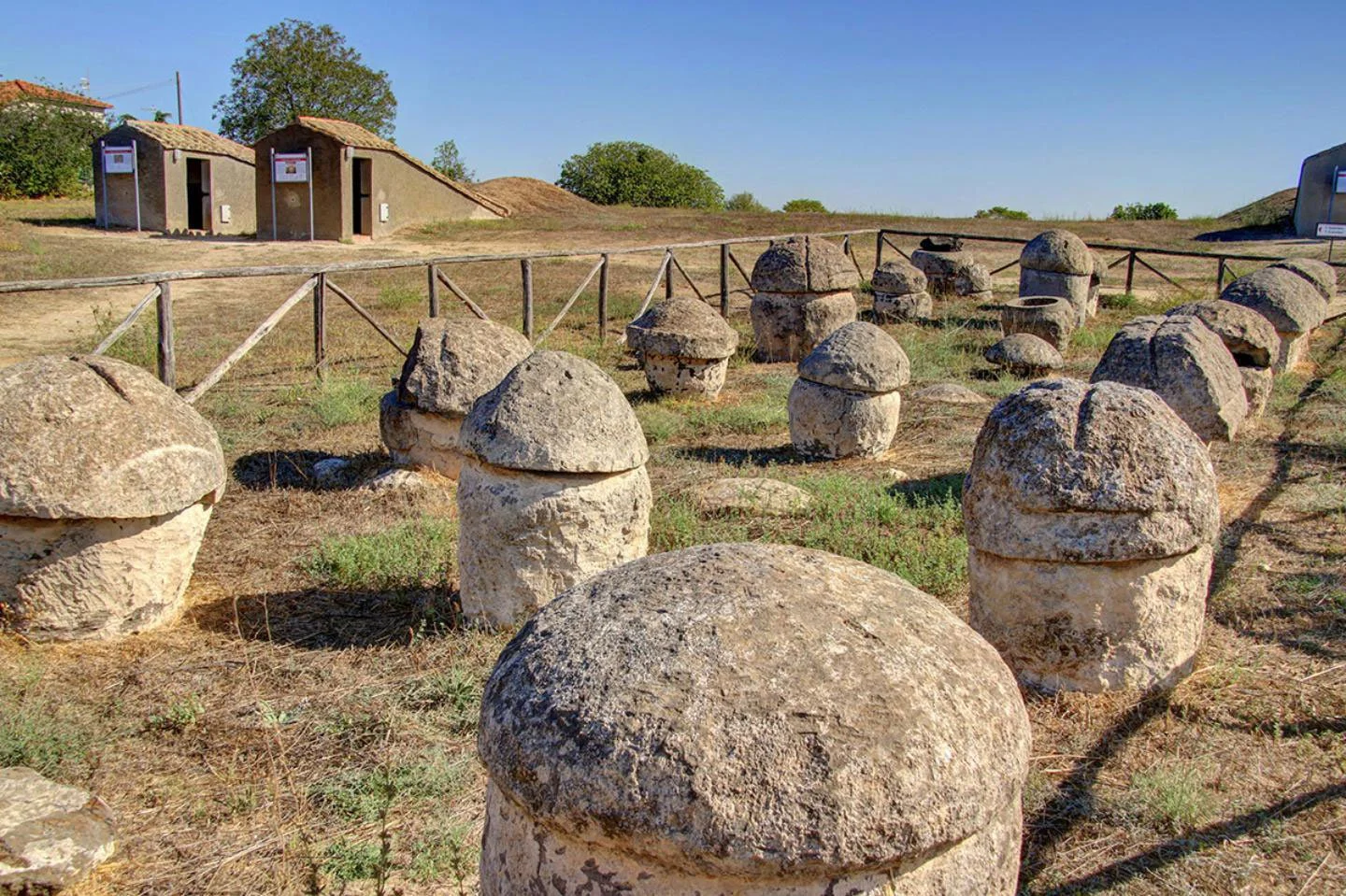
The Monterozzi Necropolis makes the idea of a city of the dead feel concrete rather than abstract.
An Etruscan necropolis was not just a graveyard. It was a planned burial landscape that could feel uncannily like a city: roads, clusters of tombs, family monuments, façades, chambers, and long-term social memory all organized outside the city of the living. That is why the word matters. It helps us understand that Etruscan burial was architectural, collective, and deeply tied to identity.
This is also one of the fastest ways to make sense of Etruscan civilization as a whole. If you place an Etruscan necropolis beside an Etruscan city, you begin to see how closely the two worlds were linked. The dead were not pushed into an invisible corner. They were given structured space, durable form, and often something close to an urban afterlife. In Etruria, burial could mirror the logic of the living city.
A necropolis means a city of the dead, and in Etruria that idea is often literally visible
Yes, that is the clearest starting point. The word necropolis comes from Greek and means “city of the dead.” In many ancient cultures, that phrase is partly metaphorical. In Etruria, it can feel surprisingly concrete. Some Etruscan burial sites were organized with streets, blocks, tomb façades, mounded monuments, and rock-cut chambers in ways that really do resemble urban planning.
That matters because it changes how we look at burial. An isolated grave tells us one thing. A necropolis tells us much more. It tells us how a society arranged families across space, how it marked social rank, how long burial grounds remained in use, and how architecture could carry memory across generations.
This is why Etruscan tombs and the necropolis belong together but are not quite the same topic. A tomb is a single burial structure or chamber. A necropolis is the larger funerary landscape that gives those tombs spatial and social meaning.
These burial landscapes matter because they preserve architecture, memory, and hierarchy together
Yes, one of the main reasons Etruscan necropolises are so important is that they preserve more than the fact of death. They preserve a whole social order. Families were often buried in shared tombs over time, and those tombs could become long-term monuments to lineage, status, and continuity. Burial was not only about the individual. It was about belonging to a family and to a larger civic world.
That is why tomb placement matters. A larger tumulus, a more elaborate façade, a better position along a main route, or a more carefully built chamber all signal different things about wealth and prestige. In this sense, the necropolis becomes readable almost like a map of social structure.
It also preserves architecture in a way ordinary settlement areas often do not. Many Etruscan houses and temples survive only in fragments, but tombs can preserve carved beams, interior layouts, benches, doorways, and room divisions that echo domestic space. So the necropolis is not just a cemetery. It is one of the best archives for understanding how the Etruscans imagined both the house and the family.
Cerveteri is one of the best places to see the necropolis as a true built landscape
Yes, if you want the clearest large-scale example, Cerveteri is hard to beat. The Banditaccia Necropolis shows exactly why the phrase “city of the dead” is so useful. It contains roads, zones of tombs, monumental tumuli, and rock-cut chamber tombs arranged across a broad landscape in ways that make the site feel planned rather than accidental.
What makes Cerveteri especially powerful is the combination of monumentality and domestic reference. Many tombs are not just cavities in the earth. They are structured interiors that imitate rooms, ceilings, and house-like arrangements. The necropolis therefore becomes a parallel settlement, one for ancestors rather than the living.
This is where the subject becomes easy to grasp visually. You are no longer imagining burial as one grave after another. You are looking at a funerary environment with routes, landmarks, and architectural types. That is why Banditaccia Necropolis is such an important next step. It lets you see the concept at full scale.
Tarquinia matters for a different reason, because it turns the necropolis into a painted world
Yes, not all Etruscan necropolises preserve the same strengths. If Cerveteri is especially powerful for tomb architecture and spatial organization, Tarquinia is especially powerful for painted interiors. Its necropolis, especially the Monterozzi area, preserves tombs whose walls are covered with banquets, dancers, musicians, games, animals, and later more complex underworld imagery.
That changes the necropolis from a built landscape into a visual one as well. The city of the dead is not only made of roads and chambers. It is also made of images. The buried do not occupy blank rooms. They occupy painted spaces designed to shape memory and belief.
This is why the Necropolis of Tarquinia matters so much. It shows that the necropolis was not only an architectural system. It was also a place where Etruscan ideas about life, status, ritual, and the afterlife were staged on the walls.
Necropolises help explain Etruscan geography too, because they belonged to specific city-states
Yes, a necropolis is never floating in abstraction. It belongs to a place, and that place matters. Etruscan civilization was organized through city-states, so each major necropolis was tied to a specific urban center and its surrounding territory. Cerveteri belonged to Caere. Tarquinia belonged to Tarquinii. Other important burial grounds belonged to other Etruscan cities across central Italy.
That geographical link matters because it reminds us that necropolises were part of a civic world. They stood outside the city proper, but they were not socially separate from it. Their roads, tomb types, and long duration of use reflect the life of the city that created them.
If you want to place that relationship more clearly, an Etruscans map helps, because the burial landscapes make more sense once you see where the major Etruscan centers stood in relation to one another.
Why do these cities of the dead matter so much? Because they show how the Etruscans thought about continuity
Yes, this is the deeper answer. Etruscan necropolises matter because they reveal a civilization that took continuity seriously. Continuity of family. Continuity of social rank. Continuity of memory. Continuity, in some form, between life and death.
That is why tombs could resemble houses. That is why burial grounds could be planned like urban districts. That is why objects, paintings, inscriptions, and architecture were placed together so carefully. The dead were not imagined as erased. They were placed within a lasting system of remembrance.
For a beginner, that is the key idea to keep. An Etruscan necropolis is important not only because it contains ancient tombs, but because it shows a whole way of thinking. The city of the dead was built seriously because the dead still belonged to the order of the living world.

Conclusion
An Etruscan necropolis was a structured burial landscape that often functioned like a true city of the dead. With roads, tombs, chambers, mounds, painted interiors, and family monuments, these sites preserve far more than burial alone. They reveal how the Etruscans organized memory, rank, architecture, and belief across generations. Once you see that, a necropolis stops looking like a cemetery on the edge of history. It becomes one of the clearest places where Etruscan civilization is still visible.
FAQ
What is an Etruscan necropolis?
An Etruscan necropolis is a large organized burial area connected to an Etruscan city, often planned with roads, tomb clusters, and monumental funerary architecture.
Why is it called a city of the dead?
Because many necropolises were arranged in ways that resemble urban space, with routes, separate tomb structures, and long-term family use.
What is the difference between a tomb and a necropolis?
A tomb is one burial structure. A necropolis is the larger funerary landscape that contains many tombs and gives them spatial and social context.
Which Etruscan necropolises are the most famous?
Cerveteri and Tarquinia are the most famous, especially because of their scale, preservation, tomb architecture, and painted interiors.
Why do Etruscan necropolises matter for art and architecture?
Because they preserve chamber plans, mound tombs, façades, wall paintings, and carved interiors that reveal both Etruscan building habits and beliefs about the afterlife.
Sources and Further Reading
UNESCO World Heritage Centre — “Etruscan Necropolises of Cerveteri and Tarquinia” (2004)
Smarthistory — “Etruscan Necropolises of Cerveteri and Tarquinia” (n.d.)
Encyclopaedia Britannica — “Necropolis” (2026)
Ministero della Cultura / Parco Archeologico di Cerveteri e Tarquinia — “Necropoli della Banditaccia” (n.d.)
Encyclopaedia Britannica — “Ancient Italic people: Etruscans, Latins, & Samnites” (2026)
You may also like