Banditaccia Necropolis: The House-City of the Etruscan Dead
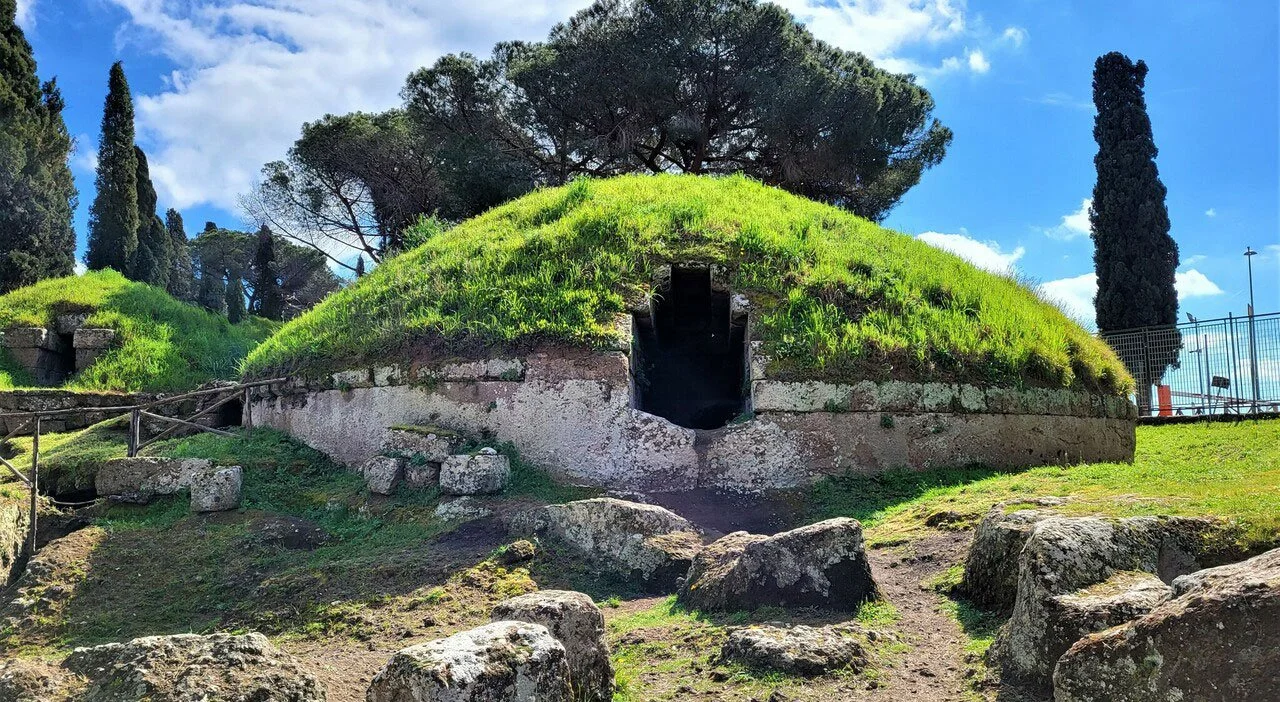
The tumuli at Cerveteri show why Banditaccia feels less like a cemetery and more like a planned funerary city.
The Banditaccia Necropolis at Cerveteri is one of the best places to understand Etruscan burial architecture at full scale. This is not just a collection of graves. It is a vast planned funerary landscape with streets, tumuli, carved chambers, and family tombs arranged so clearly that it can feel like a second city. That is the key idea. Banditaccia matters because it shows the Etruscan world of the dead built with almost urban seriousness.
It also matters because so much Etruscan architecture survives unevenly elsewhere. Houses are hard to reconstruct. Temples often survive only in fragments. But at Banditaccia, tombs preserve rooms, layouts, carved details, and long-term spatial organization in a way that makes Etruscan architecture suddenly easier to grasp. If you want to see why Etruscan burial was never just about disposal of the dead, this is one of the clearest places to start.
Banditaccia matters because it really does feel like a city of the dead
Yes, the phrase is not just a metaphor. The necropolis is organized with roads, sectors, tomb clusters, and a strong overall plan. Instead of scattered graves, you find an ordered landscape that suggests neighborhoods, routes, and built family spaces. That is why the site often feels less like a cemetery in the modern sense and more like an urban world running in parallel to the city of the living.
This is exactly what makes Banditaccia so important within the larger topic of Etruscan necropolis. A necropolis in Etruria could mirror the logic of a settlement: structured, lasting, and deeply tied to family memory. At Banditaccia, that logic is visible on the ground.
The site belongs to ancient Caere, modern Cerveteri, one of the major Etruscan cities. That connection matters, because the necropolis was not socially separate from the city. It was one of the ways the city imagined ancestry, rank, and continuity over generations.
The tombs are varied, and that variety is part of the lesson
No, Banditaccia is not made of one repeated tomb type. That is one reason it is such a good site for beginners. You can see different forms of burial architecture across time, from earlier simpler tombs to monumental tumuli, the great circular mounds that dominate parts of the necropolis.
These tumuli are especially striking because they make family burial visible in the landscape. They are not hidden graves. They are large built statements, often with chambers cut into the tufa rock below. Other parts of the site include more rectilinear, street-lined tomb arrangements that feel even more urban.
This variety helps explain the larger story of Etruscan tombs. Burial in Etruria changed over time, and Banditaccia preserves that long development in one place. The necropolis is not only large. It is historical.
The most remarkable thing is how house-like many tombs feel
Yes, this is what gives Banditaccia its real architectural force. Many tomb interiors imitate domestic space. They have carved beams, benches, door-like openings, room divisions, and details that make them feel less like abstract burial chambers and more like versions of houses underground.
That matters because it reveals something deep about Etruscan belief. The tomb was not only a place to store the dead. It was a place where family identity continued in built form. The dead were given rooms, objects, and settings that echoed the architecture of life.
The clearest single example is the Tomb of the Reliefs, one of the most famous tombs at Cerveteri. Its interior is modeled with tools, weapons, vessels, and domestic objects in relief, turning the burial chamber into an extraordinary stone version of an inhabited world. If someone asks what is the name of the famous Etruscan tomb from Cerveteri, this is one of the most important answers.
Banditaccia also matters because it helps explain famous Etruscan objects
The necropolis is not just important for architecture. It also helps us understand the funerary culture that produced some of the best-known Etruscan works. Cerveteri is closely connected with the world of terracotta sarcophagi, banquet imagery, and the presentation of the dead as still socially present.
That is why the Sarcophagus of the Spouses belongs naturally in the conversation. Even though the object is now seen in a museum, its meaning is inseparable from the funerary culture of Caere and sites like Banditaccia. The reclining couple, alive with gesture and presence, makes much more sense once you understand the kind of burial world this necropolis represents.
Why this site still matters
Banditaccia matters because it makes Etruscan civilization visible in spatial terms. It shows that the Etruscans built for the dead with the same seriousness they gave to the living world. Roads, tombs, tumuli, carved chambers, and family monuments come together here in a way that is unusually clear and unusually moving.
For a beginner, that is the real takeaway. Banditaccia is not important only because it is large or old. It is important because it lets you see how architecture, ritual, family memory, and urban logic could all meet in one funerary landscape.

Conclusion
The Banditaccia Necropolis is one of the clearest surviving expressions of the Etruscan city of the dead. Its streets, tumuli, chamber tombs, and house-like interiors show that Etruscan burial was architectural, collective, and deeply tied to family identity. More than almost any other site, Banditaccia turns abstract ideas about Etruscan funerary culture into something you can picture, walk through, and understand as a real built world.
FAQ
What is the Banditaccia Necropolis?
It is the great Etruscan necropolis at Cerveteri, a large burial landscape organized with streets, tumuli, and chamber tombs.
Why is Banditaccia so important?
Because it preserves Etruscan burial architecture at large scale and shows how a necropolis could function almost like a city.
What kinds of tombs are found there?
The site includes tumulus tombs, rock-cut chamber tombs, and other burial forms spanning a long period of Etruscan history.
Why is it called a house-city of the dead?
Because many tombs imitate houses, and the necropolis itself is laid out with roads and organized sectors like an urban settlement.
What famous tomb from Cerveteri should I know?
The Tomb of the Reliefs is one of the most famous examples from Cerveteri, especially for its richly modeled interior.
Sources and Further Reading
UNESCO World Heritage Centre — “Etruscan Necropolises of Cerveteri and Tarquinia” (2004)
Ministero della Cultura / Parco Archeologico di Cerveteri e Tarquinia — “Necropoli della Banditaccia” (n.d.)
UNESCO World Heritage Centre — “Cerveteri and Tarquinia (Italy) No 1158” (2003)
Smarthistory — “Tomb of the Reliefs” (2015)
Visit Lazio — “Necropolis of Banditaccia, Cerveteri” (n.d.)
You may also like