Etruscan Tumulus: How the Burial Mound Worked
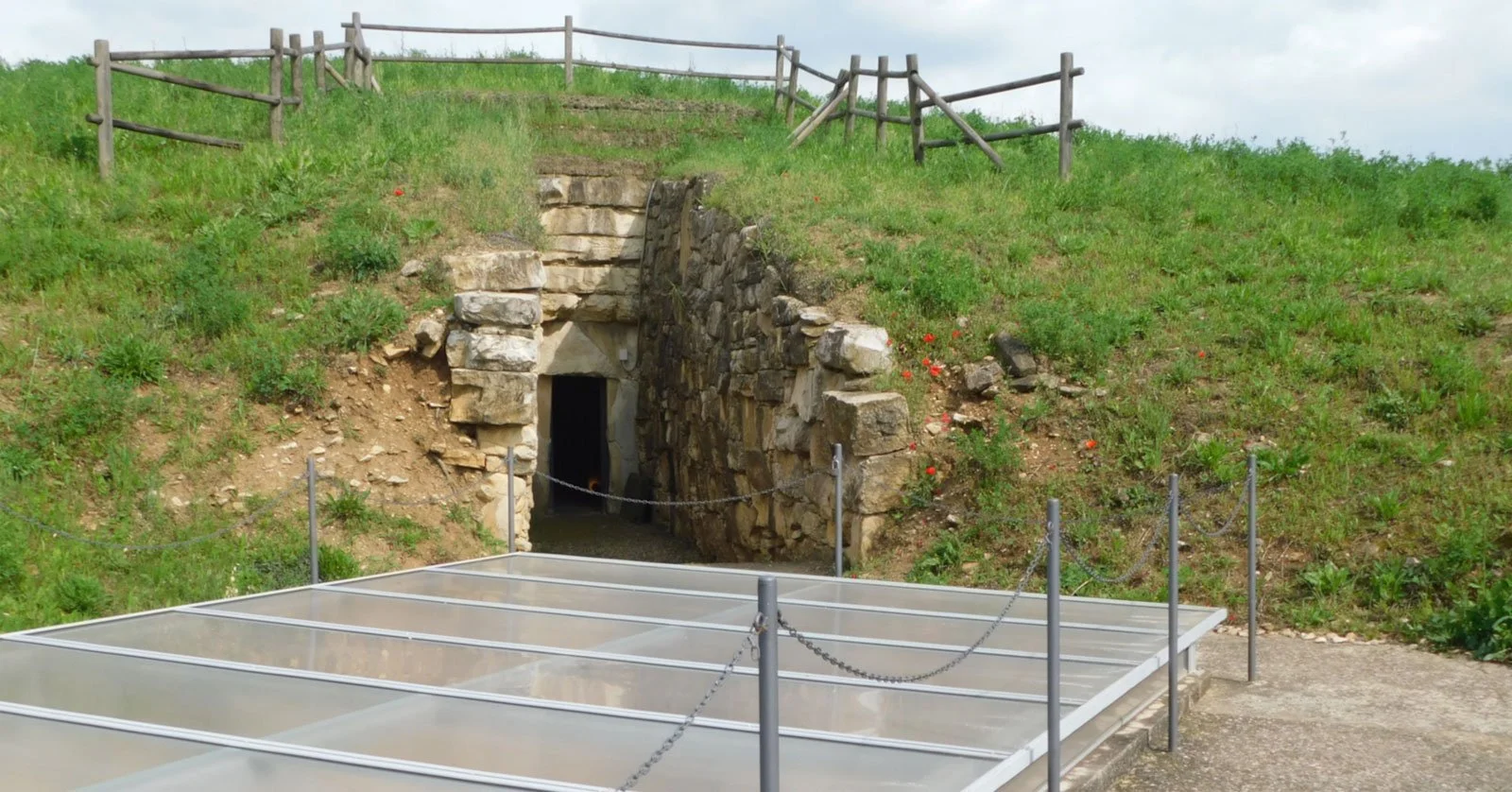
The Tumulo della Montagnola is a clear example of how an Etruscan tumulus worked as both landscape marker and tomb.
An Etruscan tumulus is one of the clearest and most distinctive forms of Etruscan burial architecture. At its simplest, it is a mound tomb: an earthen or stone-covered mass raised over one or more burial chambers. But that simple definition does not really capture what made it important. In Etruria, the tumulus was not just a heap over a grave. It was a built monument, a family marker in the landscape, and often a house-like space for the dead below.
That is why the tumulus matters so much for beginners. It helps make Etruscan burial easier to picture from the outside and the inside at once. Outside, it appears as a rounded mound, often monumental and highly visible. Inside, it can contain cut chambers, corridors, benches, and details that make the tomb feel structured, inhabited, and enduring. Once you understand how those two levels worked together, the whole logic of Etruscan burial becomes clearer.
The tumulus worked as both a landscape marker and an underground tomb
Yes, that double role is the key idea. An Etruscan tumulus had an exterior and an interior that meant different things but worked together. The exterior mound made the burial visible in the landscape. It announced memory, family presence, and status. The interior chamber or chambers created the actual place of burial, where bodies, objects, and ritual meanings were gathered.
This is what makes the form so effective. A tumulus is not hidden. It rises out of the ground and gives burial a monumental profile. At the same time, it protects and encloses a chambered world beneath the surface. The dead are both marked publicly and housed privately.
That is one reason tumuli became so important in Etruria. They turned burial into architecture and landscape at the same time. If you want the larger funerary framework around this type, Etruscan tombs gives the broader overview of how tumuli relate to chamber tombs, necropolises, and burial rituals more generally.
The mound on the outside was not just symbolic. It organized the whole structure
Yes, the mound itself was doing real work. A tumulus usually consisted of an imposing earthen mass, often supported or defined by a stone base or circular drum. That gave the tomb both stability and visual weight. In some cases, the mound covered more than one burial chamber, which means the tumulus could function as a family monument over time rather than a one-time individual grave.
This matters because the exterior shape was not only decorative. It helped structure the whole monument. The mound protected the chamber below, gave it presence above ground, and turned the burial into something durable and memorable. In a necropolis, a tumulus could stand out immediately from a distance, marking family rank and long-term continuity.
That is why tumuli often feel more public than other tomb forms. A rock-cut chamber hidden in a slope may preserve a rich interior, but a tumulus declares itself outwardly. It makes burial part of the visible order of the landscape.
Inside, the tumulus often worked like a house for the dead
Yes, and this is where the Etruscan tumulus becomes especially revealing. Below the mound, many tombs contained one or more chambers reached through an entry passage. These chambers were not empty cavities. They could include benches, carved ceiling forms, interior divisions, and architectural details that made them feel house-like.
That house-like quality matters because it tells us how the Etruscans imagined death. The tomb was not simply a place of disposal. It was a place of continued belonging. Family members could be buried together, surrounded by grave goods and enclosed within a built environment that echoed domestic life.
This is one of the clearest examples of the Etruscan idea of the tomb as a kind of second home. The dead were given space, order, and often surroundings that reflected the world of the living. That is why the tumulus can feel both monumental and intimate at once.
A particularly famous example connected to this world is the Tomb of the Reliefs. It is not important only because it is richly decorated. It is important because it shows with unusual clarity how an Etruscan burial chamber could be made to feel like an inhabited interior.
Tumuli mattered most in necropolises, where they became part of a larger funerary city
No, the tumulus was not usually meant to stand in total isolation. Its strongest meaning often appeared within a larger funerary landscape, especially in major Etruscan necropolises. There, tumuli could be arranged along routes, grouped by family, and set among other tomb forms so that the entire burial ground became readable as a structured environment.
This is especially clear at Cerveteri. The Banditaccia Necropolis is one of the best places to understand how tumuli worked in context. There, monumental mounds sit within an organized network of paths and tomb zones, making the necropolis feel like a real city of the dead.
That connection matters because an Etruscan necropolis was not just a place where tombs happened to accumulate. It was often a planned landscape of memory. In that setting, the tumulus became both a family monument and part of a wider civic funerary order.
The tumulus reveals what the Etruscans cared about most in burial
Yes, the form tells us a great deal about Etruscan values. First, it shows the importance of family continuity. Many tumuli contained more than one burial, which suggests long-term use and ancestral identity rather than a single isolated death. Second, it shows the importance of visibility. Burial was made monumental and public, not hidden away. Third, it shows the importance of architectural thinking. The dead were given chambers, routes, and enclosing forms that reflected a serious investment in spatial design.
That combination is what makes the tumulus more than a burial technique. It is a statement about how death should be housed, remembered, and placed in the landscape. In Etruria, funerary architecture was not marginal to culture. It was one of the clearest places where belief, status, and built form came together.

Conclusion
The Etruscan tumulus worked by combining a visible mound above ground with a built burial chamber below it. That combination made it both a landscape monument and a house for the dead. In necropolises such as Cerveteri, tumuli helped turn burial into a structured, enduring world of family memory and architectural form. Once you see how the tumulus worked outside and inside, Etruscan funerary culture becomes much easier to understand.
FAQ
What is an Etruscan tumulus?
An Etruscan tumulus is a mound tomb, usually built as a raised earthen or stone-covered monument over one or more burial chambers.
What was inside an Etruscan tumulus?
Inside there could be corridors, chambers, benches, and house-like architectural details used for burials and funerary offerings.
Why were tumuli important in Etruria?
They made burial visible in the landscape and created durable family monuments tied to status, memory, and the afterlife.
Where can you see famous Etruscan tumuli?
Some of the best-known examples are at Cerveteri, especially in the Banditaccia Necropolis.
Is a tumulus the same as any Etruscan tomb?
No. It is one major type of Etruscan tomb, but Etruscan burial also included other forms such as chamber tombs, urn burials, and painted rock-cut tombs.
Sources and Further Reading
UNESCO World Heritage Centre — “Etruscan Necropolises of Cerveteri and Tarquinia” (2004)
UNESCO World Heritage Centre — “Cerveteri and Tarquinia (Italy) No 1158” (2003)
Smarthistory — “Tomb of the Reliefs” (2015)
Encyclopaedia Britannica — “Ancient Italic people: Etruscans, Latins, & Samnites” (2026)
You may also like