Etruscan Funerary Art: Why the Tomb Became a Painted Home
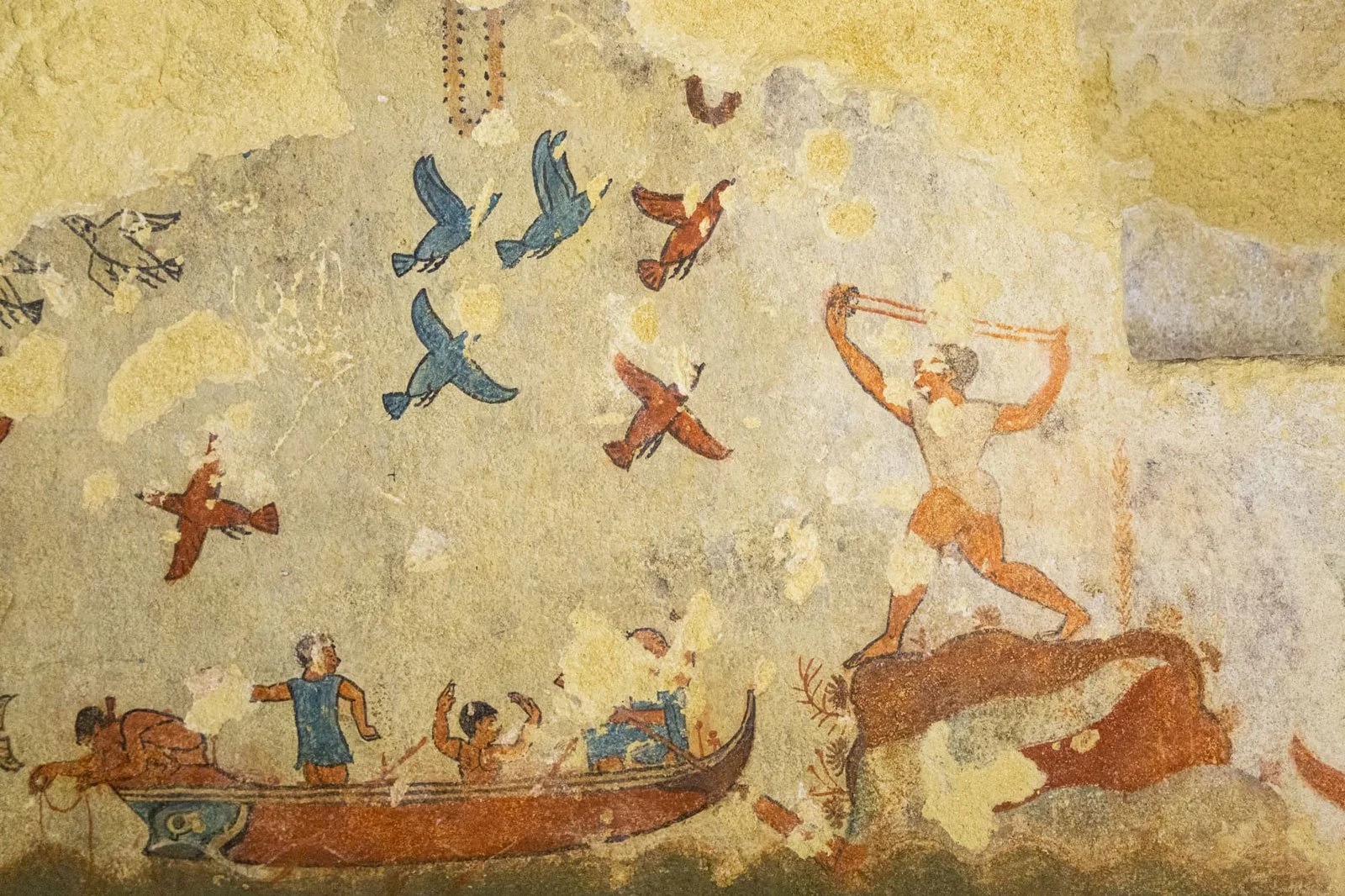
This painted chamber shows how Etruscan funerary art could turn the tomb into a vivid world of memory, movement, and ritual.
Etruscan funerary art is where some of the most important parts of Etruscan culture come together at once: art, architecture, ritual, family memory, and ideas about the afterlife. The shortest answer is this: the tomb became a painted home because the Etruscans did not treat burial as a simple ending. They built and decorated tombs as spaces where identity, status, and forms of life could continue in symbolic ways.
That is why Etruscan funerary art feels so rich. It is not just one medium. It includes wall paintings, sarcophagi, urns, relief sculpture, grave goods, and whole burial chambers designed like interiors. In some tombs, the dead are shown reclining at banquets. In others, the walls fill with dancers, musicians, animals, and scenes that feel almost festive. Elsewhere, tools, weapons, vessels, and domestic objects appear in relief as if the tomb were still inhabited. Once you see that, the subject stops being “art about death” in a narrow sense. It becomes art about how a culture imagined memory and continued belonging.
The tomb became a home because burial was imagined as continuity, not disappearance
Yes, this is the central idea. Etruscan tombs often suggest that the dead were not imagined as simply erased from the social world. Instead, they remained connected to family, ritual, and status. That is why tomb interiors can feel house-like, furnished, and even welcoming. The burial chamber is not always presented as a void. It is a built environment.
This helps explain why Etruscan funerary spaces are so different from what many beginners expect. Modern people often imagine a tomb as a sealed place of silence. Etruscan tombs can feel more like inhabited rooms. Benches, carved beams, painted walls, chambers arranged like domestic interiors, and carefully placed grave goods all point in the same direction: the dead were housed, remembered, and symbolically surrounded by the signs of life.
That is also why Etruscan tombs matter so much. The funerary art only makes full sense when you see that the tomb itself is part of the artwork. The chamber, the objects, the walls, and the burial ritual all work together.
Painting mattered because the walls turned burial into a living visual world
Yes, wall painting is one of the clearest reasons Etruscan funerary art feels so immediate. In painted tombs, especially those at Tarquinia, the walls do not simply frame the burial. They activate it. Banqueters recline, musicians perform, dancers move, animals cross the space, and scenes of games, hunting, or ritual unfold around the dead.
This is where the phrase “painted home” becomes especially useful. The chamber stops feeling like a bare container and starts feeling like an environment. The walls shape mood, memory, and meaning. They do not usually aim at deep illusionistic realism in the later Roman sense. Instead, they rely on strong contour, vivid color, and clear gesture to make the room feel alive.
That liveliness matters because funerary art here is not only about mourning. It is also about preserving forms of life that mattered: feasting, music, elite display, movement, companionship, and ceremony. In this sense, painting extends the social world into the tomb.
If you want to follow that medium more directly, Etruscan frescoes is the natural next step, because the painted wall is one of the most distinctive parts of the whole funerary tradition.
The tomb became social because banquets, couples, and family mattered so much
Yes, one of the most striking things about Etruscan funerary art is how often it presents the dead through shared social forms. Banquet scenes are everywhere. Reclining figures appear again and again. The dead are often imagined not in isolation, but in relation to others.
That is why the Sarcophagus of the Spouses became such an icon. It shows a reclining couple together, still present, still communicative, still occupying shared space. The work is funerary, but it does not feel cold or withdrawn. It feels relational. That is a major clue to the wider logic of Etruscan burial art.
The same pattern appears in tomb painting. Banquets do not just show food and furniture. They show status, memory, and companionship. A feast is one of the strongest images a culture can use for continuity. It turns burial into an extension of social identity. The dead remain recognizable through the gestures and settings that once defined elite life.
This is one reason Etruscan funerary art can feel unusually human to modern viewers. It does not always stage death as pure absence. It often stages remembered presence.
Objects mattered because the tomb was filled with the signs of a lived world
Yes, Etruscan funerary art is not limited to painted scenes or sculpted lids. Grave goods and modeled objects are part of the same system. Pottery, mirrors, jewelry, armor, banqueting vessels, tools, and other items could accompany the dead, and in some tombs those objects are not only placed there but represented on the walls themselves.
This is what makes certain tombs at Cerveteri so extraordinary. The tomb chamber can feel like a stored household or an aristocratic interior preserved underground. Objects are not random deposits. They help define who the dead were and what world they belonged to.
That also means funerary art in Etruria is deeply material. Clay, bronze, paint, carved tufa, stucco, metalwork, and ceramics all participate. The tomb is not a single artwork. It is a whole material environment. That is why Etruscan art is so closely tied to funerary evidence. Much of what survives from the civilization survives because it was placed in tombs.
The mood changed over time, and that makes the funerary art even more interesting
No, Etruscan funerary art does not always send the same message. Earlier and Archaic tombs often emphasize banquets, music, dancing, games, and a strong continuity with worldly life. Later funerary imagery can become darker, more mythological, and more explicitly concerned with underworld beings and the dangers of the afterlife.
That shift matters because it shows that Etruscan belief was not fixed. Funerary art changed as Etruscan society changed. Contact with the Greek world, local religious development, and the pressures of later history all shaped the tone of burial imagery. So the tomb as “painted home” remains an important idea, but it becomes more complicated over time. The home of the dead could also become a place of transition, uncertainty, and supernatural presence.
This is one reason the Necropolis of Tarquinia is so important. It allows us to see not only the beauty of painted tombs, but also how funerary imagery develops across generations.
The best way to understand Etruscan funerary art is to see it as a total environment
Yes, this is the most useful final frame. Etruscan funerary art is not just painting, not just sculpture, and not just burial architecture. It is all of these together. The tomb itself is designed space. The paintings create atmosphere and memory. The sarcophagus or urn gives the dead a visible form. The objects around them reinforce identity, rank, and ritual meaning.
Once you look at it this way, the phrase “painted home” stops sounding poetic and starts sounding exact. The tomb became a home because the Etruscans built it to function that way symbolically. It could hold the dead, preserve the family, stage remembered life, and give visual form to the afterlife all at once.

Conclusion
Etruscan funerary art matters because it turns burial into a complete social and symbolic world. Through painted walls, sculpted sarcophagi, grave goods, and carefully built chambers, the tomb becomes more than a place of death. It becomes a house of memory, a family monument, and a visual setting where life continues in transformed form. That is why Etruscan funerary art feels so distinctive: it does not separate art, ritual, and architecture. It makes them live together underground.
FAQ
What is Etruscan funerary art?
It is the art made for Etruscan burial contexts, including tomb painting, sarcophagi, urns, relief decoration, grave goods, and the design of tomb interiors.
Why did Etruscan tombs look like homes?
Because burial was often imagined through continuity with life, family, and domestic space. The tomb could function symbolically as a house for the dead.
What are the main themes in Etruscan funerary art?
Common themes include banquets, music, dance, family presence, elite display, ritual objects, and later more explicit underworld imagery.
Why are painted tombs so important?
Because they preserve rare ancient wall painting and show how Etruscan funerary spaces were turned into vivid visual environments.
Is the Sarcophagus of the Spouses part of Etruscan funerary art?
Yes. It is one of the most famous examples, showing how the dead could be represented as socially present rather than absent or anonymous.
Sources and Further Reading
The Metropolitan Museum of Art — “Etruscan Art” (2004)
UNESCO World Heritage Centre — “Etruscan Necropolises of Cerveteri and Tarquinia” (2004)
Smarthistory — “Tomb of the Triclinium” (2015)
Smarthistory — “Sarcophagus of the Spouses (Rome)” (2015)
Encyclopaedia Britannica — “Etruscan art” (2026)
You may also like