Etruscan Tombs: Chamber Tombs, Necropolises and Burial Rituals
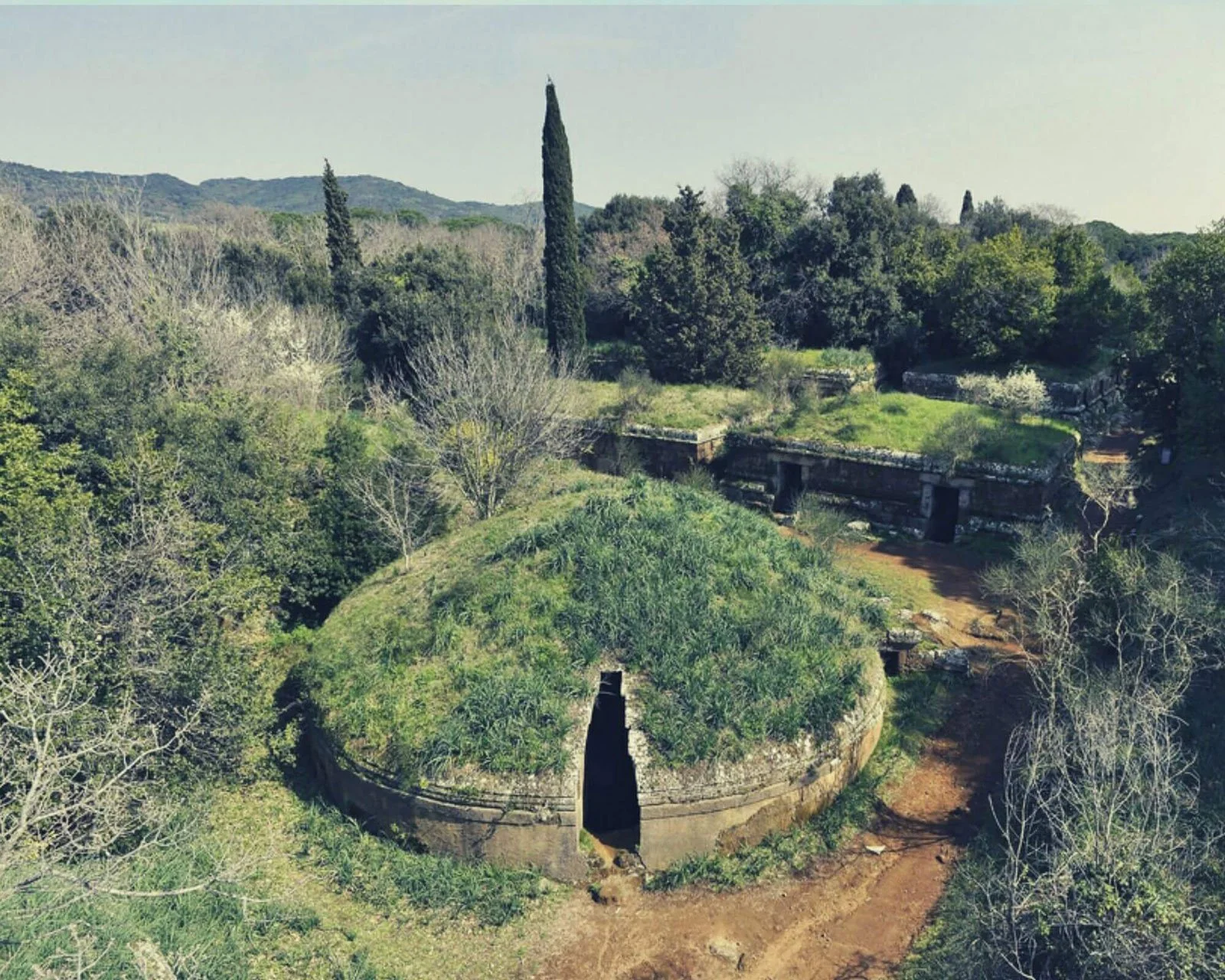
Banditaccia is useful here because it shows Etruscan burial as a whole landscape of tombs, paths, and family memory.
Etruscan tombs were not all the same, and that is one of the first things worth understanding. Some were simple burials. Some were monumental mounds. Some were rock-cut chambers arranged like houses. Some were painted with banquets, dancers, animals, and scenes of the afterlife. Taken together, they form one of the richest funerary landscapes in the ancient Mediterranean.
That matters because tombs are one of the main ways we know the Etruscans at all. Their cities were real, active, and important, but tombs often preserve what ordinary buildings no longer do: architecture, objects, names, images, and clues to belief. If you want a beginner-friendly shortcut, it is this: Etruscan tombs tell us how the Etruscans thought about family, memory, status, ritual, and life after death. They are not just burial places. They are one of the clearest archives of the civilization itself.
Etruscan tombs matter because they preserve a whole world, not just human remains
Yes, that is the core idea. An Etruscan tomb was often designed as more than a place to deposit the dead. It could be a built environment filled with objects, images, furniture-like forms, inscriptions, and architectural features that made the burial space feel continuous with life. In many cases, the tomb was imagined almost as a second home.
This is why Etruscan funerary archaeology feels so unusually vivid. Tombs preserve jewelry, bronze vessels, pottery, sarcophagi, mirrors, weapons, banqueting equipment, painted walls, and even carved details that echo beams, doors, and domestic interiors. A burial chamber can therefore tell us about craft, ritual, social hierarchy, architecture, and visual culture all at once.
The broader idea behind this is important. The Etruscans did not treat the dead as simply removed from the world. Their tombs suggest that the afterlife was understood through continuity: continuity of family, continuity of rank, continuity of possessions, and often continuity of shared social life. That is why so many tombs feel furnished, staged, and carefully composed.
If you want the most general spatial term first, an Etruscan necropolis is simply a city of the dead, a burial landscape organized almost like an urban one. That phrase is not poetic exaggeration. In Etruria, it is often literally true.
The main tomb types changed over time, and that timeline helps everything else make sense
Yes, the burial forms changed across the centuries. That matters because Etruscan tombs are not one static type repeated endlessly. Their history begins in the Iron Age, in the Villanovan phase, when cremation was especially common. Cremation means the body was burned, and the ashes were placed in urns. Some of the best-known early examples are hut urns, containers shaped like houses, which are important not only as funerary objects but also because they preserve clues about early domestic architecture.
Later, especially as Etruscan society became wealthier and more stratified, inhumation became increasingly prominent in many areas. Inhumation means burial of the body rather than cremated remains. This shift helped produce larger and more elaborate tomb chambers, richer grave assemblages, and more visibly monumental funerary architecture.
That shift is worth remembering because it shows how burial practice followed social change. As elite families grew more powerful, tombs became bigger statements. Burial was no longer only about disposal or remembrance in a narrow sense. It became a way of staging status, lineage, and the relationship between the dead and the living.
So when beginners ask what Etruscan tombs were like, the clearest answer is: they ranged from early urn burials to large chamber tombs and tumuli, and those changes reflect the development of Etruscan society itself.
Chamber tombs are the clearest expression of the Etruscan idea of the tomb as a house
Yes, if one type best captures the Etruscan funerary imagination, it is the chamber tomb. These are tombs with one or more interior rooms, often cut into rock or built into mounded structures, designed to hold the dead and their goods over time. They are especially important because they can feel almost architectural in the domestic sense.
Some chamber tombs imitate the inside of a house. You find carved beams, benches, door-like openings, niches, roof forms, and divisions that make the interior feel inhabitable rather than purely symbolic. This is one of the strongest clues to Etruscan belief. The tomb was not imagined as a sealed void but as a place where the dead continued to exist within a structured environment.
That is exactly why the Tomb of the Reliefs at Cerveteri is so famous. Its interior is carved and modeled with tools, weapons, vessels, household items, and architectural features in raised relief, creating one of the most remarkable surviving funerary interiors from the ancient world. It does not just contain burial. It stages an inhabited world in stone. If you want the most direct single example of the house-like Etruscan tomb, Tomb of the Reliefs is the obvious place to go next.
This also explains why chamber tombs matter beyond funerary studies. In some cases, they preserve the only evidence we have for architectural types that no longer survive above ground.
Tumuli made burial visible in the landscape
Yes, another major type is the tumulus tomb. A tumulus is a burial mound, usually a large circular earthen mass built over one or more tomb chambers. In Etruria, tumuli could be monumental and highly organized, with stone bases, internal chambers, and strong presence in the surrounding landscape.
What makes tumuli important is that they work at two scales at once. Inside, they can contain carefully arranged chambers and multiple burials. Outside, they mark the landscape in a bold, unmistakable way. A tumulus is not a hidden grave. It is a visible claim of family memory and social prestige.
This is especially clear at Cerveteri, where many of the most famous tombs are monumental tumuli set within an organized funerary landscape. There, the burial ground becomes almost urban, with roads and clusters of tombs arranged in ways that make the necropolis feel like a parallel settlement. That is one reason Banditaccia Necropolis matters so much. It shows how tumuli, chamber tombs, and urban planning come together in one of the greatest Etruscan cemeteries.
For a beginner, the simplest way to picture the tumulus is this: it is burial architecture that expands outward into the landscape, turning family memory into a public, lasting form.
Necropolises were planned landscapes, not random fields of graves
Yes, this is one of the most striking features of Etruscan burial culture. An Etruscan necropolis was often organized with a logic that resembles a town. There could be streets, paths, clusters, open areas, and different tomb types grouped together over time. That is why the phrase “city of the dead” is so appropriate here.
The two most famous examples are Cerveteri and Tarquinia, but they do not preserve exactly the same thing. Cerveteri is especially strong for tomb architecture and urban-like organization. Tarquinia is especially strong for painted tomb interiors. Together they reveal two sides of the same civilization: one more architectural and spatial, the other more pictorial and narrative.
This matters because burial in Etruria was collective as well as individual. Families used tombs across generations. Tomb placement, monument size, and location within a necropolis all helped express identity and continuity. The necropolis therefore preserves not just private grief but public order. It is a social landscape.
That is also why the term etruscan necropolises is usually better than imagining one standard cemetery. These sites developed over long periods and contain different types of tombs, burial methods, and levels of wealth. They are layered, historical places.
Burial rituals reveal changes in belief, rank, and family identity
Yes, burial ritual is one of the main things these tombs are trying to show us. The way a body was treated, the objects placed beside it, the architecture of the chamber, and the imagery of the tomb all reveal how the Etruscans thought about death and social belonging.
Grave goods are especially important. Objects buried with the dead might include pottery, banquet vessels, mirrors, jewelry, weapons, furniture, writing-related items, and personal adornment. These are not random deposits. They indicate gender roles, rank, craft identity, domestic life, elite display, and the expectation that the dead continued to need, or at least be represented through, familiar possessions.
The tomb also reveals family structure. Many Etruscan tombs were used repeatedly across generations, which means they were less like isolated memorials and more like family monuments. Burial gathered ancestors together, creating a lineage visible in space.
Belief in the afterlife also shifts across time. Earlier tombs often emphasize continuity with worldly life, especially through banquets, household forms, and images of music or festivity. Later funerary imagery can become darker, with stronger emphasis on underworld figures and the hazards of transition after death. That change matters because it reminds us that Etruscan religion was not fixed. Burial ritual evolved.
One of the most famous objects in this wider funerary world is the Sarcophagus of the Spouses, which captures the Etruscan tendency to present the dead not as inert remains but as socially present, reclining as if at a banquet. It is funerary art, but it is also a statement about life, partnership, and memory.
Painted tombs show that funerary space was also a visual world
Yes, in some sites, especially Tarquinia, tombs were not only architectural and ritual spaces. They were painted environments. Wall paintings show banquets, musicians, dancers, animals, games, and later scenes connected to myth and the afterlife. These images turn the chamber into a stage for memory and belief.
That painted dimension is important because it shows the tomb functioning on several levels at once. It is a burial place, a family monument, a ritual setting, and a visual program. The dead do not lie in a blank cavity. They occupy a meaningful, image-filled room.
This also helps explain why Etruscan tombs are so central to the study of ancient painting. So much large-scale painting from the ancient world has disappeared. Etruscan painted tombs preserve a rare body of wall imagery that still communicates color, movement, and atmosphere.
For beginners, it is useful to keep one distinction in mind. Cerveteri often teaches you how Etruscan tombs were built. Tarquinia often teaches you how they were painted. Both are essential.
The best way to understand Etruscan tombs is to see them as architecture, ritual, and memory together
Yes, this is the clearest final framework. If you look at Etruscan tombs only as archaeological containers, you miss too much. If you look at them only as art, you also miss too much. Their real power lies in the combination.
They are architecture because they create rooms, façades, chambers, mounds, streets, and necropolises. They are ritual because they structure burial, offerings, remembrance, and the relation between the living and the dead. They are memory because they preserve lineage, status, identity, and cultural values across generations.
That is why Etruscan tombs still matter so much. They are one of the clearest places where a whole civilization becomes visible in built form. Through them, we can see how the Etruscans imagined the family, the body, the afterlife, and the city itself.

Conclusion
Etruscan tombs ranged from early urn burials to monumental tumuli, rock-cut chamber tombs, painted graves, and vast necropolises planned like cities. Their differences are not noise around the edges of the subject. They are the subject. Each type reveals something about changing burial practice, social rank, family memory, and belief in the afterlife. Seen together, Etruscan tombs are not just burial evidence. They are one of the richest ways to understand how the Etruscans lived, how they imagined death, and how they wanted to be remembered.
FAQ
What are the main types of Etruscan tombs?
The main types include early cremation burials with urns, chamber tombs, tumulus tombs, and painted rock-cut tombs within large necropolises.
What is an Etruscan necropolis?
An Etruscan necropolis is a large organized burial area, often planned with roads and clusters of tombs, almost like a city of the dead.
What is a tumulus in Etruscan burial?
A tumulus is a burial mound, often monumental, covering one or more tomb chambers and marking family memory in the landscape.
Why are Etruscan tombs so important for art history?
Because they preserve architecture, wall painting, grave goods, inscriptions, and funerary sculpture that reveal much of Etruscan culture.
Did all Etruscans bury their dead the same way?
No. Burial practices changed over time and varied by place, status, and period, including both cremation and inhumation.
Sources and Further Reading
UNESCO World Heritage Centre — “Etruscan Necropolises of Cerveteri and Tarquinia” (2004)
UNESCO World Heritage Centre — “Cerveteri and Tarquinia (Italy) No 1158” (2003)
Smarthistory — “Etruscan Necropolises of Cerveteri and Tarquinia” (n.d.)
Smarthistory — “Tomb of the Reliefs” (2015)
Smarthistory — “The Regolini-Galassi tomb and the Parade Fibula” (n.d.)
The Metropolitan Museum of Art — “Etruscan Language and Inscriptions” (2013)
You may also like