Alexander the Great and Hellenism: How Greek Culture Spread
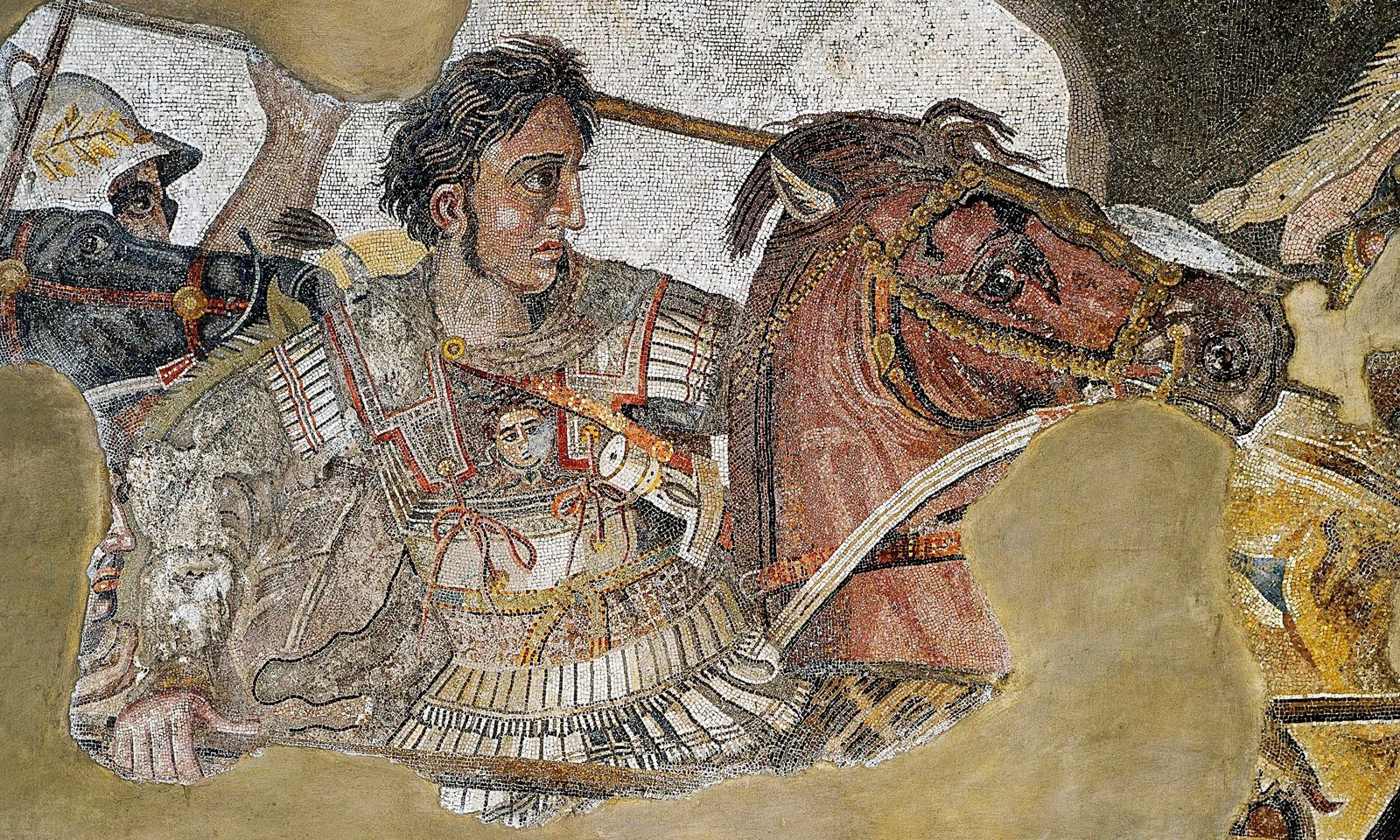
The Alexander Mosaic turns conquest into image and helps explain how Hellenism spread through a wider world.
Alexander the Great did not invent Greek culture, and he did not spread it single-handedly in some simple, automatic way. But he is still the turning point. His conquests created the political and geographic conditions that allowed Greek language, cities, artistic forms, and ways of organizing public life to move far beyond the older Greek homeland. That is the core of Alexander the Great and Hellenism.
In simple terms, Hellenism means the spread of Greek culture through a much wider world, especially after Alexander’s campaigns. It does not mean everything suddenly became purely Greek. It means Greek influence became much more mobile, much more international, and much more deeply woven into places far beyond the old world of the polis, or city-state.
That is why Alexander matters so much for art history. He does not just conquer territory. He helps create the world in which later Greek art, cities, and identity will change shape.
Alexander changes the map, and that changes everything else
The first thing to understand is geographic scale.
Before Alexander, the Greek world was already active, connected, and culturally rich. Colonies existed. Trade networks existed. Greek art and architecture already had a long history, which you can feel across ancient Greek art. But the political center of gravity still belonged mainly to a world of regional powers, especially the old network of ancient Greek city-states.
Alexander changes that map dramatically.
His campaigns carry Macedonian and Greek power from Greece into Egypt, across Anatolia, through the Near East, and as far as parts of Central and South Asia. If you look at an ancient Greek map, the point becomes immediately clear: the Greek-speaking world after Alexander is no longer a relatively compact Aegean story. It becomes a huge transregional world.
That scale matters because culture travels differently across a vast empire than across a cluster of neighboring cities. Ideas, images, building types, languages, and people now move through a much wider field. Even after Alexander’s empire breaks apart, that larger world remains.
So the spread of Hellenism begins with conquest, but it lasts because conquest reshapes the map.
Hellenism spreads through cities, not just armies
It is tempting to imagine Hellenistic culture spreading only because armies marched east. That is too narrow.
Armies open routes and establish power, yes. But culture spreads more durably through settlement, administration, education, trade, and urban life. One of the most important things Alexander and his successors do is found, refound, or reorganize cities across the conquered territories. These urban centers become hubs where Greek language, institutions, and artistic habits can take root.
A city matters because it concentrates people and practices. It can have theaters, gymnasia, markets, sanctuaries, government spaces, and elite houses. It can attract artists, merchants, teachers, and officials. It becomes a place where culture is not just imported once, but lived daily.
This is one reason built space matters so much in this story. Greek culture did not spread only through texts and objects. It also spread through urban forms and public environments, the kinds of patterns you can connect more broadly to ancient Greek structures. Architecture, planning, and civic layout helped make Greek ways of living visible and repeatable.
So if someone asks how Hellenistic culture spread, one of the best answers is this: it spread through cities that made Greek habits durable.
Greek language becomes a major connector across the eastern Mediterranean
One of the strongest tools of Hellenism is language.
After Alexander, a shared form of Greek, often called koine, meaning common Greek, becomes a major language of administration, trade, education, and elite culture across large parts of the eastern Mediterranean and Near East. That does not mean local languages disappear. They do not. But Greek becomes a powerful connector between different regions and peoples.
This matters because language is never just vocabulary. It carries literature, education, habits of public speech, systems of knowledge, and ways of organizing identity. Once Greek becomes widely usable across a large territory, Greek culture becomes easier to circulate.
That circulation helps explain why the later Greek world feels so different from the earlier Classical one. In the age linked to Athens and the Golden Age of Greece, Greek culture is still powerfully local and civic. In the Hellenistic world, it becomes more portable.
That portability changes everything. A sculptor, a philosopher, a merchant, or a court official can operate in a much larger Greek-speaking sphere. The result is a world that feels more connected, more urban, and more culturally layered.
Hellenism is not “pure Greek culture”; it is Greek culture mixing with local worlds
This is the correction that makes the whole topic clearer.
When people ask, “What is Hellenistic culture?”, they sometimes imagine a one-way process: Greeks arrive, local cultures fade, Greek culture wins. The real picture is more mixed and much more interesting.
Greek culture spreads widely, but it enters places with long histories of their own. Egypt, Mesopotamia, Syria, Anatolia, and other regions were not empty spaces waiting to become Greek. They already had religions, artistic traditions, political systems, and social structures. So what emerges is not a simple copy of Greece. It is a blended world.
That is why Hellenism matters as a historical idea. It names a process of interaction. Greek models become influential, but they do so inside landscapes where local traditions continue, adapt, resist, and merge. The result is not cultural purity. It is cultural layering.
This is also why later Greek art feels broader and more varied. The world it belongs to is no longer the smaller civic world of old Greece alone. It is a larger and more entangled environment shaped by movement, contact, and exchange.
Alexander’s empire does not last politically, but it lasts culturally
Here is the paradox at the center of the story: Alexander’s empire breaks apart quite quickly after his death in 323 BCE, but the world he helped create does not disappear with him.
His generals and their successors divide the empire into competing kingdoms. Politically, unity fails. Culturally, however, the larger Greek-shaped world remains. Greek-speaking courts continue. New cities continue to matter. Trade and artistic exchange continue. The wider Hellenistic world keeps functioning even without one single ruler holding it together.
That is why Alexander’s legacy is so large. His importance is not just that he conquered a vast territory. It is that his campaigns helped create the conditions for a long cultural era that outlived him.
So when we talk about Alexander the Great and Hellenism, we are really talking about a chain reaction. Military expansion opens the map. Cities and institutions stabilize Greek influence. Language connects distant places. Local cultures interact with that influence in complex ways. And out of that process comes the world we call Hellenistic.
This matters because Hellenistic art grows inside that new world
The reason this topic matters so much for art is that art never floats above history.
Once Greek culture spreads through larger cities, royal courts, and mixed populations, art changes too. The Greek world after Alexander becomes more international, more theatrical, and more varied in its patrons and audiences. That helps explain why later Greek art can look more emotionally intense, more dramatic, and more expansive than what came before.
In other words, Hellenism is not just background. It is the environment that makes later Greek visual culture possible in its new form.
So the best way to think about Alexander is not as the artist of Hellenistic culture, but as the historical trigger. He helps create the world in which Hellenistic culture can happen.

Conclusion
Alexander the Great helped spread Greek culture not because he personally designed the Hellenistic world, but because his conquests transformed the map, opened new urban and political networks, and made Greek language and institutions far more mobile than before. Hellenism then spread through cities, courts, trade, education, and cultural exchange across a much larger and more mixed world.
That is why Alexander matters so much. He does not just end one chapter of Greek history. He helps begin the world that comes after it.
FAQ
What is Hellenistic culture in simple terms?
It is the wider Greek-influenced culture that spreads across the eastern Mediterranean and Near East after Alexander the Great.
How did Hellenistic culture spread?
It spread through conquest at first, but more durably through cities, trade, administration, education, and the spread of Greek language.
Did Alexander create the Hellenistic world by himself?
No. He created the conditions for it, but the full Hellenistic world developed through his successors and the systems that continued after his death.
What was the Hellenistic empire?
People often use that phrase for the vast world shaped by Alexander’s conquests and the kingdoms that followed, though his original empire did not remain politically united.
Did Hellenism mean local cultures disappeared?
No. Greek influence became very strong, but it mixed with many local traditions rather than simply replacing them.
Why does Alexander matter for Greek art?
Because he helped create the wider international world in which later Greek art, cities, and cultural identity changed shape.
Sources and Further Reading
The Metropolitan Museum of Art — “Art of the Hellenistic Age and the Hellenistic Tradition” (2007)
Smarthistory — “Empire and Art in the Hellenistic world (c. 350–31 B.C.E.)” (n.d.)
Encyclopaedia Britannica — “Alexander the Great: Evaluation” (2026)
The Metropolitan Museum of Art — “Art of the Hellenistic Kingdoms: From Pergamon to Rome” (2021)
You may also like