Pont du Gard: Why This Roman Aqueduct Still Feels Impossible
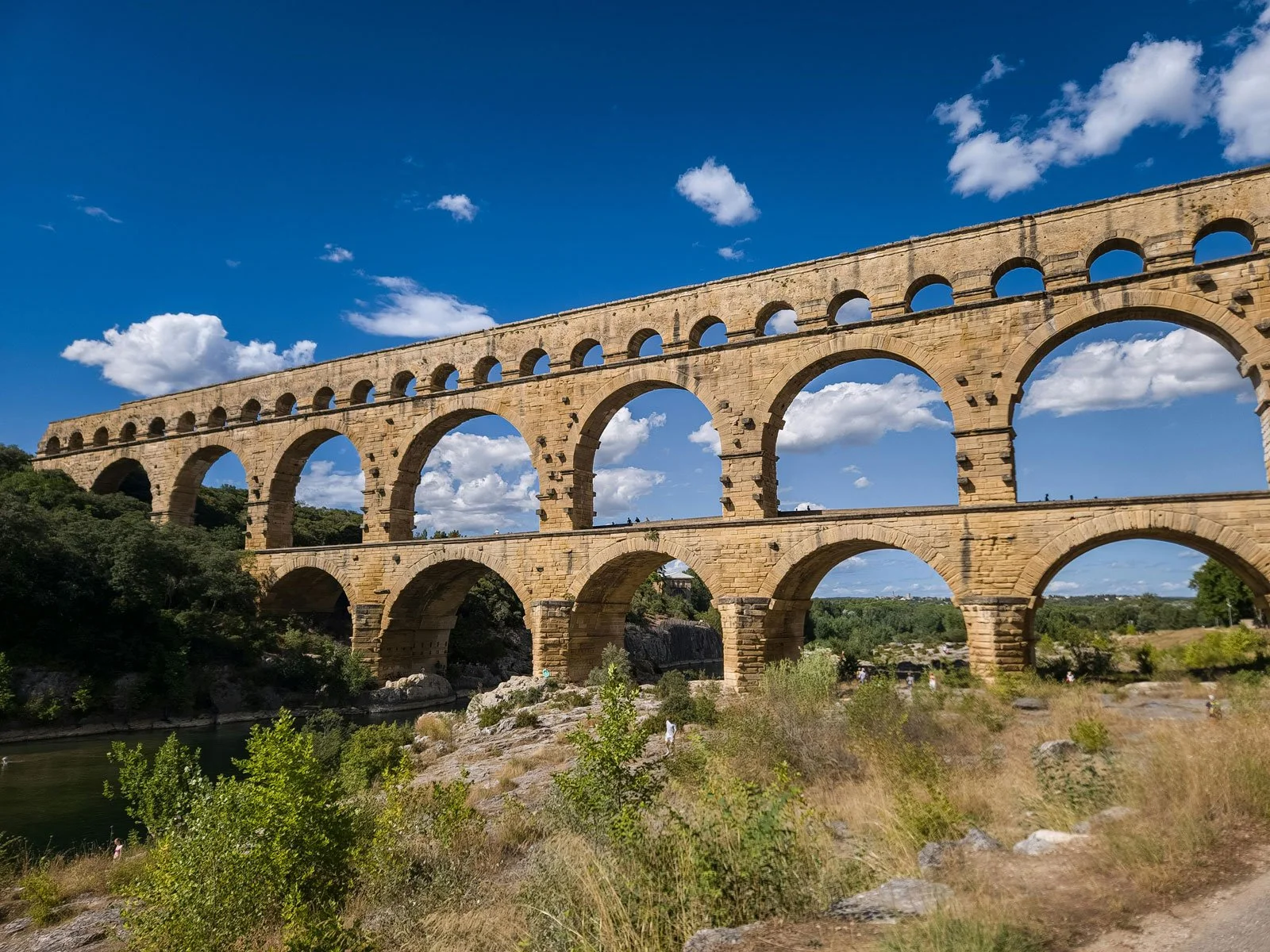
Pont du Gard feels so striking because it is both infrastructure and spectacle, built with the confidence of a monument.
The Pont du Gard feels impossible because it is doing two things at once. It is a piece of infrastructure, built to move water across a river valley, but it also feels like a monumental work of architecture. That double identity is what makes it so memorable. You are not just looking at a utility structure. You are looking at Roman engineering turned into landscape-scale form.
For many beginners, the first surprise is that the Pont du Gard is only one part of a much longer aqueduct system. It was built to help carry water to the Roman city of Nîmes, and its famous arches are only the most dramatic section of that larger route. The second surprise is that the bridge is so huge even though the water itself needed only a very slight downward slope to keep flowing. That contrast, between the quiet movement of water and the massive confidence of the structure, is part of why the monument still feels visually overwhelming.
If you want to understand why Roman infrastructure still amazes people, the Pont du Gard is one of the best places to start.
What is the Pont du Gard?
The Pont du Gard is a Roman bridge-aqueduct in southern France. In simple terms, it is the section of the Nîmes aqueduct that carried water across the Gardon River valley. It was not built as a road bridge in the modern sense, though later periods adapted it for crossing. Its original purpose was hydraulic: to keep the water channel at the right level while the land dropped below it.
That makes it part of the broader story of Roman aqueducts. Like other Roman aqueduct systems, it relied on gravity, careful surveying, and a tightly controlled gradient. But unlike many aqueduct stretches that stayed underground or close to the ground, this crossing had to become highly visible because the valley demanded a raised structure.
So the Pont du Gard is not just a bridge, and not just an aqueduct. It is a bridge-aqueduct, meaning a bridge whose main job was to carry a water channel across difficult terrain.
Why is it so famous?
The Pont du Gard is famous partly because it is extraordinarily well preserved, but also because it makes Roman engineering easy to see. Many Roman infrastructures are impressive in principle yet hard to visualize because much of the system is buried, broken, or fragmented. Here, by contrast, the logic is right in front of you.
It rises in three stacked levels of arches, creating a structure that is both legible and dramatic. The bridge is nearly 49 meters high, which makes it the highest surviving Roman bridge-aqueduct. It also stretches across the river with such calm proportional control that it seems almost too precise to be real.
That is where the emotional force of the monument comes from. The Pont du Gard does not look improvised or merely heavy. It looks measured, even elegant. Its scale is huge, but its rhythm stays clear. Each tier steps back from the one below, so the whole structure feels balanced rather than crushed by its own mass.
This is why it still feels so powerful in person and in photographs. It is not only large. It is large with confidence.
When was Pont du Gard built?
The Pont du Gard is generally dated to the 1st century CE, and it is now often placed around the middle of that century, probably around 50 CE. That dating matters because it places the monument in the early imperial Roman world, when large public works were expanding both inside Rome and across the provinces.
Older scholarship sometimes linked the aqueduct more closely to Agrippa and the Augustan period, and that older attribution still appears in some reference works. But current site-based interpretation tends to place the structure later, under the reigns of Claudius or Nero.
For a beginner, the most useful point is not the historiography of the debate, but the broader context. The Pont du Gard belongs to the moment when Roman engineering had become capable of building at a very high level of territorial ambition. It was not an isolated experiment. It was part of a mature Roman infrastructure culture.
How did the aqueduct work?
The aqueduct worked through gravity. Water was brought from a source near Uzès to Nîmes, over a route of roughly 50 kilometers, by maintaining a very slight and carefully controlled slope. The average gradient was astonishingly small, around 25 centimeters per kilometer.
That detail is one of the main reasons the Pont du Gard feels so improbable. The water did not need a spectacular drop. It needed extraordinary precision. The entire system had to be surveyed so that the water would continue moving gently but steadily across long distance.
The Pont du Gard exists because the route could not simply follow the ground at that point. The valley interrupted the line, so the water channel had to be carried high above the river in order to preserve the aqueduct’s level.
This is where the monument becomes a brilliant example of ancient Roman engineering. It solves a territorial problem with a structural solution that is both exact and monumental. The Romans were not building large arches just for display. They were building them because the water needed them.
Why does it look so impossible?
The structure feels impossible because the visual effect seems far larger than the practical task. A narrow water channel is being carried by a vast three-tiered masonry framework. That mismatch between small function and huge support creates a sense of wonder.
There is also the question of construction. The bridge is made from large stone blocks with exceptional precision. The lower levels use massive masonry, and the arches create a repeated rhythm that makes the whole structure feel both strong and strangely light. Roman builders did not need steel or modern reinforced concrete to create this effect. They relied on geometry, stone cutting, and the structural logic of the Roman arch.
That arch logic matters a lot. Each arch redirects load into its supports, and when arches are repeated in sequence, they can create a durable and efficient system for spanning distance. If you want to zoom in further, even the role of the crown stone becomes clearer through the logic explained in keystone arch.
So the Pont du Gard feels impossible partly because it compresses so many kinds of intelligence into one object: surveying, masonry, structural planning, and proportion.
Is it a bridge or monument?
It is both, and that is the real key to its fascination.
Structurally, it belongs to the same family as Roman bridges, because it uses repeated arches to cross a river valley. But functionally, it is an aqueduct support rather than a road crossing in origin. Visually, though, it behaves like a monument. It dominates the landscape, frames views, and gives Roman infrastructure a kind of public grandeur.
This is one of the most revealing things about Roman building culture. The Romans did not always separate utility from monumentality in the modern way. A necessary structure could also become a statement. The Pont du Gard does exactly that. It carries water, but it also carries an image of Roman command over material and terrain.
That is why it is so often used as a symbol of Roman achievement. It feels like infrastructure raised to the level of architecture.
How does it compare with Segovia?
The most useful comparison is the Segovia Aqueduct. Both are among the most famous surviving Roman aqueduct structures, and both show how arches could carry water while becoming monumental urban or territorial landmarks.
The difference is largely one of setting and effect. Segovia is inseparable from the city. It enters urban space in a dramatic way and feels woven into civic life. The Pont du Gard, by contrast, feels more like a landscape event. It stands in open territory, so its scale is read against river, rock, and sky.
That difference changes the experience. Segovia feels urban and civic. Pont du Gard feels territorial and almost surreal. Both are extraordinary, but Pont du Gard often feels more overwhelming because the surrounding landscape gives its height and length more room to register.
Why does Pont du Gard matter?
The Pont du Gard matters because it makes Roman infrastructure visible in its most compelling form. It shows that Roman civilization was not only about temples, statues, and arenas. It was also about routes, gradients, water supply, and the ability to build systems that supported urban life over long distance.
It also matters because it reveals how closely Roman technology and visual culture could overlap. This was not a plain technical support hidden from view. It was a work whose structural necessity became architectural presence.
And finally, it matters because it changes how we look at Roman ruins. Instead of seeing ruins only as broken remnants of once-beautiful buildings, we begin to see them as parts of larger working systems. The Pont du Gard is moving precisely because it still lets us feel that system.

Conclusion
The Pont du Gard still feels impossible because it turns a precise hydraulic problem into a monumental architectural experience. It had to carry water gently across a valley, yet the solution became one of the most visually overwhelming Roman structures still standing.
That is what makes it unforgettable. The Pont du Gard is not just a ruin and not just a feat of engineering. It is a reminder that Roman infrastructure could be practical, territorial, and breathtaking at the same time.
FAQ
What is the Pont du Gard?
The Pont du Gard is a Roman bridge-aqueduct in southern France that formed part of the aqueduct supplying water to ancient Nîmes.
Why is Pont du Gard famous?
It is famous for its exceptional preservation, its three tiers of arches, and the way it turns infrastructure into monumental architecture.
How did Pont du Gard work?
It carried a water channel across the Gardon River valley while preserving the very slight gradient needed for water to flow by gravity.
When was the Pont du Gard built?
It is generally dated to the 1st century CE and is now often placed around the middle of that century, probably around 50 CE.
How tall is the Pont du Gard?
It stands nearly 49 meters high, making it the highest surviving Roman bridge-aqueduct.
Is the Pont du Gard a bridge or an aqueduct?
It is both: structurally a bridge, functionally part of an aqueduct system.
Sources and Further Reading
You may also like