Roman Dome: How the Romans Turned Concrete into Space
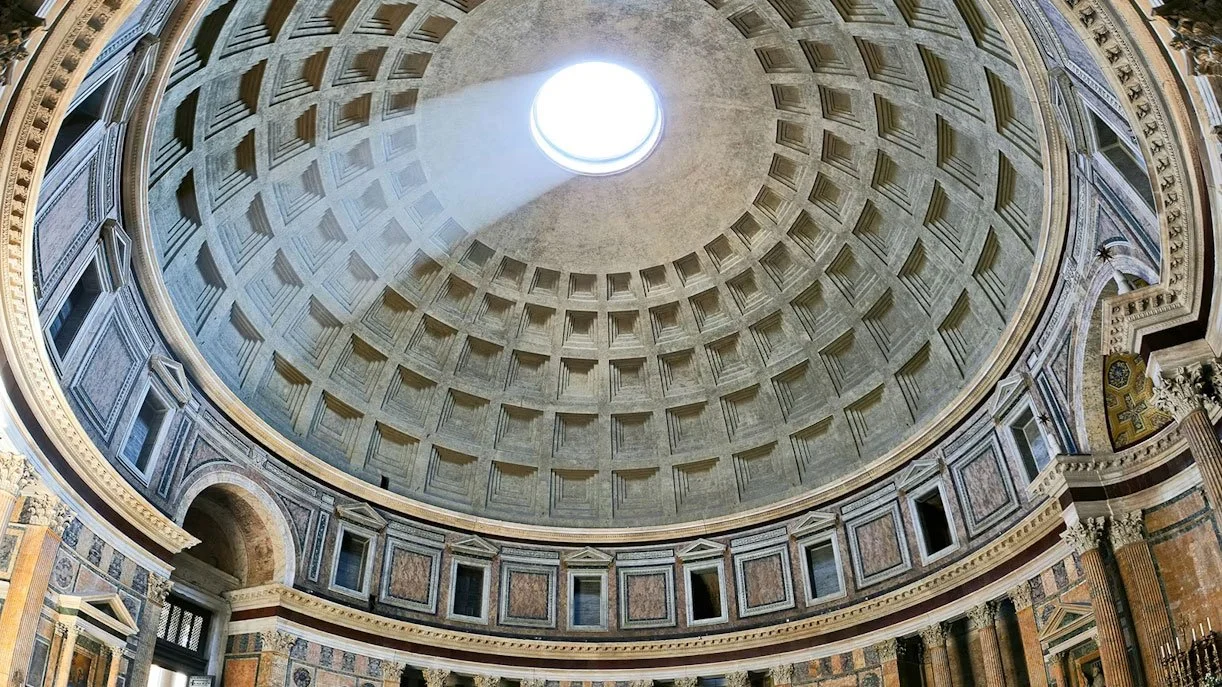
The Roman dome is not just a structural trick here. It turns light, height, and enclosure into a single spatial effect.
The Roman dome is where Roman building stops being only impressive engineering and becomes a completely new kind of interior experience. A dome does more than cover a room. It gathers space, concentrates light, and makes a building feel unified from the inside. That is why Roman domes matter so much. They did not simply solve a roofing problem. They changed what architecture could feel like.
Many people think immediately of the Pantheon, and that makes sense. Its dome is one of the most famous in the world. But the Pantheon is only part of the story. Roman domes appeared in baths, tombs, halls, and other structures across the Roman world. What makes them important is not just one masterpiece, but the broader Roman discovery that concrete, curved form, and heavy supporting mass could create vast enclosed interiors unlike anything earlier architecture had achieved at that scale.
This is also why the Roman dome matters beyond Rome itself. It became one of the clearest signs that Roman architecture was not only about columns, temples, and facades. It was about space.
In simple terms
A Roman dome is a curved roof that creates one continuous interior volume. What made it revolutionary was the Roman ability to build domes at large scale with concrete, thick supports, and precise control of weight and thrust.
What is a Roman dome?
A Roman dome is a curved roof structure that rises over a space in a roughly hemispherical or partially rounded form. In simple terms, you can think of it as a three-dimensional extension of the arch. If an arch spans an opening in one direction, a dome carries that curved logic around a central point to cover space in all directions.
That definition matters because the dome is not only a visual cap placed on top of a building. It is a structural and spatial form. It encloses a room without relying on a flat roof carried by many internal supports. The result is often a strong sense of unity. Instead of experiencing a building as a set of separate bays, you experience it as one concentrated interior.
This is part of what makes ancient Roman domes feel so striking. They are not just roofs. They reshape the room below. They create a single volume that can feel calm, immense, and even theatrical, depending on the building.
The Roman dome also belongs within the larger world of Roman architecture. It is not an isolated invention. It grows out of Roman experiments with arches, vaults, mass construction, and concrete. Once those techniques matured, the dome became one of the most powerful forms available to Roman builders.
How did a Roman dome work?
A dome works by carrying load along its curved surface and directing that force downward and outward toward its supports. That outward pressure is called thrust. This is one of the key things to understand. A dome does not simply sit on top of a room like a lid. It pushes on the structure around it.
That is why Roman domes usually need thick walls, strong drums, or heavy supporting masses. A drum is the cylindrical or polygonal wall beneath the dome that raises it and helps support it. If the base is too weak, the thrust of the dome can spread the structure outward.
This is also why Roman domes are so closely related to arches and Roman vaults. Structurally, they belong to the same family of curved construction. All of them depend on compression, meaning the controlled transfer of weight through pressure, rather than on the bending strength of a long straight beam.
Roman builders were especially good at understanding this relationship between curve and support. They knew a dome could create an extraordinary interior, but only if the structure below was designed to receive its forces. So the Roman dome is never just the visible curved shell. It includes the whole supporting system beneath it.
That supporting logic is one reason Roman domes often feel so massive from the outside compared with their elegant interior effect. The outer structure may look heavy because it has to contain the dome’s structural energy. The beauty of the Roman dome often depends on that balance between hidden resistance and visible openness.
Why did concrete matter so much?
The Roman dome would not have developed in the same way without Roman concrete. Concrete mattered because it gave Roman builders a much more flexible way to shape curved masses than traditional cut stone alone could easily provide.
A dome made entirely from carefully cut masonry is possible, but it is complex, limiting, and often more difficult at large scale. Concrete changed the situation. It allowed Roman builders to form thick, continuous curved structures with more freedom. Instead of assembling only discrete blocks, they could create a more unified mass.
This does not mean Roman domes were casually poured like modern concrete shells. Roman construction was still careful, layered, and often combined with brick facing and formwork. But concrete made large domed spaces more practical. It also worked especially well within a Roman construction culture already comfortable with arches, vaults, and massive supporting walls.
This is why Roman domes are not just geometric ideas. They are material achievements. The dome only becomes fully Roman when it is tied to concrete, wall mass, and structural planning. That is what turns the form from an interesting possibility into a repeatable building solution.
Concrete also helped Roman builders think differently about interior space. Once a curved roof could be formed more freely, architecture no longer had to depend so heavily on rows of supports and flat spans. Space could become broader, more continuous, and more dramatic.
Why is the Pantheon so famous?
The Pantheon dome is famous because it shows the Roman dome at an extraordinary level of refinement, scale, and clarity. The building combines a traditional temple front with a circular domed interior, and that contrast alone makes it memorable. From the outside, the porch still speaks the language of columns and pediments. Inside, the dome creates an entirely different architectural world.
What makes the Pantheon so powerful is not only that it is large. It is that the whole interior feels unified. The dome gathers the room into one coherent volume. The central oculus, the round opening at the top, intensifies that effect by focusing light and drawing attention upward. Instead of simply entering a hall, you step into a space that feels complete and self-contained.
The Pantheon also makes visible one of the great Roman achievements: the ability to combine classical form and radically new space. That is why it stands at such an important point in architectural history. It still uses a traditional front porch that recalls the world of the temple, yet behind it opens a domed interior that goes far beyond earlier temple logic. If you want the chronology of the monument itself, see when was the Pantheon built.
But the Pantheon should not be treated as if it appeared from nowhere. It is a peak, not a beginning. It belongs to a larger Roman exploration of vaulted and domed forms that had already been developing in baths, tombs, and other structures.
Why is the Pantheon not enough?
The Pantheon is the most famous Roman dome, but it is not the only Roman dome and not even the only kind of Roman dome. If we focus only on that one building, we miss the broader Roman interest in domed space.
Roman domes appeared in several building types. They could cover tombs, bathing rooms, reception spaces, and specialized halls. Some were monumental and public. Others were smaller and more intimate. Some sat over circular plans. Others were adapted to more complex geometries. What matters is that the dome had become one of the available tools of Roman architecture, not just a one-time spectacle.
This broader use helps explain why Roman domes deserve to be understood as a systemic achievement. The Romans were not merely showing that one extraordinary dome could be built. They were demonstrating that curved enclosed space could become part of the architectural vocabulary.
That point is easy to miss because the Pantheon is so dominant in the modern imagination. But once you notice other domed buildings in Rome and across the Roman world, the picture changes. The dome becomes less like a miracle and more like a sign of a culture that had learned to think confidently in terms of mass, thrust, and interior volume.
So yes, the Pantheon is essential. But the fuller story is that Roman builders had already discovered that the dome could do something flat roofs and temple fronts could not: it could turn enclosure itself into the main event.
How did domes change Roman space?
This is where the Roman dome becomes especially important for architecture rather than engineering alone. A dome changes not only construction, but experience.
Inside a domed room, space often feels gathered and centered. Your eye is pulled upward. The boundary between wall and roof becomes less abrupt. Light can move differently across the curved surface. The room feels less like a box with a covering on top and more like a single shaped volume.
That effect had major consequences in Roman architecture. It allowed certain spaces to feel more ceremonial, more unified, and more memorable. In baths, a dome could intensify the atmosphere of a room by gathering steam, sound, and light into one enclosure. In monumental architecture, it could make interior space itself feel like a demonstration of power and technical command.
The Roman dome also encouraged a stronger focus on interior architecture. Earlier traditions often placed more visual emphasis on the exterior form of the building. Roman domes shifted attention inward. The real drama was often inside, where structure, light, and volume came together.
This is one reason Roman domes still feel so modern. They remind us that architecture is not only about facades or elevations. It is also about the experience of being inside a shaped volume. Roman builders understood that deeply.
How were Roman domes different?
Roman domes feel different partly because they belong to a different architectural mindset than the one we usually associate with Greek temples. A Greek temple is usually organized around exterior order, colonnades, proportion, and the clear logic of post-and-lintel construction. The emphasis is often on the outer form and its visual perfection.
Roman architecture, by contrast, became much more invested in interior capacity. That shift is visible in domes. A dome is not mainly about exterior profile. It is about the interior volume it creates and the structural system that makes that volume possible.
This does not mean Roman builders rejected the classical language of columns and entablatures. Quite the opposite. They often kept and reused those forms. The Pantheon itself still has a temple front. Roman buildings also continued to use columns and supports, which is part of why topics like Roman pillars still matter. But the Roman dome shows that columns were no longer the whole story.
The contrast becomes clearer when seen against Greek architecture more broadly. Greek builders perfected the temple as an external sculptural form. Roman builders inherited that language, then pushed architecture toward vaulting, concrete, and new kinds of enclosed space. The dome is one of the clearest signs of that change.
Why do Roman domes still matter?
Roman domes still matter because they changed the architectural imagination. They showed that buildings could create not just covered rooms, but unified interior worlds. That lesson did not end in antiquity. Later architecture kept returning to Roman domes, whether in the Renaissance, in later church architecture, or in the long history of monumental public buildings.
They also matter because they reveal what was distinctive about Roman building as a whole. Roman architecture was not only about copying Greek models or decorating surfaces with classical details. It was about combining material knowledge, structural confidence, and spatial ambition.
The dome condenses all of that into one form. It turns concrete into enclosure. It turns engineering into atmosphere. It turns support and thrust into a room that feels calm, vast, and complete.
That is why the Roman dome remains such a powerful topic for beginners. It shows, in one unforgettable shape, how technical innovation can change the way architecture feels.

Conclusion
The Roman dome was much more than a curved roof. It was one of the clearest ways Roman builders turned engineering into architecture. By combining concrete, thick supporting structures, and a strong understanding of curved construction, they created interiors that felt unified, monumental, and deeply new.
The Pantheon is the most famous example, but it is only part of the story. What really matters is the larger Roman discovery that a dome could reshape space itself. Once that happened, architecture could never be quite the same again.
FAQ
What is a Roman dome in simple terms?
A Roman dome is a curved roof that covers a space as one continuous volume. It works like a three-dimensional extension of the arch.
Why was the Pantheon dome so important?
It showed how Roman builders could use concrete and heavy supporting walls to create a huge, unified interior space that still feels remarkable today.
Did the Romans invent the dome?
Not in the absolute sense. Domed forms existed earlier, but the Romans developed the large-scale masonry and concrete dome in a new and highly influential way.
Why did Roman domes need thick walls?
A dome pushes outward as well as downward. Thick walls or a strong drum help resist that thrust and keep the structure stable.
How are Roman domes related to vaults?
Both belong to the same family of curved construction. A vault extends the logic of the arch through space, while a dome gathers that curved logic around a central point.
Were Roman domes only used in temples?
No. They appeared in several types of Roman buildings, including baths, tombs, and monumental halls, not just sacred architecture.
Sources and Further Reading
You may also like