Segovia Aqueduct: How a Roman Structure Still Dominates the City
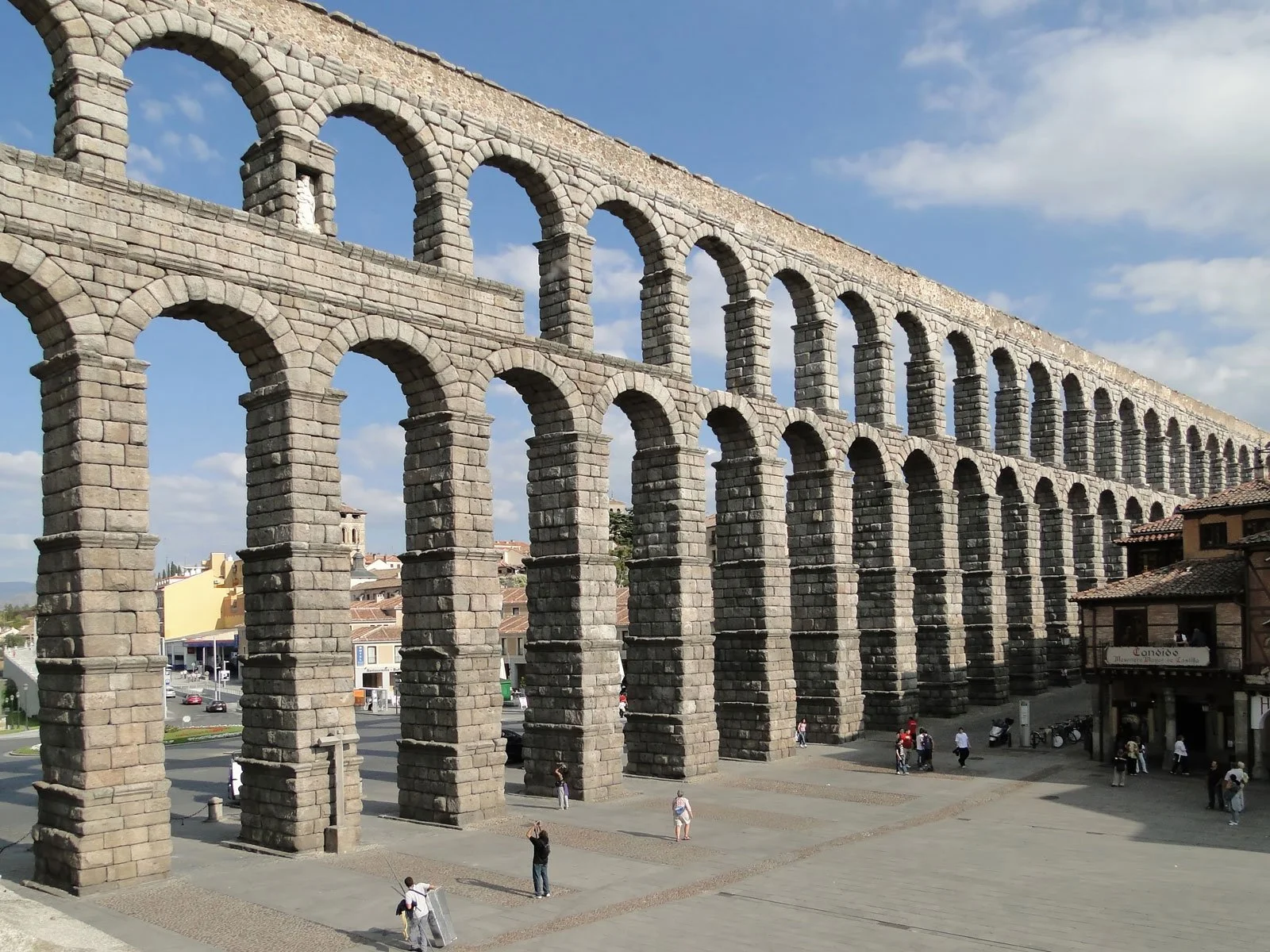
The Segovia Aqueduct still dominates the city because Roman engineering here works at true urban scale.
The Segovia Aqueduct is one of the best places to understand why Roman engineering still feels startling. It is not hidden in a field or reduced to scattered ruins. It rises directly into the urban fabric, crossing the city with such calm force that it still feels present rather than merely ancient. That is what makes it so memorable. The aqueduct is not just preserved. It still organizes how the city is seen.
For beginners, this matters a lot. Many Roman structures are easier to admire than to understand. The Segovia Aqueduct is different. Its logic is visible. You can see the arches, the stacked levels, the precision of the masonry, and the way the whole structure seems to hold itself together almost impossibly without mortar. It turns a technical system into an architectural image.
And that is exactly why the monument matters. It is a piece of water infrastructure, but it also feels like a lesson in structure, rhythm, and Roman confidence.
What is the Segovia Aqueduct?
The Segovia Aqueduct is a Roman water-supply structure in central Spain. More precisely, it is the most visible urban section of a longer aqueduct system that brought water from sources outside the city into Segovia.
That distinction is important. The monument people usually mean when they say “the Segovia Aqueduct” is not the entire route. It is the most spectacular surviving part of the system, especially the elevated stretch at the Plaza del Azoguejo, where the aqueduct rises in two levels of arches. Like other Roman aqueducts, it worked by gravity. Water moved along a controlled slope from higher ground toward the city.
So the aqueduct is both local and territorial at once. It belongs to the city, but it begins well beyond the city. That is one reason it feels so powerful: it makes distant water suddenly visible as urban form.
When was it built?
The exact date of the aqueduct is still debated, which is part of what makes it interesting. It is generally placed somewhere between the late 1st century CE and the early 2nd century CE. Some interpretations place it earlier, while others connect it more closely to the reigns of emperors such as Trajan or even the transition toward Hadrian.
For a beginner, the most useful takeaway is not the exact emperor but the broader context. The Segovia Aqueduct belongs to a mature phase of Roman engineering, when the empire already had long experience with water systems, arches, and large infrastructural works. It was not a first experiment. It was the result of a building culture that already knew how to control slope, organize labor, and construct in stone with remarkable precision.
That maturity helps explain why the monument feels so resolved. It does not look tentative. It looks like the work of a civilization that already trusted its own techniques.
How did the aqueduct work?
The aqueduct worked through gravity. Water was collected from sources in the surrounding landscape and brought toward Segovia along a route of roughly 15 to 16 kilometers. The key was not speed, but steady gradient. The water had to descend gently enough to keep moving without damaging the system.
That is where Roman engineering becomes impressive in a very quiet way. To make an aqueduct work, builders had to survey terrain carefully and preserve the right level over long distance. If the land dropped too much in one place, the water channel could not simply plunge with it. It had to remain controlled. That is why the elevated arches in Segovia exist. They keep the conduit at the right height while the ground falls away below.
This is one reason the monument belongs so clearly to ancient Roman engineering. It is not grand for the sake of grandeur. Its scale comes from precision. The huge structure is there because the water needed a stable path.
And that makes the aqueduct feel more intelligent the longer you look at it. Its beauty comes from a technical necessity handled with extraordinary discipline.
Why does it look so different?
The Segovia Aqueduct looks different from many Roman remains because it is both highly preserved and structurally legible. You do not need to imagine very much. The logic is right in front of you.
Its most famous section rises in two stacked tiers of arches and reaches a height of about 28 meters. The rhythm of those arches gives the monument its visual force. Repetition is doing a lot of the work. Instead of one dramatic span, you get a sequence that builds momentum across the city.
The material also matters. The aqueduct is built from large granite blocks fitted together without mortar. That detail surprises many first-time viewers, because the structure feels so stable and so complete that people assume it must depend on some hidden binding material. But its strength comes from geometry, weight, and careful cutting. That makes it a perfect companion to the logic explained in the Roman arch. Each arch redirects force into its supports, and the repetition of that principle creates the larger whole.
If you want to zoom in even further, the monument also makes the lesson of the keystone arch easier to understand. Even when you are overwhelmed by the full structure, the arch is still working one unit at a time.
Why does it dominate Segovia?
What makes the Segovia Aqueduct so special is that it does not sit outside the city as a picturesque leftover. It enters the city in a way that still feels commanding. It is not background. It is one of the main things that gives Segovia its identity.
At the Plaza del Azoguejo, the aqueduct becomes almost unavoidable. The city seems to gather around it. Streets, views, and photographs all end up negotiating with its presence. That is why the monument feels less like an archaeological fragment and more like an active urban fact.
This is also where it differs from the Pont du Gard. The Pont du Gard is a landscape event. Segovia is an urban event. One dominates a valley. The other dominates a city. Both are extraordinary, but the feeling is different. In Segovia, Roman infrastructure is not simply crossing nature. It is crossing civic space.
That urban presence explains why the monument still feels so strong. It is not just old. It is spatially unavoidable.
Is it a bridge too?
Not in origin, at least not in the way a road bridge is. The Segovia Aqueduct is primarily an aqueduct structure, designed to carry water. But like other elevated Roman systems, it shares important structural logic with Roman bridges. It spans space through repeated arches, distributes load through masonry, and turns structural rhythm into a visible public form.
That is why the distinction can feel blurry. A Roman aqueduct arcade and a Roman bridge are not the same type, but they belong to the same family of Roman solutions. Both show how arches could be multiplied to solve a problem across distance.
In Segovia, that bridge-like character becomes especially clear because the monument crosses open urban space so dramatically. Even though it was built for water rather than for carts or pedestrians, it still reads like a great spanning structure.
Why is it still so moving?
The Segovia Aqueduct is moving because it makes Roman time feel unusually near. Many Roman ruins move us through loss. They are fragmented, broken, or incomplete. Segovia works differently. It moves us through presence.
You can still feel the discipline of its construction. You can still read the arches as a system. You can still sense the confidence behind the design. And because the monument survives at urban scale, it has not been reduced to a museum object. It still stands in public space and still shapes the city’s image.
That continuity matters. The aqueduct carried water for many centuries, far beyond antiquity, and even now it continues to carry meaning. It has become the symbol of Segovia not just because it survived, but because it survives with unusual clarity.
Why does the Segovia Aqueduct matter?
The Segovia Aqueduct matters because it shows Roman infrastructure at its most visible and convincing. It proves that Roman engineering was not only about hidden technical systems. Sometimes it became architecture in the fullest sense: something that structures space, frames urban life, and stays memorable even after its original function has faded.
It also matters because it gives beginners a perfect entry point into Roman building. Here you can understand arches, dry masonry, water infrastructure, and urban impact all at once. The monument is complex, but it is also readable. That combination is rare.
And perhaps most importantly, it reminds us that Roman achievement was not only monumental in the ceremonial sense. It was monumental in the practical sense too. The Romans built systems that served cities, and sometimes those systems became the city’s most unforgettable form.

Conclusion
The Segovia Aqueduct still dominates the city because it was never just a technical support for water. It was a precisely engineered structure whose arches, masonry, and urban placement turned infrastructure into a permanent architectural presence.
That is why it still feels so strong today. The monument does not only tell us that Rome could build well. It shows that Roman engineering could become clear, rhythmic, and unforgettable space.
FAQ
What is the Segovia Aqueduct?
The Segovia Aqueduct is a Roman water-supply structure in Spain, best known for its monumental elevated section crossing the city.
When was the Segovia Aqueduct built?
Its exact date is debated, but it is generally placed between the late 1st century CE and the early 2nd century CE.
How did the Segovia Aqueduct work?
It carried water by gravity along a carefully controlled slope from sources outside Segovia into the city.
Why is the Segovia Aqueduct so famous?
It is one of the best-preserved Roman engineering works in Spain and still dominates Segovia’s urban image.
Was the Segovia Aqueduct built with mortar?
No. Its famous urban section is built from granite blocks fitted together without mortar.
How is it different from Pont du Gard?
Pont du Gard feels more like a landscape crossing, while the Segovia Aqueduct feels deeply urban, woven into the city itself.
Sources and Further Reading
You may also like