Religion in Minoan Crete: Goddesses, Horns and Sacred Peaks

These terracotta figures from Gazi, some crowned and with raised hands, show how simple clay images could embody local deities and community worship.
You are standing in a Cretan palace court at dusk. On the roofline, carved “horns” frame the sky. Down in a side room, a small clay goddess with raised arms stares out over a table for offerings. Far above you on a mountain ridge, tiny terracotta figurines sit in the wind. No hymns survive, no myths in their own words, but the objects are still here.
This is the world of Minoan religion. It feels strangely visible and invisible at the same time. We have shrines, symbols and ritual objects, yet almost no deciphered texts to explain them. So in this guide we walk carefully: what can archaeology show us about cults, goddesses, horns and sacred peaks, and where do we hit the honest wall of “we do not know”.
We will move from palaces to mountain sanctuaries, from snake-handling figures to horn symbols and libation tables. If you want the broader social and architectural frame, you can read our overview of Minoan civilization and our walkthrough of Minoan palaces alongside this piece.

Minoan religion is reconstructed from spaces, symbols and undeciphered writing
The first thing to admit is that Minoan religion is mostly a puzzle built from material pieces. We do not have readable sacred texts in their own language. The main script used for cult and administration, Linear A, is still undeciphered, even though we know it was used on libation tables, offering vessels and administrative tablets.
So how do we know anything at all. Archaeologists lean on three kinds of evidence:
Spaces: rooms and sites clearly designed for ritual, such as shrines, peak sanctuaries and caves.
Symbols: recurring motifs like horns of consecration, double axes, snakes and sacred trees.
Objects: figurines, libation tables, stone vessels and decorated sarcophagi that show cult scenes.
Inside palaces, small sanctuaries cluster near important corridors and courts. They might have benches for offerings, “horns” carved in stone, pillar bases and wall paintings with worshippers. Outside the palaces, peak sanctuaries sit on mountain tops or high ridges, filled with terracotta figurines, miniature altars and sometimes clay models of buildings. Caves, such as Psychro and Ida, also show signs of cult activity: offerings, figurines, even later Greek dedications that treat them as ancient sacred sites.
When you put all of this together, a pattern emerges. Minoan religion seems to connect three levels: household or small shrine, palace or local centre, and dramatic natural spots. The same symbols and gestures repeat across these levels, but we have to stay honest. We can trace how people worshipped and where; we are much less sure what they called their gods or exactly what they believed.
Definition: Minoan religion is the set of cult practices and beliefs in Bronze Age Crete, reconstructed mainly from shrines, symbols and undeciphered inscriptions rather than from surviving sacred texts.
Goddesses, snakes and horns: reading divine images without forcing a single “Great Goddess”
If you picture Minoan goddesses, you probably see the famous snake-handling figures from Knossos: bare-breasted women with flounced skirts, raised arms and snakes looping through their hands. These faience figurines were found in the so called Temple Repositories at the palace, along with tiny animals and other cult objects. They are powerful images, and they have shaped a whole conversation about Minoan religion.
For decades, scholars spoke confidently about a single Minoan Great Goddess, a mother or nature deity who dominated the pantheon, with a younger male consort in the background. Today the mood is more cautious. Yes, female figures appear very often in cult contexts. They stand on mountain tops, between animals, with snakes, birds or flowers. They look like “Mistresses” of animals or places. At the same time, we now talk more about a cluster of related goddesses and gods, rather than one monolithic mother figure. Different shrines might honour different divine aspects, even if the visual language overlaps.
Alongside these figures, certain sacred symbols show up everywhere:
Horns of consecration: stylised horn shapes, like a shallow “V” in stone or clay, placed on roofs, altars or miniature models. They probably mark a space as sacred and tie it to bull symbolism.
Double axes (labrys): carved on pillars, painted on walls, modelled in metal. They may connect to sacrifice, power or specific deities.
Snakes: in the hands of goddesses, wrapped around cylinders, or in relief. Often linked to fertility, domestic space and the chthonic (underworld or earth) sphere.
If you have been reading about Cycladic art figures and their folded-arm idols, you might feel a faint echo here. In both the Cycladic and Minoan worlds, compact female images and simple, repeated symbols seem to hold a lot of ritual weight, even when we lack the stories behind them. You can explore that Cycladic side more in our close reading of Cycladic art figures.
Myth vs Fact
Myth: Minoan religion revolved around a single all-powerful Mother Goddess and nothing else.
Fact: Archaeology suggests a rich mix of goddesses, gods and sacred symbols, with prominent female figures but no clear evidence for one exclusive Great Goddess.
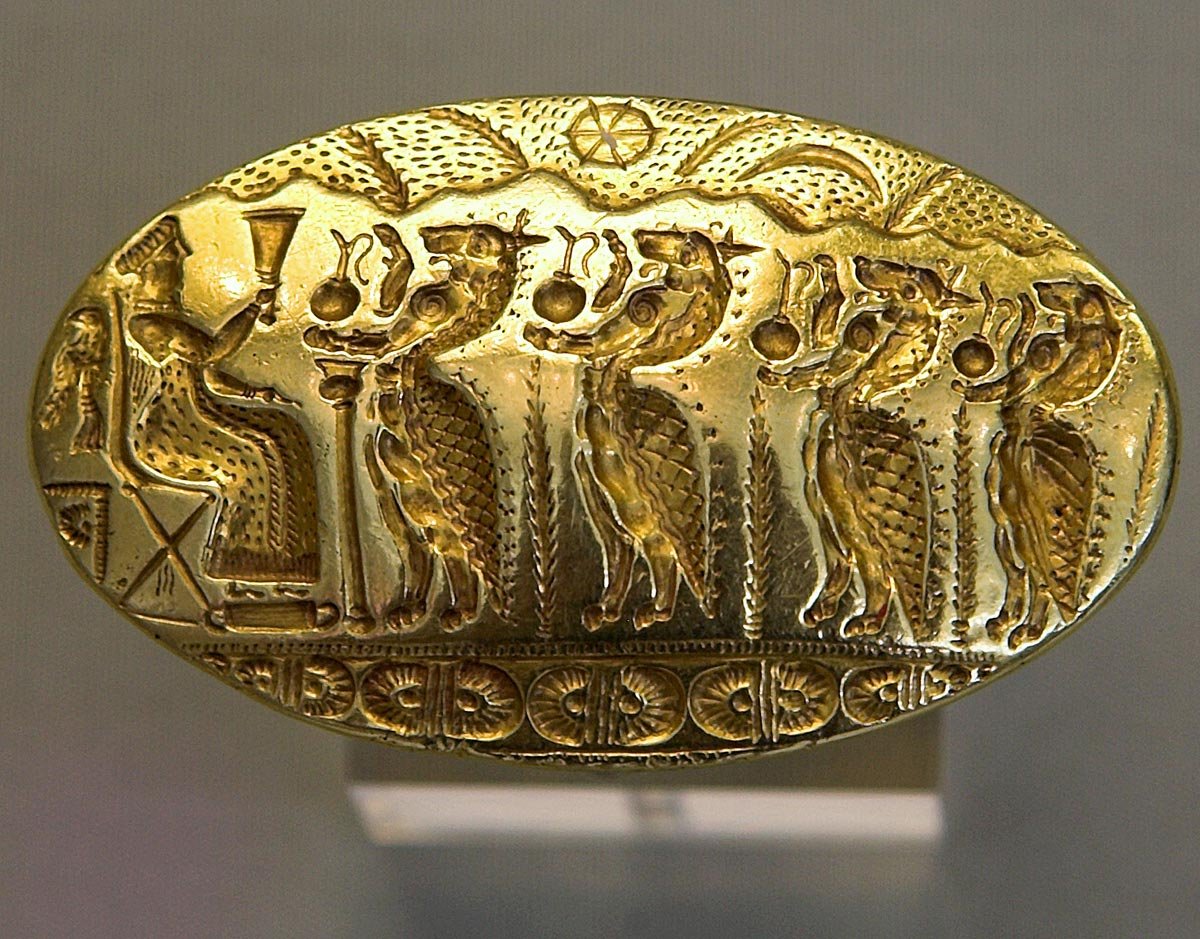
The tiny relief on this gold ring compresses a whole ritual—deity, attendants, and offerings—into a space no larger than a thumbnail.
Sacred peaks, caves and household shrines: a religion shaped by landscape
One of the most distinctive things about Minoan civilization religion is how strongly it leans on landscape. Sacred places are not just buildings; they are mountain tops, caves and trees turned into focal points.
Peak sanctuaries are the clearest example. From the end of the Early Minoan period onward, shrines appear on high ridges and summits across Crete, though not everywhere. Archaeologists identify them by the mix of finds: terracotta human figurines, animal figures, miniature altars, stone “horns”, even small stone models of buildings. People climbed up to these exposed sites to make offerings, perhaps during seasonal festivals or in response to crises. From there, they could see farmland, villages and sea at once. It is hard not to read them as places where humans, gods and the wider landscape met.
Caves play a different but related role. Places like the Psychro Cave on Mount Dikte and the Idaean Cave on Mount Ida show long histories of offerings: bronze objects, figurines, libation vessels. Later Greeks turned them into birthplaces or refuges for Zeus, but the Minoan phase already treats them as deep, powerful spaces. They likely served as sites for initiation, healing, or contact with chthonic powers.
At the other end of the scale, we find small shrines in houses and settlements. These might be simple niches with figurines, painted symbols on walls, or small altars and offering tables in a corner room. They tell us that Minoan religion was not only about big ceremonies at palaces or peaks. It also lived in daily routines: pouring a libation at home, placing a figurine near a hearth, or marking a threshold with sacred signs.
In that sense, Minoan cult is a three-layer system:
household shrines for everyday contact,
local or palatial shrines for communal rituals and administration,
peaks and caves for dramatic, landscape-scale ceremonies.
The same core symbols and gestures travel between layers, but the scale and mood change.
Writing, ritual objects and the limits of what we can know
The last piece of the Minoan religion puzzle is written and ritual equipment. Here again, we have rich material but poor translation.
Many sanctuaries and shrines have libation tables, flat or slightly concave stone blocks with depressions or channels to pour liquids. Some carry inscriptions in Linear A, following a repeated “libation formula”. We can transcribe the signs and see that certain sequences recur, probably naming deities, donors or ritual actions, but we cannot yet read them as Greek, or any other known language. These texts prove that Minoan ritual had a repeatable, probably spoken component, but the content stays just out of reach.
Other Minoan artifacts add visual detail to cult life. The Hagia Triada sarcophagus, for example, shows painted processions, sacrifices and offerings, including a bull being brought toward a table and libations poured at an altar. The Harvester Vase, a carved stone vessel, depicts a singing procession of men, possibly in a harvest or religious festival. These pieces confirm that music, communal movement, sacrifice and liquid offerings were central features of Minoan worship.
When we compare all this to Mycenaean Greece, where Linear B tablets list named gods like Zeus, Hera and Poseidon, the contrast is sharp. On Crete, under later Mycenaean control, some Linear B tablets from Knossos mention divine names, but they belong to a different phase, after the peak of Minoan independence. In our article on Linear A and Linear B we follow this shift from unread Minoan language to early Greek. For Minoan religion itself, that means there is a hard line between what we can see and what we can actually read.
So where does that leave us. For me, the honest answer is: with a clear sense of practice and a blurred map of belief. We can track where sacrifices happened, which symbols mattered, how bodies moved in processions, and which spaces were marked as sacred. We cannot reconstruct a neat pantheon chart or a full set of myths. And maybe that is okay. It forces us to stay close to evidence and comfortable with open questions.
Conclusion
Minoan religion is one of those topics where every new object feels like both a clue and a tease. A pair of clay horns on a rooftop, a terracotta worshipper from a peak sanctuary, a libation formula on a stone table: each tells us that someone stood here, lifted a vessel, spoke certain words, and believed they were heard. The gods themselves stay mostly offstage, but their traces in space and habit are everywhere.
For our broader journey through Aegean art, this is a useful exercise in humility. After the clean marble of Cycladic art figures and the bright energy of Minoan bull-leaping, Minoan religion reminds us that ancient belief systems are rarely simple or fully knowable from the outside. We work with what we have: shrines, symbols, landscapes and a script we can copy but not yet truly read.
If this guide has helped you picture Minoan worship not as a single “goddess cult” but as a layered, landscape-shaped network of practices, then you already have a stronger base for anything you meet later, from Greek temples to Roman mystery cults. The peaks, caves and courts of Crete can stay in the background as we move on, quietly reminding us to ask: where are the sacred spaces in this culture, and how do people actually use them.
Sources and Further Reading
Wikipedia / scholarly overview — “Minoan religion” (n.d.) (Wikipedia)
Khan Academy — “Minoan art, an introduction” (2020) (Khan Academy)
Smarthistory — “Minoan art, an introduction” (2020) (Smarthistory)
Khan Academy — “Snake Goddess” (Minoan) (n.d.) (Khan Academy)
Soetens et al. — “Peak sanctuaries in the Minoan cultural landscape” (PDF, 2008) (Academia)
Oxford Research Encyclopedia of Classics — “Religion, Minoan and Mycenaean” (2016) (Oxford Research)
Palaima, R. — “The role of the Linear A tablets in Minoan administration” (Ktema, 2001) (Persee)
Khan Academy — “Hagia Triada sarcophagus” and “Harvester Vase” (n.d.) (Khan Academy)
You may also like