The Plank Idols: How to Read a Cycladic Figure
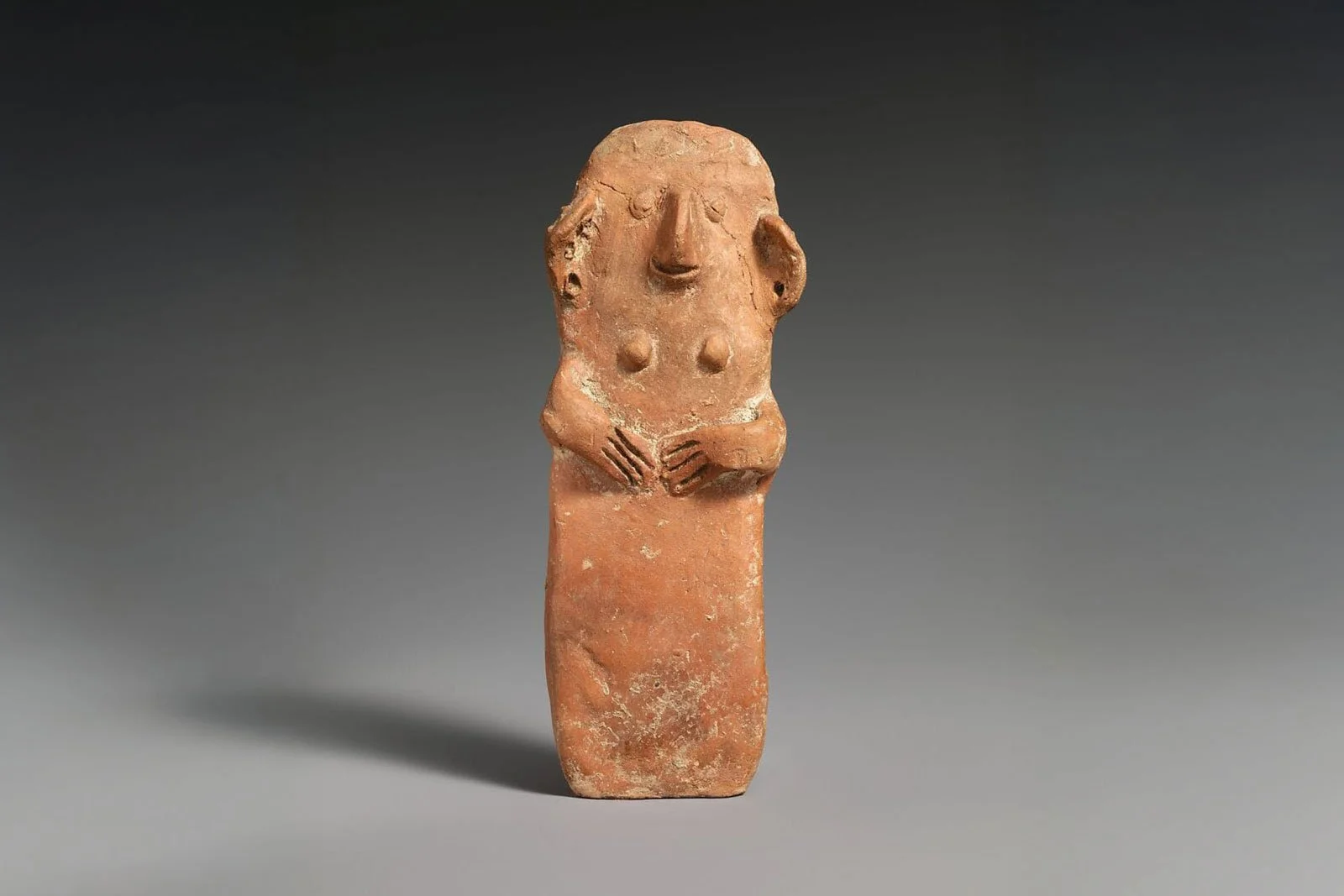
A Bronze Age Cypriot plank figurine, instantly recognizable for its flat geometry and incised decoration.
Imagine you are standing in front of one Cycladic figure, just one. Marble, small enough to fit in your hand. Flat like a plank, arms quietly folded, face reduced to a long nose and smooth planes. It looks simple, almost obvious. Then the longer you stare, the more questions it raises.
This is the kind of object we call a Cycladic plank idol or Cycladic art figure. It comes from the Early Bronze Age islands in the central Aegean, from a world we now group under Cycladic art and the wider Cycladic art tradition. In this analysis we will stay with one imagined figure and learn how to read it: pose, proportions, surface, and the traces of paint we can still detect. We will also be honest about the limits of what we can say.

A Cycladic plank idol is a flat human body carved from island marble
When we say “plank idol” in this context, we mean a flat, stylised human figure carved from marble, produced in the Cycladic islands around 3200–2000 BCE. The body is usually very thin in profile, wider in front view, so it feels like a carved plank rather than a rounded statue. Most examples represent a nude female figure, or at least a body with breasts and an indicated pubic triangle.
The basic scheme is surprisingly consistent. The head is an oval or shield shape with a projecting nose. The neck is narrow, the shoulders widen, and the arms are folded across the torso, usually with the right arm placed under the left. Legs are together, separated only by a shallow groove. Feet taper to a point, often angled, so the figure cannot stand upright on its own. It must lie down or be supported by another object.
All of this is carved from local Cycladic marble, a fine-grained stone available on several islands. The sculptor starts from a thicker block, then cuts away material until only the “plank” remains. Tool marks are smoothed out, especially on the front, to create those soft planes we recognise so easily. The back can be slightly less finished, but it still carries the general outline of the body.
This type of stylised human figure appears mainly in graves, along with pottery and other grave goods, within the broader Cycladic civilization that we explore more fully in our overview of Cycladic civilization. So from the very start, we are dealing with an object that lives between daily life and death, between the home and the tomb.
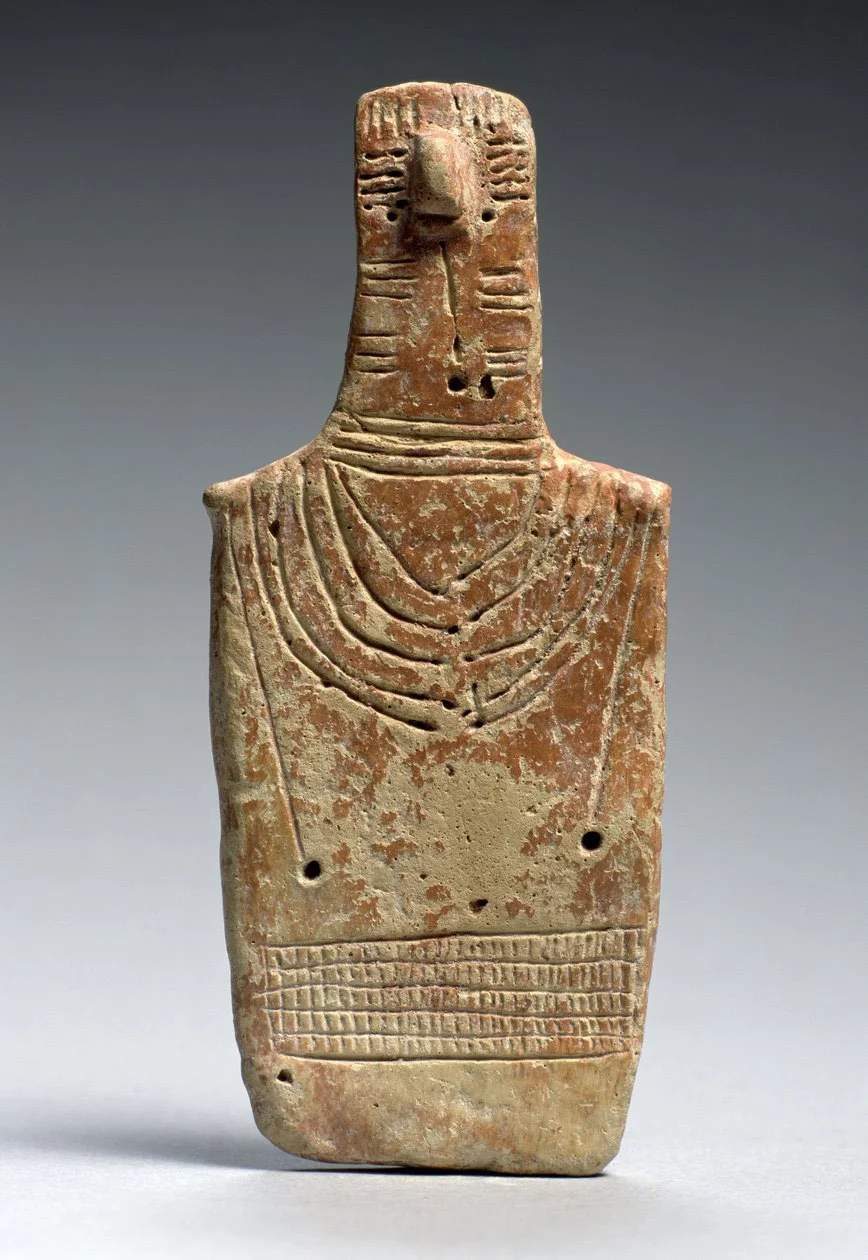
One of Cyprus’s signature plank idols: a blend of abstraction and sacred symbolism.
Pose and proportions show a human, but also a design system
If we slow down and read the pose, the figure becomes more than a generic “idol”. The folded arms, closed legs and slight backward tilt of the head do several things at once. They create a compact, self-contained silhouette. They suggest a calm, possibly resting body. They also make the figure easy to carve from a flat slab, with no fragile limbs sticking out.
Proportions are where we can really see a design system at work. Many Cycladic art figures follow similar ratios: head size to body, torso length to leg length, shoulder width to narrow feet. Archaeologists even speak of different “types” or “varieties” that tweak these ratios in characteristic ways across time and islands. Within a workshop, carvers seem to have used mental or physical templates that keep their figures recognisable and coherent.
This does not mean the figures are mechanical. Small variations matter. A slightly longer neck, a sharper angle at the knees, a more pronounced curve at the hips can all shift the mood of the piece. We, as viewers, might read one as more youthful, another as more monumental, even when they are similar in height. The sculptor is working within a set of shared rules, but there is room to play.
For comparison, think of how graphic designers handle a logo. The basic form stays the same so that it is recognisable, yet small adjustments in thickness, curve or angle can fine-tune the feeling it gives. Cycladic sculptors are doing something similar, centuries earlier, but in marble rather than on a screen. Their “logo” is the folded-arm female figure, and each new carving is a small variation on that theme.
Mini-FAQ
How can you tell a Cycladic plank idol is female?
Usually from small carved breasts and an outlined pubic triangle, although not every figure preserves these features clearly.
Why are the arms always folded?
We do not know for sure, but the pose makes the figure compact and stable, and it may have had ritual or symbolic meaning in Cycladic belief.
Surface, edges and paint traces change how we see the figure
At first glance, Cycladic figures seem like pure white marble. In reality, surface and colour carry a lot of extra information. The level of polish tells us how much time and care the sculptor invested. Some idols are carefully smoothed all over. Others retain more obvious tool marks on the back or sides, suggesting quicker work or a different intended viewing angle.
Edges are equally revealing. The line where face meets neck, where shoulder turns into arm, where thigh meets calf, can be soft or sharp. These transitions guide our eye along the figure. A soft edge produces a calm, flowing outline. A sharper cut can emphasise a joint or a change in direction. When we look closely, we notice that nothing is random. Every transition between planes is a small decision about how the body should “read” from a distance and at arm’s length.
Then there is colour. On many figures, microscopic analysis has identified traces of red, blue or even green pigment. Eyes were once painted on otherwise blank faces. Hairlines, necklaces or bands across the body were added in colour. Dots or stripes on the cheeks might reflect body painting or tattooing on real people. In some cases, red pigment collects in grooves between fingers or toes, making those details stand out more clearly.
All of this means that the figure we see today is missing some of its original signals. The smooth, unmarked face that feels so “minimalist” to us may once have had vivid painted eyes. The body might have carried patterns that indicated status, role or ritual function. When we read a Cycladic idol now, we have to constantly remind ourselves that we are looking at a weathered and partially erased surface, not a neutral one.
Meaning: what we can say, and what stays honest mystery
The hardest part of reading a Cycladic art figure is meaning. It is tempting to jump straight from a female body and a grave context to a clear story: “this is a goddess” or “this is a mourning woman”. But we do not have written explanations from the Cycladic world, and the archaeological record is incomplete, especially because of past looting. That means we need to separate what we see, what we can reasonably infer, and what slides into speculation.
From the object and its context, we can say a few solid things. These figures were important enough to be placed in graves, often alongside other valuable items. Their repeated female form and careful execution suggest they played a role in how communities understood bodies, identity and perhaps fertility or protection. Wear and repair marks on some pieces indicate they were used for some time before burial, not made only for the tomb.
Beyond that, meanings multiply. Some scholars see them as images of a major goddess, others as representations of specific women, ancestors, or even abstract “persons” used in ritual. It is possible that different islands, or even different families, used similar figures in different ways. The same type of folded-arm idol could serve more than one symbolic role, depending on context.
For us, as viewers and students, the most honest position is a double one. We honour the power of the form and the care that went into it, and we accept that its full symbolic meaning is partly out of reach. Instead of inventing a single story to fill the gap, we use the figure as a chance to practice slow looking and careful thinking. We also let it lead us back outwards: to the island landscapes, settlements and burials that make up the wider Cycladic art and Cycladic civilization that produced it.
Conclusion
Cycladic plank idols are small, but they reward patience. The more time we spend with one figure, the more layers appear. A simple pose turns into a whole design system. A blank face turns out to have lost its paint. A smooth surface starts to show the decisions and revisions of the hand that carved it.
For me, the most useful lesson in reading a Cycladic figure is this: look hard, claim little. We can describe what is there with precision, connect it to other finds, and sketch possibilities for meaning. We can also accept that some of the stories these figures carried into Bronze Age graves will never fully come back. That mix of clarity and mystery is part of what makes them so compelling.
As we move on to other objects and periods, from Minoan frescoes to Mycenaean citadels and later Greek temples, we can bring this habit of looking with us. Start from one object, slow down, and see how much the surface, pose and context already tell you before any myth or label steps in.
Sources and Further Reading
The Metropolitan Museum of Art — “Early Cycladic Art and Culture” (2004) (The Metropolitan Museum of Art)
The Metropolitan Museum of Art — “The Painted Details on Early Cycladic Marble Figures in the Museum’s Collection” (2024) (The Metropolitan Museum of Art)
The Metropolitan Museum of Art — “Who Were the Early Cycladic Figures?” (2024) (The Metropolitan Museum of Art)
Smarthistory — “Cycladic art, an introduction” (2020) (Smarthistory)
Smarthistory — “Early Cycladic figurines” (2020) (Smarthistory)
Khan Academy — “Early Cycladic figurines” (n.d.) (khanacademy.org)
You may also like