Hellenistic Artists: The Names Behind the Drama of Greek Art
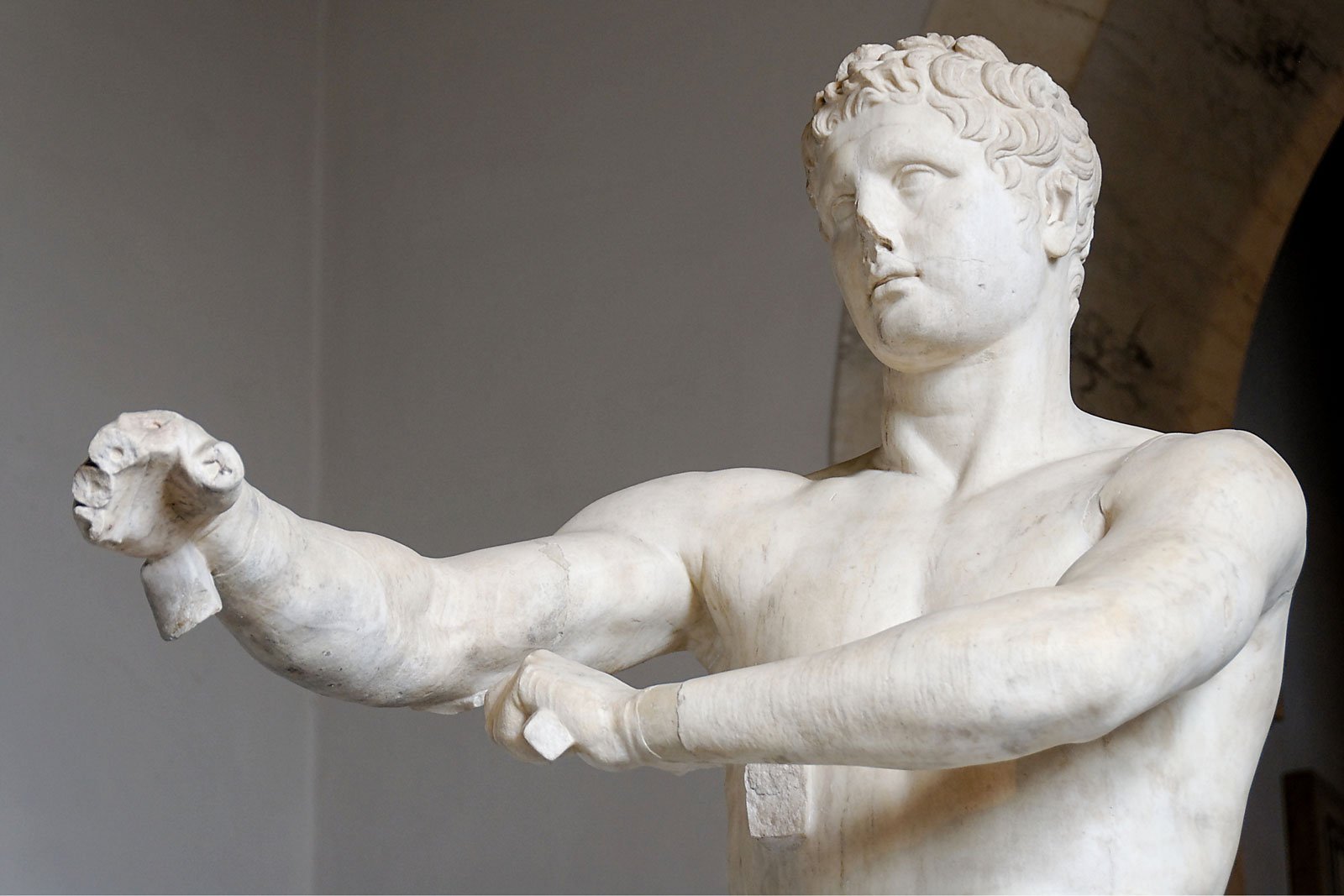
Apoxyomenos is a useful entry point because Lysippos helps open Greek sculpture toward the Hellenistic world.
When people first meet Hellenistic art, they usually remember the works before they remember the artists. They remember the twisting bodies, the emotional faces, the sense of motion and pressure. They remember the Laocoön, the Venus de Milo, the Dying Gaul, the Nike of Samothrace. The names behind them often feel harder to sort out.
That is not your fault. One of the strange things about Hellenistic artists is that many of the most famous Hellenistic works are anonymous, debated, or known through later Roman copies. So the clearest answer is this: there are important names, but Hellenistic art is also a world of workshops, schools, signatures, lost originals, and partial attributions. If Classical Greece gives us a few star sculptors with relatively clear reputations, the Hellenistic world often gives us famous artworks with blurrier authorship.
Still, some names matter a lot. And once you know which ones actually help, the whole period becomes easier to read.
The first thing to know is that Hellenistic art is famous partly because the names are messy
If you are trying to learn hellenistic period art, it helps to start with one honest fact: Hellenistic art is not organized around artist biographies as neatly as later European art often is.
We do know some names from inscriptions and ancient texts. But many major works are unattributed, and many others survive only as Roman copies or later versions. That means Hellenistic art history often works backward. We begin with the style or the sculpture, and then ask whether we can connect it to a person, a workshop, a city, or a tradition.
This is one reason the period can feel harder to memorize than classical art. In Classical Greek art, names like Phidias, Polykleitos, and Praxiteles often function as clean anchors. In the Hellenistic world, the story is more distributed. Artists matter, but so do regions, courts, and workshops.
That is not a weakness. It actually tells us something important about Hellenistic art itself. It is a wider, more mobile, more international world than earlier ancient Greek art. Artists move. Styles travel. Patrons change. And the results do not always stay neatly attached to one famous name.
So before we sort out the names, it helps to accept that part of the drama of Hellenistic art lies in the fact that the art often outshines the biography.
Lysippos matters because he helps open the door into the Hellenistic world
If you want one artist who stands at the threshold between the Classical and Hellenistic worlds, it is Lysippos.
Strictly speaking, he begins in the later Classical period, not the mature Hellenistic one. But he matters enormously for the Hellenistic story because he changes how the body works in Greek sculpture. Ancient writers describe him as Alexander the Great’s preferred sculptor, and he is associated with slimmer proportions, smaller heads, and more spatially open compositions.
That shift matters because it loosens the older Classical ideal without breaking it. A figure by Lysippos still belongs to the world of classical sculpture, but it no longer feels as self-contained. The body projects more actively into surrounding space. It invites the viewer to move around it.
The best example is the Apoxyomenos, or Scraper. The athlete extends his arm outward while cleaning himself with a strigil. That one gesture changes a lot. The figure no longer stays neatly within a frontal frame. It claims real space.
This is why Lysippos matters so much for hellenistic art characteristics. He helps make Greek sculpture more elastic, more spatial, and more physically immediate. He is not fully “Hellenistic drama” yet, but he helps make that drama possible.
Skopas matters because he pushes emotion closer to the surface
Another key bridge figure is Skopas.
Like Lysippos, he belongs to the late Classical world, but his influence reaches straight into Hellenistic art. What makes him important is not only anatomy or proportion. It is emotional force. Ancient writers associate him with intense expression, deeply set eyes, and figures charged with inner agitation.
That is a major shift.
If earlier Classical sculpture often values composed calm, Skopas helps create a body language in which feeling starts pressing outward. The figure no longer just stands beautifully. It seems to carry tension inside it. That tension becomes one of the foundations of later Hellenistic drama.
This is why Skopas is so useful in a beginner’s guide to Hellenistic artists. He reminds us that styles do not change overnight. Hellenistic intensity has roots. Some of its most important roots lie in late Classical experiments with mood, bodily strain, and emotional gravity.
So even if he is not “late Hellenistic” in date, he belongs in the story because he helps Greek sculpture learn how to be more emotionally legible.
The Rhodian sculptors matter because they give us one of the most famous names attached to one of the most famous groups
Once we move into fully developed Hellenistic drama, one of the clearest named examples is the group of Rhodian sculptors associated with the Laocoön: Hagesandros, Athenodoros, and Polydoros of Rhodes.
They matter because they are one of the rare cases where a monumental and highly famous Hellenistic-style work can be linked to named artists. Whether we call the Laocoön late Hellenistic or Roman in date but Hellenistic in style, it still tells us something crucial about the artistic world that produced it.
The sculpture is all about pressure: twisting bodies, pain, resistance, compression, and emotional overload. It is one of the clearest examples of how far Greek sculptural drama could go. And because named artists are attached to it, the group gives students something precious: a direct connection between artwork and makers.
This also helps explain why Rhodes matters. Hellenistic art is not centered in one city the way Classical art is often mentally tied to Athens. Different centers matter, and Rhodes becomes one of them. The world of Hellenistic art is regional, mobile, and networked.
So if Lysippos helps open the door, the Rhodian sculptors show us what the full theatrical language can become.
Many of the most important Hellenistic artists are really workshops, schools, and regional traditions
This is the part that makes the period finally click.
If you try to reduce Hellenistic art to a short list of genius individuals, you will miss something essential. A lot of major hellenistic artwork is better understood through cities, courts, workshops, and regional styles than through single heroic names.
Pergamon is a perfect example. The great sculptural style associated with Pergamon, especially the high-drama mode we often call “Hellenistic baroque,” is hugely important. But the most famous surviving works tied to this world are not always attached to one artist we can confidently teach like a Renaissance master. What matters is the visual language: violent motion, emotional intensity, muscular tension, and theatrical composition.
The same is true of many other works. The Nike of Samothrace is unforgettable, but its maker is not the central point of its fame. The Dying Gaul is one of the most moving sculptures in ancient art, yet the individual artist is not what first structures its importance for us.
That does not mean artists do not matter. It means Hellenistic art asks us to think differently about artistic identity. Instead of asking only “Who made this?”, we often also have to ask “What workshop, what city, what court, what stylistic world made this possible?”
And honestly, that question is one of the things that makes the Hellenistic world so interesting.
The best beginner takeaway is not a long list of names, but a short map of influence
If you are trying to remember the main Hellenistic artists, the most useful map is this:
Lysippos helps open the Hellenistic body into space.Skopas helps intensify emotional expression.Hagesandros, Athenodoros, and Polydoros of Rhodes give us one of the most famous named sculptural groups in the dramatic Hellenistic tradition.And beyond them, many of the defining achievements of Hellenistic art come from workshops, regions, and artistic centers rather than from one famous name alone.
That is actually a very Hellenistic lesson. The period is bigger, wider, and more mixed than the older world of ancient Greek sculpture. Its art reflects that scale.

Conclusion
The names behind Hellenistic art are harder to sort out than the names behind some earlier Greek art, but they still matter. Lysippos helps move Greek sculpture toward a more open and dynamic body. Skopas pushes emotion toward the surface. The Rhodian sculptors linked to the Laocoön show us how fully theatrical Hellenistic art could become. And beyond these names, the period reminds us that great art can also come from workshops, schools, and regional traditions whose individual biographies remain partly hidden.
So the real answer is not just a list of artists. It is a way of reading the period. Hellenistic art is dramatic because the world behind it is larger, more mobile, and less centered on one single artistic model.
FAQ
Who are the most important Hellenistic artists?
The most useful names for beginners are Lysippos, Skopas, and the Rhodian sculptors Hagesandros, Athenodoros, and Polydoros associated with the Laocoön.
Was Praxiteles a Hellenistic artist?
Not exactly. Praxiteles belongs to the late Classical period, but his softer and more intimate style helped shape what later Hellenistic art could become.
Why are Hellenistic artists harder to memorize?
Because many major Hellenistic works are anonymous, debated, or known through later Roman copies, so the artworks are often more famous than the makers.
Is Lysippos really Hellenistic?
He is better understood as a late Classical sculptor who strongly influences the Hellenistic world, especially through his new proportions and more spatial compositions.
Why is the Laocoön important for named artists?
Because it is one of the most famous ancient sculptural groups linked to a specific set of named makers: Hagesandros, Athenodoros, and Polydoros of Rhodes.
What matters more in Hellenistic art: individual artists or workshops?
Both matter, but workshops, regional schools, and artistic centers often matter more than a single artist biography.
You may also like