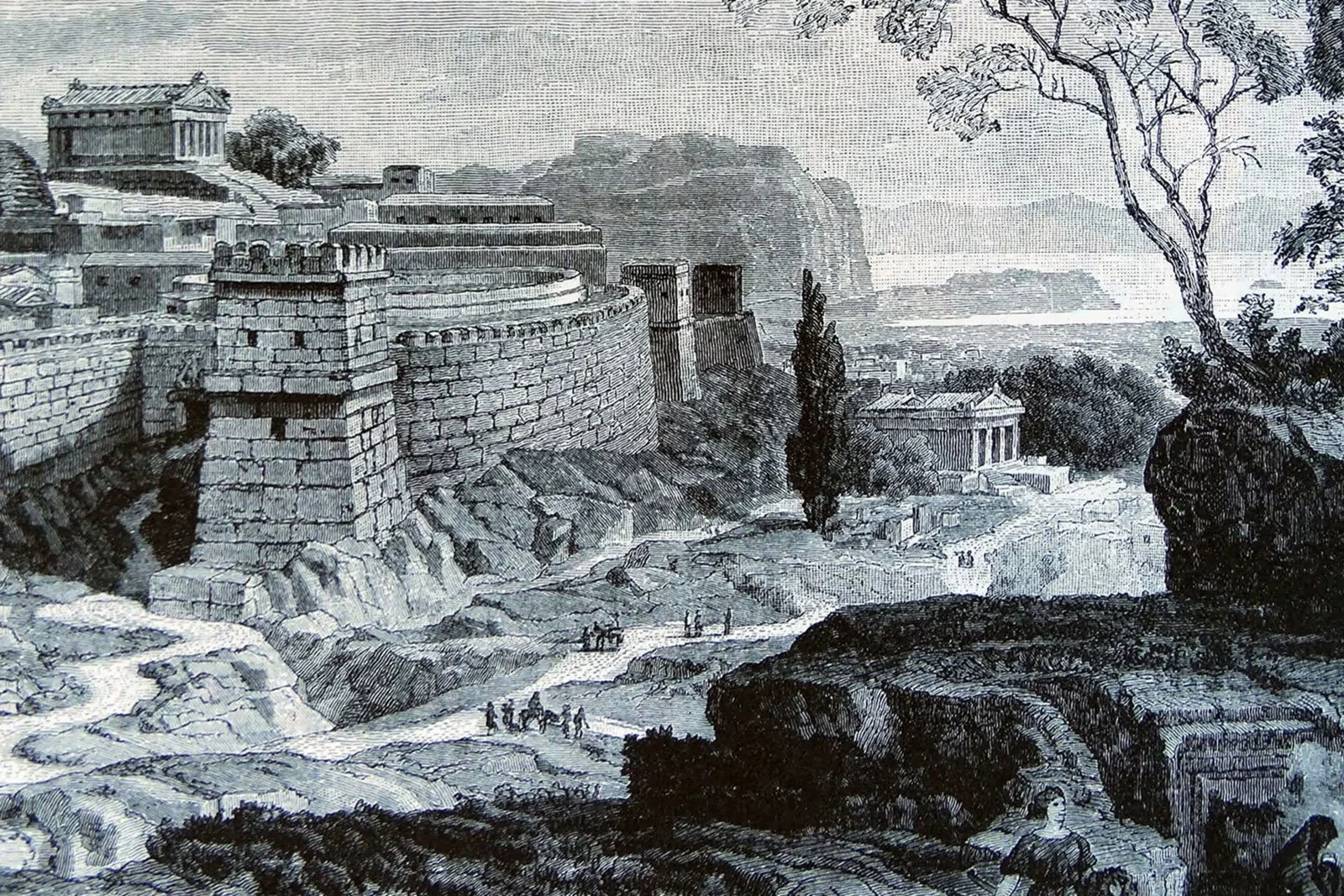
The huge, roughly cut blocks of Mycenae’s fortification walls gave rise to the later idea that only giants—the Cyclopes—could have built them.
Climb a rocky hill in the Peloponnese and imagine the noise. Bronze armour clinking, carts creaking, animals being driven up a ramp. Ahead of you rises a wall of massive stone blocks, stacked so huge that later Greeks will say only giants could have lifted them. You pass under a gate crowned by two carved lions. Somewhere above, in a smoky hall with a central hearth, a ruler sits on a throne.
This is the world of the Mycenaeans. Long before classical Athens or the Parthenon, they build fortified citadels, run palace economies, send ships across the Aegean and bury their elites with gold. Later, Homer will turn some of them into epic heroes. Archaeology lets us meet the people behind the stories.
In this guide we will answer a simple question with many layers: who were the Mycenaeans. We will look at their fortress-cities and citadels, their palace halls and art, and the slow, messy way their world comes to an end. If you want to place them next to their island neighbours, you can also read our overview of Minoans and Mycenaeans, where we compare the two cultures side by side.

The Mycenaeans were the first clearly Greek-speaking palace society
The short answer to what is a Mycenaean is this: they were a Late Bronze Age people on mainland Greece, active roughly between 1600 and 1100 BCE, who spoke an early form of Greek and organised themselves around palace centres. The name comes from the site of Mycenae in the Argolid, but the culture spreads across much of southern Greece: Tiryns, Pylos, Thebes, Athens and other sites show similar patterns.
What makes the Mycenaeans stand out is that we can finally hear their language, at least in bureaucratic form. They use a script called Linear B, written on clay tablets for accounting. When this script was deciphered in the 1950s, it turned out to record early Greek: lists of grain, oil, bronze, chariots, slaves and offerings. That means we are no longer guessing whether these people are “proto-Greek”. We know they are part of the Greek language family, even if their spoken dialect would sound very old-fashioned to a classical Athenian.
Socially, Mycenaean palaces are power hubs. Each centre is ruled by a wanax, a king or high ruler, supported by officials, warriors and administrators. The palace controls land, redistributes goods, organises crafts and probably coordinates military campaigns. This is not a loose tribal world. It is a network of small kingdoms, sometimes allied, sometimes in competition, all sharing a recognisable Mycenaean culture: similar architecture, pottery, weapons and burial customs.
Contact with Crete and other parts of the eastern Mediterranean is crucial. Early on, the Mycenaeans borrow and adapt from Minoan civilization: writing systems, artistic motifs, some aspects of palace design. Over time, they put their own stamp on things. Palaces become more fortress-like. Art leans toward hunting, warfare and chariot scenes. The overall feeling is more martial, less coastal-ritual, than on Minoan Crete.
Definition: The Mycenaeans were a Late Bronze Age Greek-speaking people on mainland Greece (c. 1600–1100 BCE), known for fortified palaces, rich graves and the earliest written Greek.
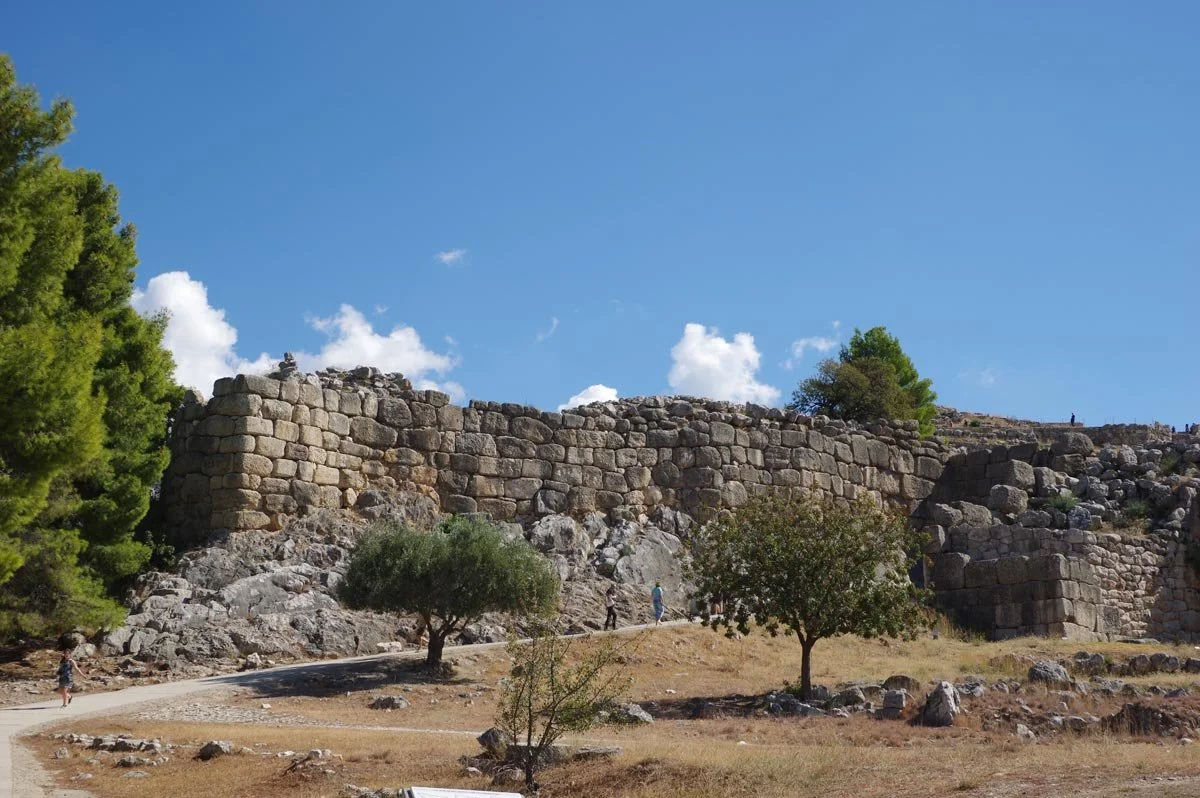
From the citadel of Mycenae we can see why this hilltop was chosen: it commands the fertile plain while remaining strongly defensible.
Fortress-cities and citadels: how Mycenaean architecture works
When you visit a Mycenaean site today, the architecture is usually what hits you first. These are fortress-cities, with palace complexes set on hilltops and wrapped in thick walls of rough stone. Archaeologists call this Mycenaean architecture “Cyclopean”, because later Greeks said only Cyclopes – mythical giants – could have built with stones that big.
The classic example is the citadel at Mycenae, a fortified hill with walls that follow the rocky contours and enclose palace buildings, storerooms, workshops and elite graves. You enter through the famous Lion Gate at Mycenae, where two lion figures carved above the lintel frame a central column. The passage narrows just before the gate, creating a small open space where defenders could easily control any attackers. Everything in the approach is designed to slow, funnel and expose.
Inside the walls, the palace structure centres on a megaron, a great hall with a central hearth, four surrounding columns and a throne along one wall. If you want to zoom in on this plan type, we unpack it in detail in our explainer on what is a megaron. At Mycenae, Tiryns and Pylos, this hall is the key ceremonial and political space: a place for feasting, receiving guests and performing royal authority. Around it, smaller rooms handle storage, craft, archives and everyday life.
Other citadels follow the same logic with local twists. Tiryns has famously massive walls and complex gate systems. Pylos, often linked to the Homeric Nestor, has a well-preserved megaron with painted floors and wall frescoes of griffins flanking the throne. As you move from site to site, you can feel a shared architectural language: ramps, gates, courts and megaron halls arranged to protect, impress and control. Our dedicated article on Mycenaean architecture takes that language apart in more detail.
This is where the Mycenaeans feel very different from the Minoans. Where Minoan palaces are open, multi-courted and less heavily walled, Mycenaean citadels are about height, enclosure and defensibility. You still get painted walls and storage rooms, but everything is wrapped in stone that says: we are ready to fight.
Warrior elites, rich graves and the art of the Mycenaean age
If the citadels tell us how the Mycenaeans lived in power, the graves tell us how they wanted to be remembered. Early on, at Mycenae, elite burials take place in shaft graves, deep rectangular pits lined with stone. Later, they move into tholos tombs, large beehive-shaped chambers cut into hillsides and approached by long dromoi (entrance passages). Both types contain serious amounts of gold and fine objects.
This is where Mycenaean art really starts to glow: gold funerary masks, decorated daggers, inlaid weaponry, carved seal stones, finely made cups and jewellery. You likely know the most famous piece, the so-called “Mask of Agamemnon”, a gold sheet pressed into the form of a man’s face. It is probably earlier than any historical Agamemnon, but it shows how important it was for these elites to be buried not just with goods, but with crafted images of themselves.
In daily life, pottery and small items also carry the visual language of the Mycenaean age. Stirrup jars and kraters show chariots, warriors, hunting scenes, simple geometric motifs and sometimes naval processions. Wall paintings inside palaces depict processions, chariots and ceremonial activities, echoing Minoan style but with a more martial tone. Small terracotta figurines – often schematic female forms with raised arms – appear in domestic, funerary and cult contexts, hinting at everyday religious practices we only partially understand.
What ties all this together is the centrality of the warrior elite. Weapons are not just tools; they are status objects, engraved and inlaid. Chariots appear in texts and images as key symbols of rank. Even if not every Mycenaean warrior rode into battle daily, the idea of being part of a fighting aristocracy mattered deeply. When Homer later imagines bronze-clad heroes, he is working with an already old memory of this world.
Myth vs Fact
Myth: The Mycenaeans were exactly like Homer’s heroes, living as constant warriors in a world of duels and divine interventions.
Fact: The Mycenaeans were palace-based states with complex economies and administration; warfare and heroism mattered, but so did farming, storage, craft and bureaucracy.
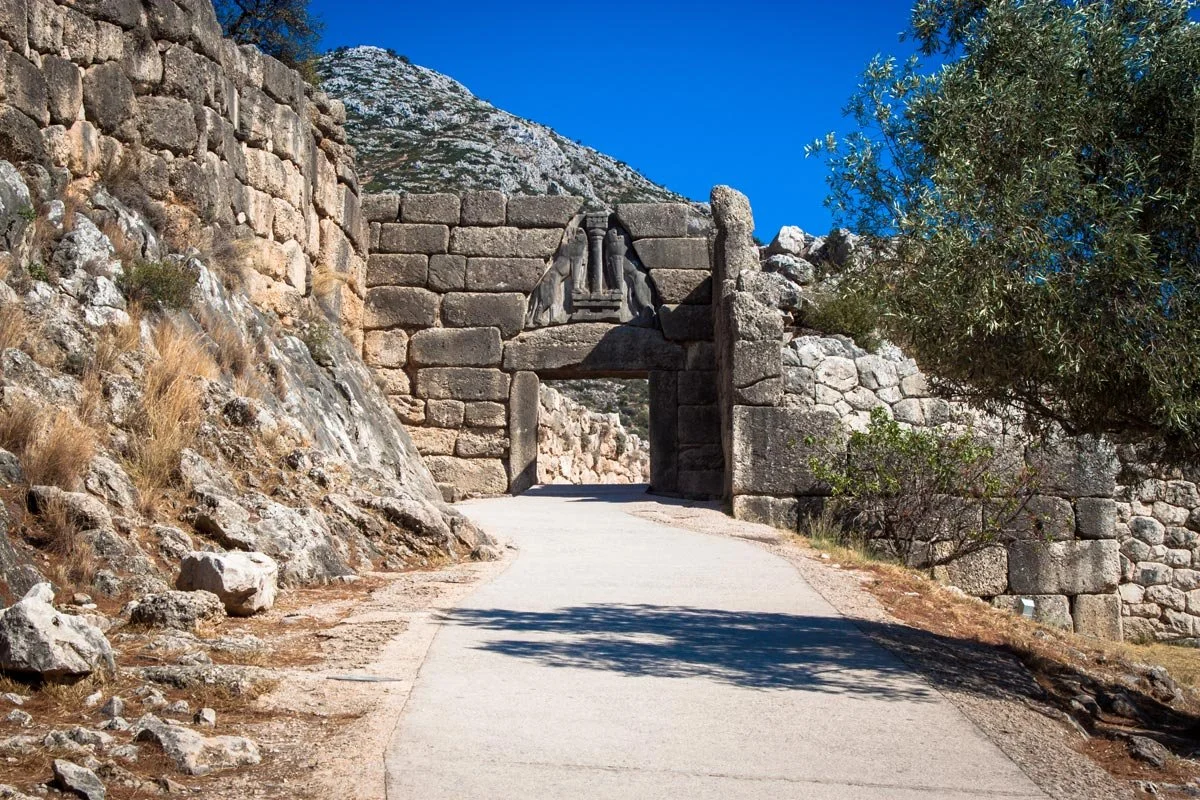
Approaching Mycenae through the narrow path to the Lion Gate, visitors are funnelled past towering walls in a carefully staged display of power.
What happened to the Mycenaeans? Collapse, survival and Homer’s afterlife
The question what happened to the Mycenaeans does not have a single neat answer. Around 1200–1100 BCE, many Mycenaean palaces suffer destruction by fire. Mycenae, Tiryns and Pylos all show evidence of violent damage and abandonment or drastic reduction. This is part of a wider Late Bronze Age collapse that affects much of the eastern Mediterranean: cities from Anatolia to the Levant and Cyprus also fall, trade networks shrink and writing systems disappear for a while.
Scholars have proposed many possible causes: climate stress, earthquakes, internal conflict, invasions, shifts in trade routes, changes in warfare. The honest position is that several factors probably overlapped. If palace economies were already under pressure, even a modest external shock – a bad harvest, a raid, a failed diplomatic relationship – could push them over the edge. Once the central administration goes, the whole system of redistribution and long-distance exchange becomes fragile.
Importantly, the end of the palaces is not the end of the people. Populations on the mainland and islands continue into what we call the Early Iron Age. Pottery styles change, long-distance contacts become rarer, and writing disappears for a few centuries, but there is continuity in language and many local traditions. By the time Homeric epics are composed (probably in the 8th century BCE), the Mycenaean world is already several hundred years in the past. It survives as heroic memory: recalibrated, enlarged, and mixed with later concerns.
When Homer describes “Mycenae rich in gold” and its king Agamemnon, he is probably echoing genuine memories of wealthy citadels and powerful rulers. But he is also reshaping them into drama. The real citadel at Mycenae becomes the backdrop for divine quarrels and tragic choices. The Lion Gate turns from a political symbol into a poetic one. If you want to connect those ruins back to the stones on the ground, our dedicated entries on the citadel at Mycenae and Lion Gate at Mycenae bridge the gap between archaeology and story.
Conclusion
The Mycenaeans are easy to romanticise. Giant walls, gold masks, epic wars – it all feels tailor-made for legend. But when you slow down and look at the evidence, a more interesting picture appears. Behind the fortress stones are scribes counting grain, potters painting chariots, weavers producing textiles for export, farmers working fields beyond the walls. The warrior kings stand on top of a very wide social pyramid.
For our broader journey through Aegean and Greek art, the Mycenaeans are a key hinge. They connect the island worlds of Cycladic and Minoan culture to the later city-states of classical Greece. Their megaron halls hint at future Greek temples. Their palaces show how architecture, image and politics can fuse into one system. Their collapse reminds us how fragile complex societies can be, even when they look unshakeable.
If this guide has helped you answer “who were the Mycenaeans” in a way that includes walls, halls, graves and stories, not just names from Homer, then you are ready for the next steps. You might zoom in on a single gate, like the Lion Gate, or on a whole plan, like Mycenaean architecture, or follow the thread into the early Greek world that comes after. The hilltop is still there. We can keep climbing.
Sources and Further Reading
You may also like