The Lion Gate at Mycenae: Architecture, Symbol and Power
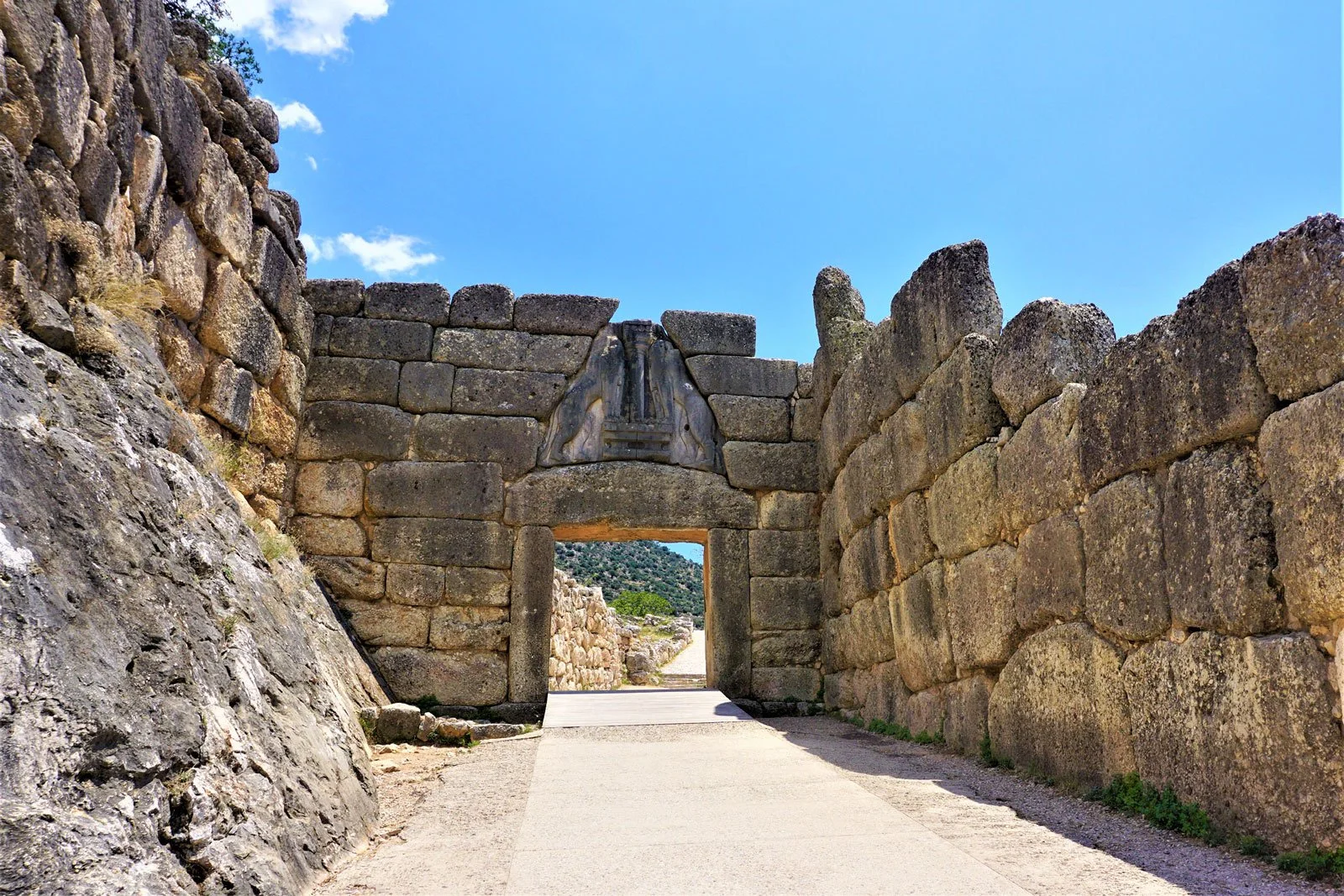
The Lion Gate forms a dramatic, controlled entry into Mycenae, combining practical defence with a sculpted symbol of royal authority.
Walk up the ramp at Mycenae and there is a moment where the whole landscape suddenly compresses. The view of the plain disappears. The sky narrows. In front of you there is only stone: two huge jamb blocks, a massive lintel and, above it, a triangle of carved lions standing over a single column. You are not just “entering a ruin.” You are passing through a carefully staged statement of power.
In this analysis we slow right down in front of the Lion Gate Mycenae. We will treat it as both architecture and sculpture: how the approach is engineered, how the gate is built, what the lions and column might mean, and why this single relief has carried so much symbolic weight from the Bronze Age to now. If you want the wider setting around it, you can pair this with our walkthrough of Mycenaean architecture and the site-focused entry on the citadel at Mycenae, where we zoom out to the whole hill.

Standing at the Lion Gate: what exactly are we looking at?
Before we jump into meaning, it helps to get the basic facts straight. The Lion Gate is the main entrance to the Bronze Age citadel of Mycenae, built around 1250 BCE on the north-west side of the hill. It belongs to a phase when the fortification wall is extended to enclose the royal graves of Grave Circle A and to reinforce the whole archaeological site of Mycenae as a showpiece of power.
The opening itself is not huge in modern terms. At threshold level it is just over 3 metres wide and just under 3 metres high. Two upright monoliths form the sides; a single lintel block, weighing many tonnes, spans the gap. Above that, the stones step inward in a corbelled arch (stones projecting slightly past the one below), leaving a triangular opening. This is the relieving triangle, a void that reduces the weight directly pressing on the lintel. In that void sits the famous relief panel.
On that panel, two large feline bodies – probably lionesses – stand facing each other in a heraldic pose (mirrored around a central axis). Their front paws rest on a platform. Between them rises a single column that tapers upward, a form we also see in Minoan and Aegean art. The heads of the animals, probably separate pieces attached in a different material, are lost. Even so, the composition is easy to read from a distance: vertical column, two sloping bodies, a tight triangle of force pointing down at the gate.
So at the simplest level, the Lion Gate is three things at once: a functional entrance, a structural solution and a sculpted emblem. Every reading we build has to sit on top of those three layers.
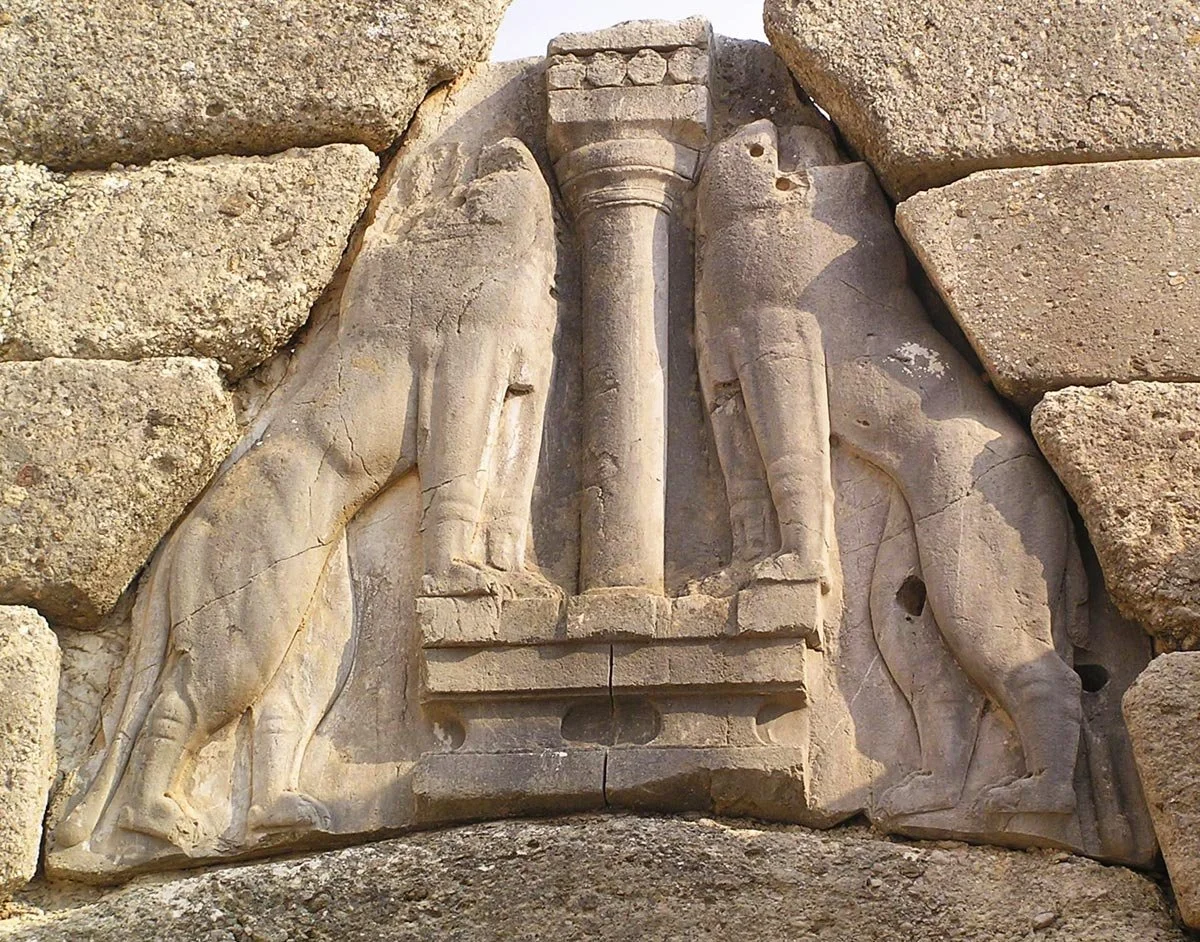
Seen in detail, the heraldic lions and column suggest a visual emblem for the palace or ruling house that visitors passed under as they entered.
Architecture first: ramp, bastion and relieving triangle
It is tempting to look only at the lions, but the architecture leading up to them does half the work. Approaching the gate, you climb a ramp that is part natural slope, part built surface. On your right a rectangular bastion, built of huge blocks in Cyclopean masonry, projects from the wall. On your left the older wall face rises steeply. The path narrows into a small forecourt in front of the opening.
From a defensive point of view, this is smart. Attackers are channelled into a confined space where their right side – the side not covered by a shield – faces the bastion. Defenders above can strike or throw downwards. The gate is not a weak point in the wall; it is a carefully designed kill zone. Even in peacetime, that choreography shapes how visitors experience arrival: you do not stroll casually into the citadel; you are squeezed, slowed, made to look up.
Structurally, the combination of monolithic jambs, huge lintel and relieving triangle is equally deliberate. A relieving triangle is a triangular opening above a lintel that diverts weight to the sides. By corbelling the stones above the lintel, Mycenaean builders remove heavy vertical pressure from its centre. The large limestone slab with the lions sits in that triangle, but it is not acting as a load-bearing block. It is essentially a monumental in-fill.
Seen from inside the citadel, the gate is just one point in a sequence: ramp, Lion Gate, curve around Grave Circle A, climb further up toward the palace and its megaron hall. Our article on who the Mycenaeans were puts that whole route into the social world of wanax, warriors and scribes. From that angle, the Lion Gate is the architectural moment where outside space, graves of ancestors and inner palace start to connect.
Myth vs Fact
Myth: The Lion Gate and its walls were built by Cyclopes, a mythical race of giants.
Fact: The gate was built by Mycenaean engineers using massive but workable limestone blocks; the “Cyclopean” label is a later Greek attempt to explain its extraordinary scale.
Symbol on stone: lions, column and possible meanings
Now we can focus on the carved relief itself. It matters that this is the only large-scale surviving relief sculpture from Bronze Age Greece that remained visible in antiquity. Later Greek travellers, like Pausanias, already describe the lions above the gate centuries after the palace culture collapsed.
The basic scheme – two animals flanking a central vertical element – is not unique to Mycenae. Similar motifs appear on Minoan seals, rings and painted pottery: a goddess between lions, sphinxes flanking a sacred tree, animals on either side of a column or shrine. In these contexts, the vertical form often stands for a deity or cult object rather than a literal tree or building. The tapering column at Mycenae probably echoes this language. It can be read as an abstracted shrine, a palace propylon, or even a divine presence signalled in architectural form.
The lions (or lionesses) are classic guardian animals. We see similar roles for lions at Near Eastern palace gates and on later Greek pediments and doorways. At Mycenae, they may be doing two jobs at once: guarding the gate and proclaiming the status of whoever controls the space behind it. Their bodies are powerful, their claws anchored on a platform that itself rests over the apex of the gate. Even without their heads, their stance reads as alert.
Because the heads are missing, we cannot say for sure whether they were turned outward toward the viewer or inward toward the column. Either direction changes the emotional tone. Outward heads would confront you as you enter; inward heads would stress their relationship with the central emblem. In both cases, the trio works as a concentrated logo of authority: a column or shrine upheld by royal or divine beasts, placed exactly where everyone must pass.
The key thing is to resist overconfident translation. We cannot point to a Linear B tablet that says “this is the emblem of X goddess” or “this is the official crest of the wanax.” What we can say, with some confidence, is that the relief compresses ideas Mycenaeans cared about: protection, sacred space, rulership and its connection to a larger Aegean iconographic language.
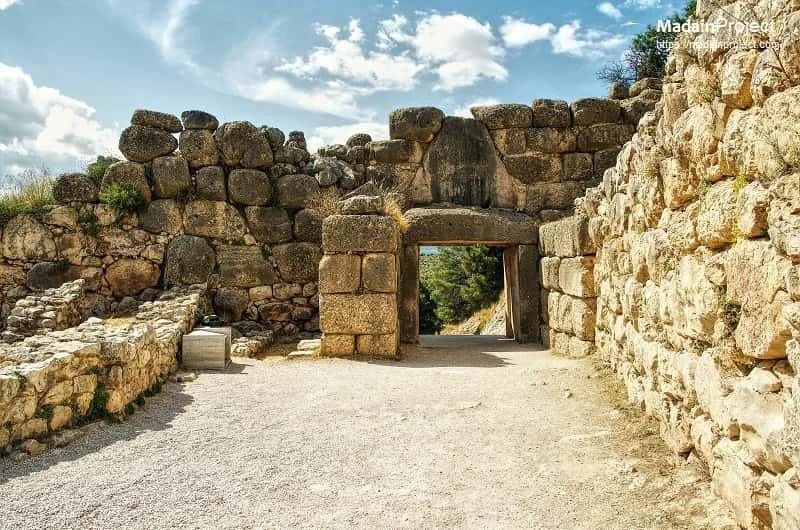
This gate reminds us that the citadel was approached through a sequence of controlled passages, not a single monumental doorway.
Afterlives: from ruin in Pausanias’ day to modern “brand image”
The story of the Lion Gate does not end with the Bronze Age. When Mycenae’s palace system collapses around 1200 BCE, the gate remains standing. By the time Pausanias visits in the 2nd century CE, he describes the Lions’ Gate and the massive walls as the most striking survivals in an otherwise ruined site. Medieval and early modern travellers lose track of the exact location, but when Mycenae is rediscovered in the 18th–19th centuries, the Lion Gate once again becomes the anchor for identifying the archaeological site of Mycenae itself.
In modern scholarship and tourism, the image is everywhere. Guidebooks, museum panels and websites often use the silhouette of the gate as a shorthand for Mycenaean culture. UNESCO’s listing for the Archaeological Sites of Mycenae and Tiryns name-checks the gate as one of the key elements expressing the outstanding value of the site. For visitors, it is often the first place where the Bronze Age feels tangible: you can stand where warriors, messengers and traders once passed, and put your hand on the same stone.
There is a small irony here. For the Mycenaeans, the gate is a tool: a controlled point in a defensive system, framed by a symbol. For us, it has become the symbol of the whole site. Our mental map of Mycenae often begins and ends with those lions. That is one reason it is helpful to read this gate in context with the rest of Mycenaean architecture and the full citadel at Mycenae: it shifts the focus from a single Instagrammable moment to the complete system of walls, ramps, courts and halls that gave the gate its original meaning.
Conclusion
If you strip away the tourist flow and the modern fences, the Lion Gate Mycenae is still doing exactly what it was built to do: compressing space, focusing attention and making you feel that passing through this opening matters. Architecturally, it uses a ramp, a bastion, a carefully sized opening and a relieving triangle to solve very practical problems of defense and weight. Sculpturally, it drops a compact emblem – two lions and a column – into that structural gap, turning a piece of engineering into a statement about power and sacred protection.
For our wider journey through Aegean art and architecture, the gate is a perfect micro-lesson. It shows how Mycenaean architecture, image and politics fuse at scale you can feel with your own body. It also shows how a single object can outlive its original world and acquire new meanings, from Homeric legend to UNESCO logo. If this analysis helps you see the Lion Gate not just as “the famous photo spot” but as a designed interface between outside and inside, fear and safety, human and divine, then you have already stepped a little closer to how a Mycenaean visitor might have felt here 3,200 years ago.
Sources and Further Reading
UNESCO World Heritage Centre — “Archaeological Sites of Mycenae and Tiryns” (1999) (Centro Patrimonio Mondiale dell'UNESCO)
Smarthistory — “Mycenaean art, an introduction” (2020) (Smarthistory)
The Metropolitan Museum of Art — “Mycenaean Civilization” (Heilbrunn Timeline of Art History, 2003) (The Metropolitan Museum of Art)
You may also like