Cyclopean Masonry in Two Minutes
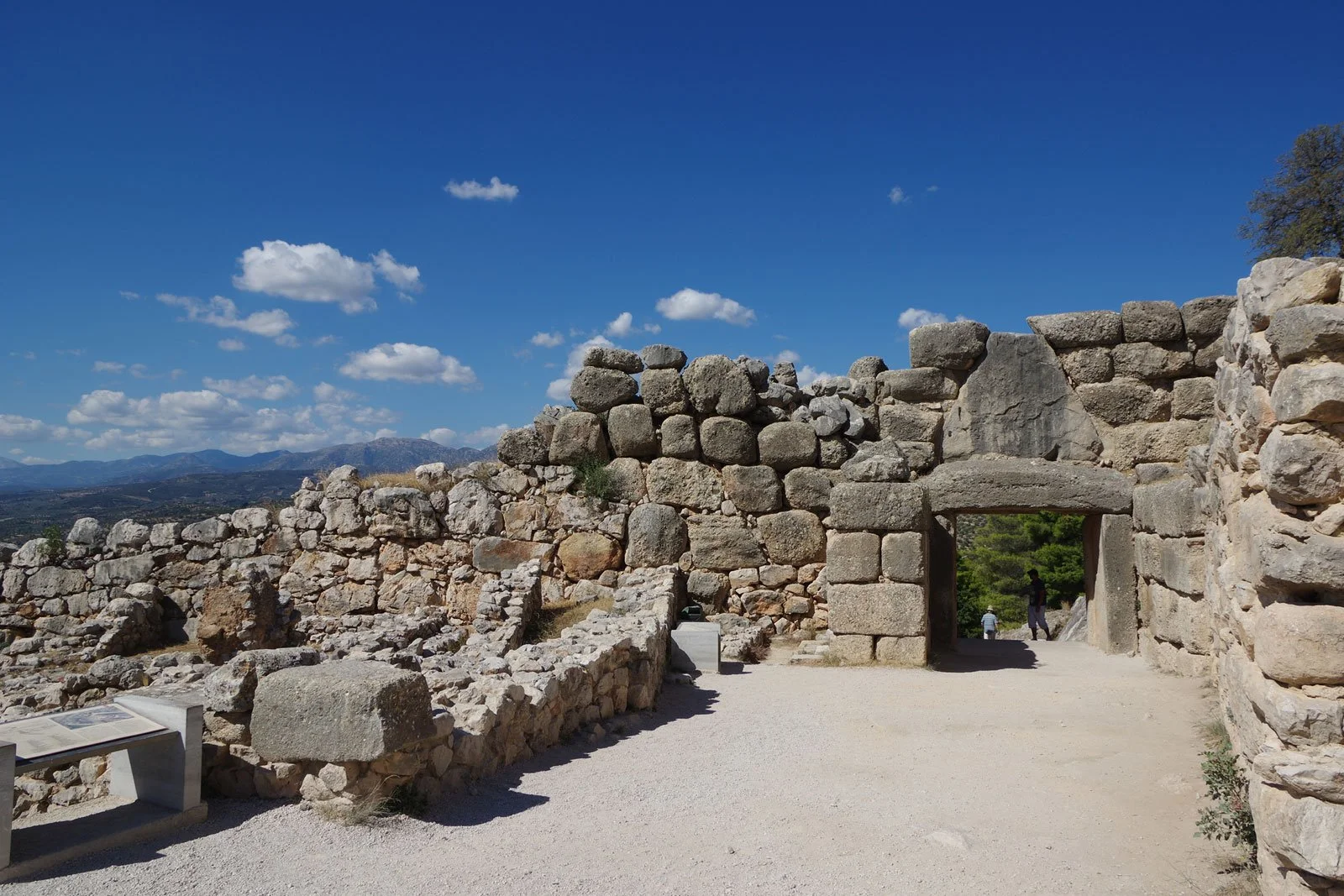
Seen from the inside, the rough Cyclopean blocks behind the Lion Gate show how mass and weight were central to Mycenaean ideas of defence.
Stand next to the citadel at Mycenae and look up. The wall is not tidy bricks. It is a cliff of huge limestone blocks, stacked so tightly that your fingers barely fit into the joints. No mortar, no visible order, just mass. It feels less like “building” and more like geology that someone has pushed into shape.
Ancient Greeks looked at these same walls and decided that normal humans could not have built them. So they invented an answer: Cyclopes, mythical one-eyed giants. That is where the term cyclopean masonry comes from. Once you understand this one phrase, a big part of Mycenaean architecture in stone becomes easier to read.

What “cyclopean masonry” means at the citadel of Mycenae
Let us pin down the definition first, then we add the story.
Definition: Cyclopean masonry is stonework built with huge, roughly shaped boulders fitted together with very small gaps and little or no mortar.
At Mycenae, these cyclopean walls form the outer ring of the acropolis: a fortified hill with palace, storerooms and graves on top. The blocks are limestone boulders, some several metres long and weighing many tonnes. To build the fortification, Mycenaean masons stacked these stones in irregular courses, trimming them just enough so that they lock together with smaller stones packed into the gaps. You can see this clearly near the Lion Gate at Mycenae, where the blocks around the gate opening almost feel like a dry-stone dam holding back the hill.
From a distance, the wall reads as one continuous rock face. Close up, you notice how carefully the joints are chosen, and how the wall leans slightly inward for stability. No visible mortar does not mean “random pile.” It means a different kind of engineering: balancing weight, friction and tight contacts. In places, the wall reaches several metres in thickness, turning the acropolis Mycenae into a true citadel rather than just a high town.
The same technique appears at other Mycenaean ruins like Tiryns and Midea. There, too, giant blocks form casemates, galleries and bastions. Archaeologists group these under the same label, but Mycenae’s fortification is the one that usually stands for the whole category. If you zoom out with our guide to who the Mycenaeans were, you will see how these walls frame royal graves, palaces and processional ramps inside one controlled envelope of stone. For a full architectural walkthrough, our article on Mycenaean architecture breaks down how the walls, gates and megaron hall work together.
Why Greeks blamed giants and why the walls still matter
Now for the fun part: why “Cyclopean”.
By the time classical Greeks visited Mycenae, the palaces were long gone. What remained were the huge fortification blocks. Compared to the cut ashlar masonry they knew from their own city walls and temples, these stones felt inhuman in scale. So writers and local traditions said that the walls had been built by the Cyclopes, a race of giant builders that worked for early heroes and kings. Saying “cyclopean masonry” was a way to acknowledge that here, the stones themselves seemed beyond normal human effort.
Myth vs Fact
Myth: The citadel walls at Mycenae were literally built by Cyclopes, one-eyed giants.
Fact: The walls were built by Mycenaean engineers using large limestone boulders moved and set with Bronze Age tools, labour and careful planning.
Today, “cyclopean masonry” is a technical term, not a belief in monsters. Archaeologists use it to describe this kind of very large, roughly worked block construction in the Late Bronze Age Aegean. Engineers study it for how it handles weight and earthquakes without mortar. Visitors respond to it viscerally: when you stand at the base of the wall below the citadel at Mycenae, you feel yourself shrink.
What I find helpful is to think of cyclopean masonry as a deliberate choice, not a limitation. Mycenaean builders could lay smaller blocks neatly when they wanted. Here they chose oversized stones that shout permanence and power. The message is political as much as practical: “this centre will not be easily broken.” That is why those walls still anchor modern ideas about “heroic age Greece,” from UNESCO listings to schoolbook images. They are part of the reason the phrase “Mycenaean fortress” feels so strong in our heads.
Conclusion
In two minutes, we can say this much: cyclopean masonry is the giant-block skin of the citadel at Mycenae and other Mycenaean centres. It uses huge, roughly shaped boulders, stacked with tight joints and little or no mortar, to turn a hilltop into a stone enclosure that still intimidates us. Later Greeks saw those walls and invented Cyclopes to explain them. We keep the name, but now we read the blocks as evidence of organised labour, engineering know-how and a very clear desire to project power.
For The Art Newbie journey, this term is a good reminder that sometimes a single technical label unlocks a whole landscape. Once “cyclopean masonry” clicks, every photo of Mycenaean architecture – ramps, gates, bastions – becomes easier to parse. And every time you see those massive stones, you can quietly ask yourself what they are protecting, who they are trying to impress and how that feeling of “too big for me” still works on us today.
Sources and Further Reading
You may also like