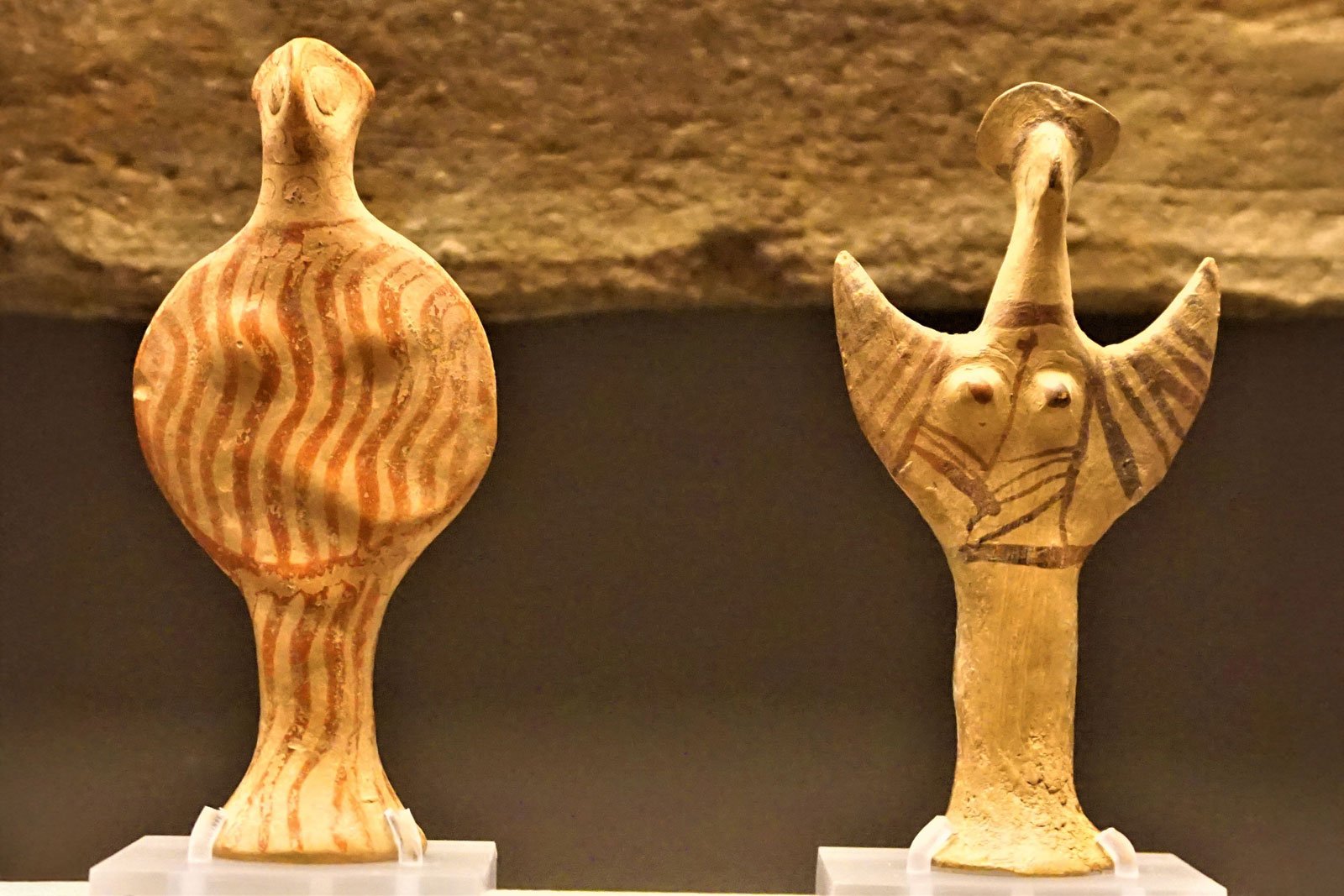
Terracotta Phi- and Psi-type figurines show how Mycenaean artists simplified the human body into abstract, symbolic shapes.
Imagine opening a museum drawer and finding a small white body, carved in marble. No eyes, no mouth, only a long nose. Arms folded quietly over the chest. Feet pointed, so it can never stand.
This is what we usually meet first as Cycladic art: a series of calm, almost abstract human figures that look strangely “modern” to us. They were carved more than 4,000 years ago on islands in the middle of the Aegean Sea, then placed in graves or lived with people in everyday spaces.
In this guide we will stay with the basics, because they are already rich. We will ask what Cycladic art is, where it was found, how these marble bodies appeared in burials, and why they have become icons in both archaeology and modern design. If you want the wider Bronze Age frame around them, you can also read our overview of Aegean art, where Cycladic, Minoan and Mycenaean worlds sit side by side.

Cycladic art is a small island culture with a big visual impact
Cycladic art comes from the Cyclades, a group of rocky islands in the central Aegean Sea, roughly between 3200 and 2000 BCE. When we say “Cycladic”, we mean the communities that lived there in the Early Bronze Age, sailing between islands, farming, fishing and trading with Crete, mainland Greece and beyond.
In this context, Cycladic art is the set of objects they created that show a distinct visual language. The most famous are the marble figurines, but we also include marble bowls, vases, pottery and a few metal items. What makes this art stand out is the combination of white marble, simple geometric forms and repeated human types. The figures are usually nude, with arms crossed, faces reduced to a single nose, and bodies flattened into a kind of rectangle with rounded edges.
Most of the pieces we care about today came from graves. Archaeologists found them in stone-lined tombs, often alongside pottery, tools and other objects. Unfortunately, many were also taken by looters and sold on the art market without proper records, so we have lost the original context for a large number of them. That is one reason why questions about their meaning are still open.
A useful way to think about Cycladic art is as an early island chapter of Bronze Age ancient Greece. It is not yet Athens or classical sculpture, but it already shows us how island communities in the Aegean experiment with human form, portable objects and marble as a medium. Later cultures in the region will remember these islands as part of their deep past.
Definition: Cycladic art is the Bronze Age art of the Cycladic islands in the central Aegean, best known for small marble human figures and related grave goods carved between about 3200 and 2000 BCE.
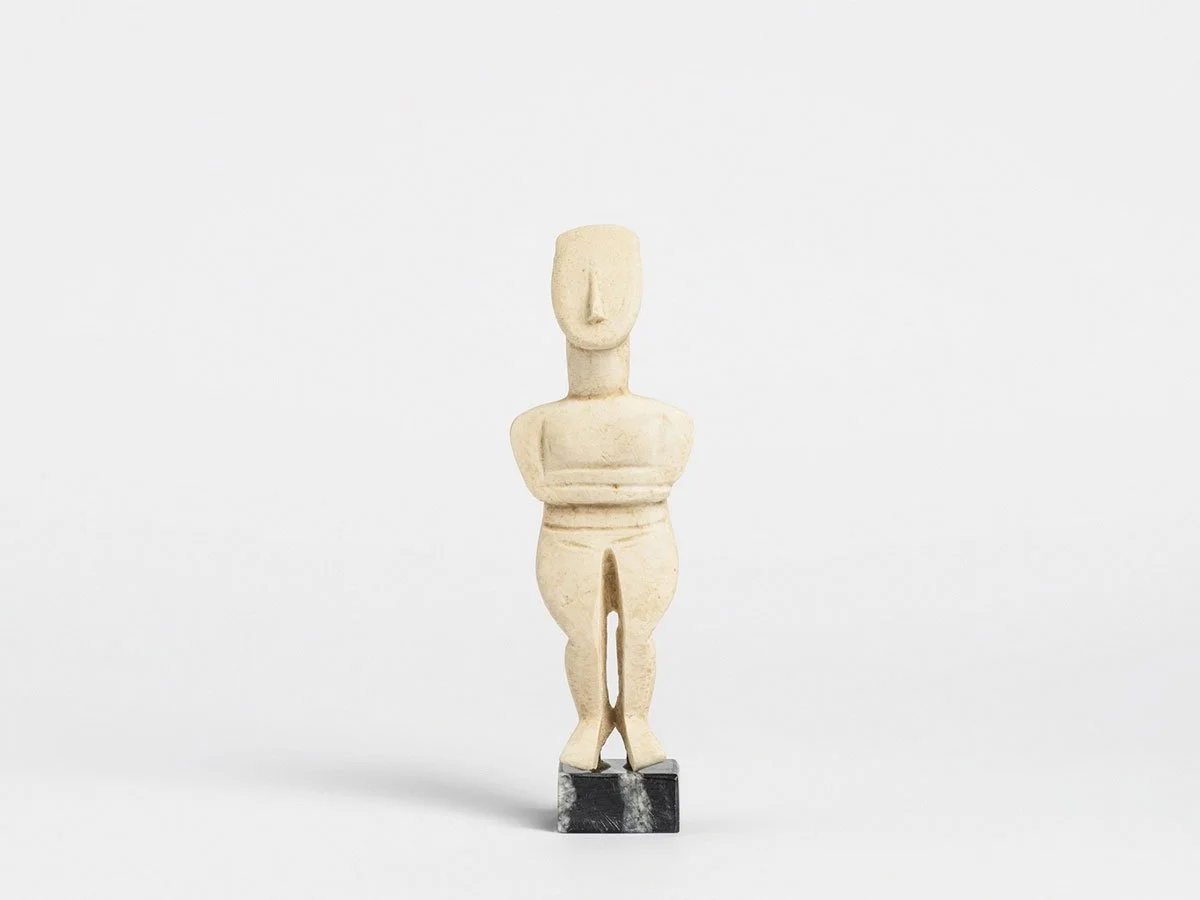
A classic Cycladic folded-arm figurine, defined by purity of form and a striking minimalist silhouette.
Cycladic figures: how do these marble bodies actually look?
If we line up a group of Cycladic figures, we see clear patterns. Most are female, or at least have features that suggest a female body: small breasts, indicated pubic triangle, rounded hips. They stand with legs together, knees only lightly separated by an incision. Arms are folded across the torso, usually with the right arm placed below the left. Heads tilt slightly back, as if the figures are quietly looking upwards.
The carving is careful and controlled. Sculptors use island marble, a fine white stone available on several Cycladic islands. Bodies are reduced to simple planes, but proportions still matter. Some types are more slender, with long legs and narrow shoulders. Others are shorter and more compact. Archaeologists group them into varieties named after cemeteries, such as Spedos or Chalandriani, to track these differences through time and place.
For us, used to contemporary design, the forms look almost minimalist. That effect is only half the story. Many figures once had painted details, now mostly lost, that made them less blank and more individual. Traces of red and blue pigments show up under strong light and analysis on some pieces. Artists painted eyes, hair, necklaces, and sometimes patterns or symbols on legs and faces. What we see in museums today is the marble skeleton of what was once a more colourful image.
Because these works are so striking, they have a separate life in modern culture. In the twentieth century, artists like Brancusi and Picasso looked at Cycladic sculpture and saw a kind of “prototype” for their own experiments with simplified human form. Designers borrow their shapes for lamps, vases and logos. This visibility is a mixed legacy. It draws attention to a small island culture that deserves it, but it also risks flattening complex archaeological objects into a moodboard of “ancient minimalism”.
If you want to go deeper into the specific types and workshop habits, we unpack that world in the dedicated explainer on Cycladic figures and our visual guide to Cycladic art figures, where we slow down image by image.
Graves, context and looting: where were Cycladic art figures found?
It is nearly impossible to answer “what is Cycladic art” without asking “where did we find it”. In archaeology, context is almost everything. For Cycladic art, the clearest contexts we have are graves.
Early excavations on islands like Naxos, Syros and Amorgos uncovered stone slab graves, sometimes with multiple burials. Inside, archaeologists often found Cycladic figurines lying beside the dead, along with pottery, tools and jewellery. The figures were not always in perfect condition. Some show repairs, suggesting they were used in life before being placed in the grave. Others seem to have been broken on purpose or carefully arranged. This mix hints at different practices: cherished possessions buried with their owners, objects made for funerary use, or older pieces recycled into new rites.
Unfortunately, the modern art market has fragmented this picture. In the late nineteenth and twentieth centuries, many graves were looted. Figurines were removed without notes, sold to collectors, and later entered museums as isolated masterpieces. When a figure has no recorded findspot or associated objects, we lose critical clues: the age and sex of the buried person, the other items in the grave, even the arrangement of the body. That makes it much harder for us to say why these pieces were there.
Archaeologists still extract patterns from the evidence we do have. Figurines appear across several islands, often in groups, and usually accompany both adults and children. Some graves have more than one figure, suggesting families with particular access to these objects. Pottery styles found alongside them help date different phases of Cycladic art. Even damaged pieces tell us something about how people handled and valued them.
When we look at a Cycladic figure in a glass case today, it is worth pausing to imagine the grave environment it once shared with other objects and with a specific person. Cycladic art is not just a gallery style; it is a set of choices people made about what to send into the ground with their dead.
Myth vs Fact
Myth: Cycladic figurines were simple “idols” of a single mother goddess.
Fact: Cycladic figurines likely had religious or symbolic roles, but their exact function is unknown, and interpretations range from deities and ancestors to status objects and personal possessions.
Meaning and mystery: how do archaeologists read Cycladic art?
So what did these figures mean to the people who made them? Here we enter the careful, sometimes frustrating, part of the story. We have no written texts from the Cycladic civilisation that explain their beliefs. The early scripts we know from Crete and the mainland do not cover these islands at this time. Archaeologists therefore work with patterns in the material record, comparisons and a lot of caution.
One common interpretation sees the figures as images connected to death and the afterlife, since they are so often found in graves. They might represent protectors, companions or idealised versions of the deceased. Their repeated female form has led some scholars to connect them with fertility or a major goddess, but that is a hypothesis, not a proven fact. The same basic shape can be used in different ways, so there may not have been a single shared meaning across all islands and periods.
Another line of thought looks at use before burial. The wear on some figurines, and the repairs on others, suggest long life histories. They could have been passed down in families, displayed in houses or used in rituals. In that view, burial is the last chapter in a longer story. Paint traces and variations in size support this. A tiny, roughly carved figure and a tall, finely made one probably did not occupy the same social role, even if they share the folded-arm pose.
Modern debates around Cycladic art also include questions about ownership, authenticity and display. The looting that removed so many figures from their original graves has also made it easier for fakes to enter the market. Museums and archaeologists now work together to repatriate stolen pieces and to set stricter standards for what they acquire. For us as learners, this is part of the meaning too. How we treat Cycladic art today reflects what we think ancient objects are for: decoration, investment, or a shared record of human history.
If you want to see how this small island world fits into the larger picture of Bronze Age cultures, you can continue with our overview of Cycladic civilization, where we zoom out from single objects to houses, trade and daily life.
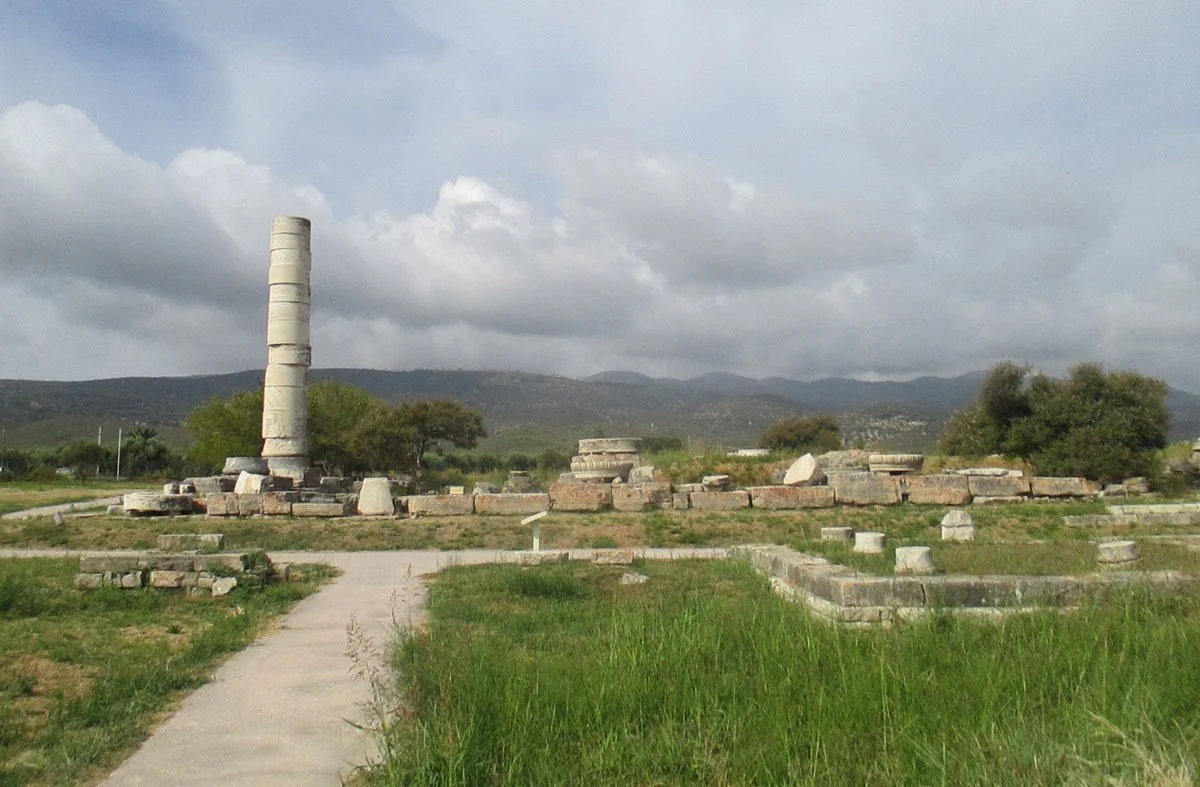
The Heraion sanctuary on Samos preserves one of the earliest monumental temples of the Greek world. Credits: Wikimedia Commons
Why Cycladic art still feels modern to us
Cycladic art is often described as “timeless”. Museums place the marble figures in minimal glass cases, bathed in white light. Designers echo their silhouettes in contemporary objects. Modern artists study their proportions and learn from their restraint. It is easy for us to fall in love with their surfaces and forget how far away their makers really are.
At the same time, that feeling of closeness can be productive. It shows how a few deliberate lines and planes can carry emotion across millennia. The tilt of a head, the curve of a shoulder or the balance between torso and legs is enough to make us recognise another human being, even when faces are almost blank. Cycladic artists understood that deeply, and they worked those insights into small, portable objects that travelled in life and in death.
For our wider journey through art history, Cycladic art offers a gentle reminder: complexity is not always about size or detail. Sometimes it sits in what is removed, not what is added. When we later study Minoan frescoes, Mycenaean citadels or Greek temples, we can carry this with us. Behind the big buildings and public monuments, there are often quiet objects that condense a culture’s questions into the size of a hand.
If, by now, Cycladic art feels more than just “pretty white idols” and starts to look like a full conversation between islands, graves and marble, then this explainer has done what it needed to do.
Sources and Further Reading
The Metropolitan Museum of Art — “Early Cycladic Art and Culture” (2004)
The Metropolitan Museum of Art — “The Painted Details on Early Cycladic Marble Figures in the Museum’s Collection” (2024)The Metropolitan Museum of Art — “Who Were the Early Cycladic Figures?” (2024)
Renfrew — “Early Cycladic Sculpture: An Introduction” (1991)
University of Nebraska — “Chapter 4.2: Cycladic Art” in Survey of Western Art History I (2021)
You may also like